GAZA- A new investigation by the Financial Times has revealed that the Boston Consulting Group (BCG) played a far more extensive and disturbing role in the US-Israeli-backed Gaza Humanitarian Foundation (GHF) than previously admitted. The report uncovers that BCG not only helped design and manage the scheme but also created financial models proposing the mass “relocation” of Palestinians from Gaza as part of post-war reconstruction efforts.
Despite its earlier claims of only offering limited “pro bono” support, BCG was under a $4 million contract spanning seven months, with over a dozen of its employees actively working on the project, internally codenamed Aurora. Sources indicate that the firm’s involvement extended well beyond its public statements, encompassing planning, financial modelling, and security operations coordination.
Forced Relocation Model
One of the most alarming elements of the project involved a detailed relocation model. The plan outlined paying 500,000 Palestinians $9,000 each as “relocation packages” to incentivize voluntary departure from Gaza. Internal projections assumed that around 25% of Gaza’s population might accept the offer, and of those, 75% would likely never return.
Disturbingly, BCG’s analysis found that forcibly expelling Palestinians would be $23,000 cheaper per person than supporting them in Gaza through the reconstruction process. BCG now claims this work was done “unauthorized” and without the knowledge or approval of senior management. The two senior partners involved—Matt Schlueter and Ryan Ordway—have since been fired.
Security Ties and CIA Connections
Further deepening the scandal are revelations about BCG’s links to the security architecture of the GHF. The firm initially joined the project through a feasibility contract with Orbis, a U.S.-based security contractor linked to Phil Reilly, a former CIA operative and long-time adviser to BCG.
Reilly later founded Safe Reach Solutions (SRS), the private military company that became GHF’s official security provider. BCG staff shifted to developing detailed business plans for SRS and GHF, including on-the-ground operations managed out of Tel Aviv. The group was later officially contracted by McNally Capital, the parent firm of Orbis, to oversee field implementation.
By early 2024, BCG’s role had evolved into strategic and operational planning alongside SRS, with at least $1 million in contracts for initial phases and travel clearances issued through BCG’s internal risk management protocols.
Opaque Funding and Humanitarian Fallout
The investigation also raises troubling questions about GHF’s funding sources, which remain undisclosed. GHF and SRS are registered in U.S. tax havens, with no public transparency. Although an anonymous source mentioned a $100 million pledge from an unidentified country, major financial institutions like UBS and Goldman Sachs have reportedly refused to work with GHF due to the foundation’s opacity.
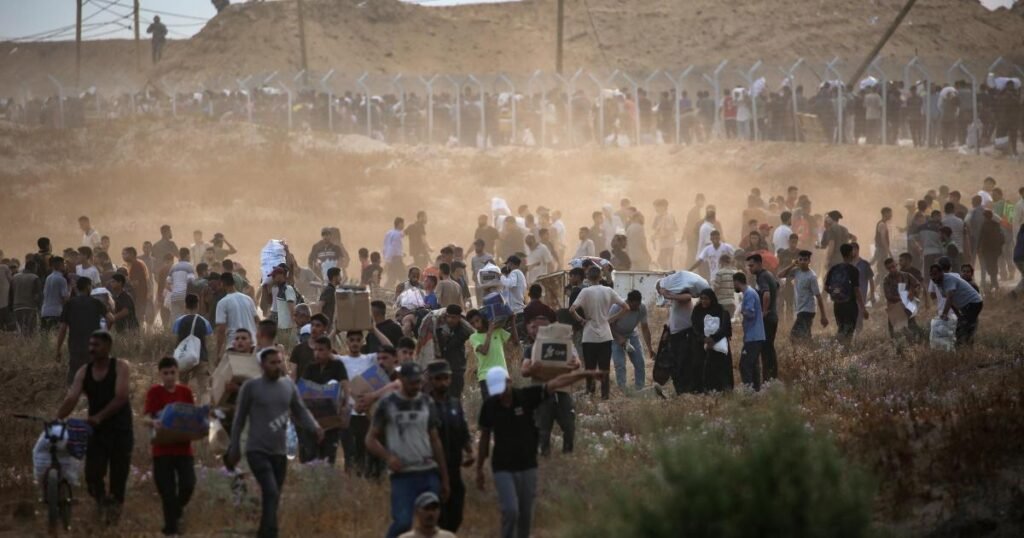
On the ground, GHF has replaced 400 traditional humanitarian distribution centers with just four heavily militarized aid hubs, forcing civilians to traverse dangerous terrain and gather in open areas where Israeli forces have been accused of targeting unarmed aid seekers. Over 600 Palestinians have been killed and 4,000 injured during such incidents.
Israeli soldiers have confirmed to media outlets that they received orders to open fire on civilians waiting for food aid, confirming that the operation has become not a humanitarian mission, but a lethal campaign wrapped in humanitarian pretense.