Gaza Herald- An Israeli strike tore through the Al-Asala residential building in western Gaza City before dawn on Saturday, killing Palestinians from both Muslim and Christian families as they slept and seriously wounding at least six others. Local reports said there was no prior warning before the building was hit, leaving families with no opportunity to escape.
 Among the victims were two pairs of mothers and daughters: Palestinian academic Dr. Yasmine Khamis al-Boubou and her mother, Haloum, and Palestinian Christians Maysa Khader Ibrahim Abu Daoud and her daughter, Maria Hafez Michel al-Najjar “Abu Daoud.” The fifth Palestinian killed was Bilal Khalil Awda, a young man of only 21.
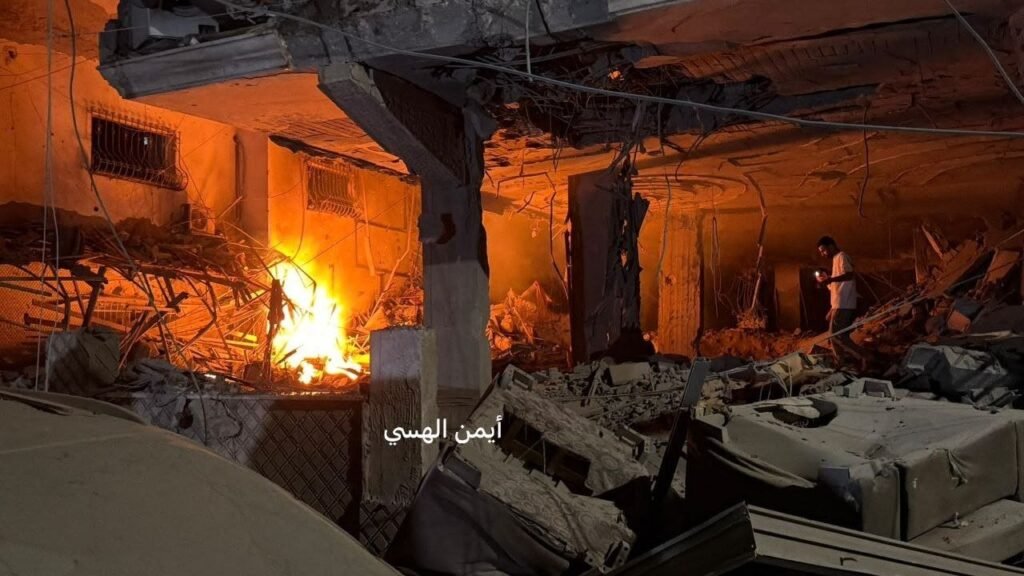
The strike hit the ground floor of the residential building near Haydar Abdel Shafi Roundabout while families were sleeping. Local reports said no warning preceded the attack. The explosion caused extensive destruction and fires, sending Palestinian Civil Defense crews into the damaged building to search for survivors and recover victims.
By the time the names of the victims emerged, the attack had become more than another entry in Gaza’s mounting toll. It had brought together, in one residential building, several generations of Palestinians and members of the two religious communities that have lived side by side in Gaza for centuries.
A Church Mourns as Muslim Families Bury Their Victims
The Greek Orthodox Church in Gaza mourned Maysa and Maria after their deaths, bringing the tragedy directly into Gaza’s ancient Christian community. For a population already reduced by years of emigration, siege and war, the loss of two women from the same family carried a particular weight.
Yet the circumstances in which they were killed were not uniquely Christian. Maysa and Maria died amid the same violence confronting Muslim Palestinian families throughout the Gaza Strip. In the same building, Yasmine and her mother Haloum were killed, while Bilal’s life ended at 21.
The five victims therefore represented different parts of the same Palestinian society. The church would mourn two of them, while Muslim families would prepare to mourn the others, but all five had been inside the same Palestinian residential building when it was struck.
For Gaza’s Christians, this shared vulnerability is not new. Christian families have been displaced alongside Muslims, while churches have opened their compounds to Palestinians seeking shelter during Israeli attacks. Christian homes have been damaged or destroyed, and members of the community have been killed during a war whose devastation has reached virtually every part of life in the Strip.
Saturday’s attack compressed that wider experience into a single building. There was no separate battlefield for Christians and Muslims, no separate displacement and no separate protection. There was only the wreckage left behind after an Israeli strike and families from both communities waiting to recover their loved ones.
Two Families Lose Two Generations
The deaths of Maysa and Maria and of Yasmine and Haloum also turned the attack into a story of generations disappearing together.
A mother normally expects to leave behind a daughter who will carry memories of her life. A daughter expects that one day she will stand at her mother’s funeral and remember the years they shared. For two Palestinian families in Gaza, neither would have that chance.
Yasmine and Haloum were killed together. Maysa and Maria were killed together. In a matter of moments, two families lost both sides of the bond between mother and daughter.
Yasmine’s death also deprived Gaza of an educator at a time when the territory’s academic and educational life has been devastated by war. She worked at the University of Palestine and had served as head of its Multimedia Department, helping educate students whose own lives have unfolded under repeated wars, blockade and displacement.
Her professional world had been one of students, classrooms, technology and creative work. Her final hours were spent not at the university but inside a residential building with her mother when the Israeli strike hit.
Maria and Maysa belonged to another part of Gaza’s social fabric. Their deaths were mourned by the Greek Orthodox Church, connecting the wreckage in Rimal to a Palestinian Christian presence that long predates the creation of Israel and remains an integral part of Gaza’s identity.
Beside the four women was Bilal. At 21, he represented yet another generation caught in the same attack. He was young enough that most of his adult life should still have been ahead of him, but his name instead joined those of two mothers and two daughters on the list of Palestinians killed before sunrise.
Gaza’s Christians Are Not Outside Gaza’s Suffering
 The deaths of Maysa and Maria challenge any perception of Gaza’s Christians as observers standing outside the suffering endured by the wider Palestinian population. They are part of that population, living under the same conditions and experiencing the same destruction.
Christianity has existed in Gaza for many centuries, and the community’s churches remain part of the city’s religious and historical landscape. Yet Palestinian Christians today live within the same besieged territory as their Muslim neighbors. When borders close, they are trapped together. When neighborhoods are evacuated, they are displaced together. When homes are struck, religion does not create a separate zone of safety.
This has been visible repeatedly during the war as Christian institutions sheltered displaced Palestinians and churches became refuges for families seeking protection. It has also been visible in funerals, where Gaza’s shrinking Christian community has mourned members killed amid the wider destruction of Palestinian civilian life.
The Al-Asala strike brought that reality into particularly sharp focus because the victims came from both communities. The dead did not merely belong to different religions; they belonged to the same Palestinian city and were killed inside the same building.
Palestinian factions Al-Ahrar and Mujahideen highlighted this aspect of the attack, saying the killing of Christian and Muslim Palestinians demonstrated that Israeli military attacks do not distinguish between Palestinians according to their religious affiliation.
Their statements reflected what the identities of Saturday’s victims had already made visible: Palestinian suffering in Gaza crosses the religious boundaries within Palestinian society.
One Gaza Beneath the Bombs
The relationship between Muslims and Christians in Gaza is older than the present war, and it cannot be reduced to shared victimhood. Both communities form part of the social and historical fabric of Palestinian life, with families living in the same neighborhoods, studying at the same universities, working in the same institutions and carrying a common Palestinian identity alongside their respective religious traditions.
War, however, has exposed just how inseparable their physical fate has become.
When Gaza is placed under siege, both communities experience the restrictions. When neighborhoods are bombarded, Muslim and Christian homes stand within the same streets. When infrastructure collapses, both depend on the same damaged hospitals, water systems and roads. When Palestinians are displaced, members of both communities search for somewhere safer to take their families.
And when the victims are recovered, their names sometimes lead mourners to a mosque and sometimes to a church.
Saturday was one of those days.
The Greek Orthodox Church mourned Maysa and Maria. Yasmine’s students and colleagues mourned an academic whose career had been devoted to Palestinian education. Two families confronted the loss of mothers and daughters, while another family was left without a 21-year-old son.
Their stories are different because their lives were different. They should not be remembered merely as interchangeable names beneath a casualty figure. Maysa and Maria were Palestinian Christian women with their own family and faith. Yasmine was an academic and daughter killed beside her mother Haloum. Bilal was a young Palestinian whose adulthood had barely begun.
What united them was not religion but the Palestinian reality in which they were living when the Al-Asala building was struck.
The attack left behind Christian mourning and Muslim mourning, but not two separate tragedies. It left one Gaza City building torn apart before dawn, five Palestinian lives ended inside it, and families from different faiths confronting the same unbearable question of how people who had gone to sleep inside a residential building could be killed by morning.
For Gaza’s Muslims and Christians, faith remains a defining part of life, identity and remembrance. But under the bombs, neither a church nor a mosque can divide Palestinian grief into separate stories.