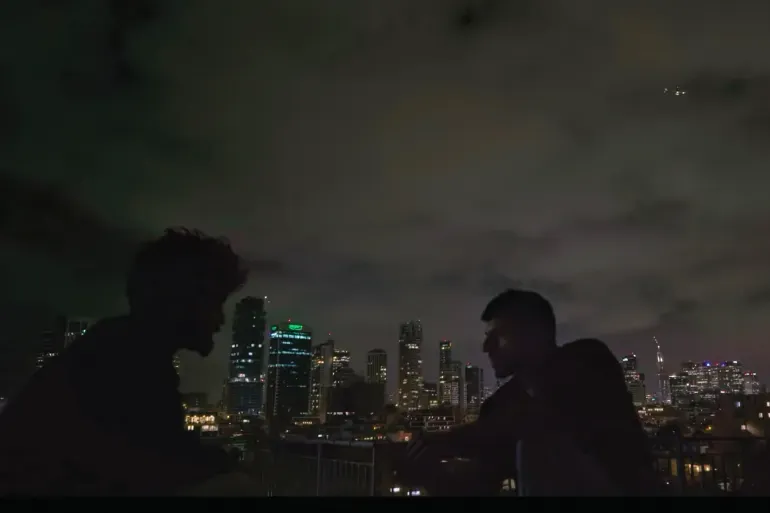
Gaza Herald – The team behind the award-winning Gaza documentary NAZA has issued a forceful response to the Israeli military’s attempt to discredit the investigation, revealing that its findings were built on interviews with more than 100 sources over three years, including senior Israeli commanders directly involved in authorizing strikes on Gaza.
The disclosure directly challenges one of the central impressions created by the Israeli military’s response to the film: that NAZA rested primarily on testimony from 24 Israeli military and intelligence personnel whose knowledge of the targeting process was limited.
Those 24 people are the Israeli military and intelligence insiders who appear anonymously in the documentary. They were not, according to the filmmakers, the investigation’s entire source base.
Behind the film was a much wider three-year investigation involving more than 100 people with knowledge of Israeli targeting systems and military decision-making in Gaza, including senior commanders who participated directly in approving strikes.
The Guardian, which produced NAZA, rejected the Israeli military’s portrayal of the film’s participants as junior personnel involved only in the early stages of selecting targets, stating that this characterization was false.
According to the filmmakers, participants had experience across different levels of the Israeli military targeting process, including intelligence gathering, operational planning and the final authorization of strikes.
The distinction is crucial because the Israeli military’s rebuttal sought to undermine the documentary by questioning whether its witnesses were positioned to understand the complete process through which Palestinians and buildings in Gaza were selected for attack.
The filmmakers responded that their investigation did not depend on the recollections of a small group of lower-level personnel. Instead, testimony was examined against classified documents, details of individual strikes and information provided by additional confidential sources who do not appear in the documentary.
More Than 100 Sources Behind the Investigation
The filmmakers said they interviewed more than 100 sources with knowledge of Israeli military systems during three years of reporting, including senior-ranking commanders directly involved in strike authorization.
That wider source base is important because NAZA examines not merely individual battlefield decisions but the systems, rules and technologies used by the Israeli military to identify targets and determine how many Palestinian civilians could be placed at risk in attacks.
The production team said the process of establishing the credibility of testimony was rigorous. Accounts were checked against leaked classified material, the circumstances of specific Israeli strikes and information from other confidential journalistic sources.
The result, the filmmakers say, was an investigation constructed through multiple layers of corroboration rather than simply accepting the testimony of the 24 anonymous participants appearing on screen.
The Guardian has said it stands fully behind the film and its reporting.
Israeli Military Denies Film’s Findings
The Israeli military, after viewing NAZA, issued an extensive response accusing the documentary of presenting a distorted and misleading account of its targeting procedures and containing what it called substantial factual errors.
It denied operating systems designed to permit the killing of large numbers of civilians and maintained that Israeli military procedures distinguish between civilians and combatants.
The military also disputed the documentary’s presentation of artificial intelligence in targeting, stressing that human officers ultimately authorize strikes rather than allowing AI systems to independently make final decisions.
But the filmmakers’ reporting does not rest on the claim that an artificial intelligence system autonomously presses a button to launch an attack. NAZA examines how automated and AI-assisted systems feed into a much larger targeting apparatus operated by human personnel, including how targets are generated, processed, assessed and ultimately approved.
The documentary also examines the rules governing the number of civilians Israeli personnel were prepared to put at risk when approving attacks on particular targets.
This is where the Israeli military’s attempt to diminish the witnesses’ knowledge becomes particularly important. The filmmakers say their sources included personnel working not only in intelligence but in operations and final authorization, as well as senior commanders directly involved in approving strikes.
Independent Reporting Examines the Same Systems
NAZA does not emerge in isolation from the wider journalistic record on Israel’s targeting practices in Gaza.
Investigations by The Guardian, +972 Magazine and Local Call formed part of the reporting on which the documentary was developed, while major international news organizations have separately examined Israel’s expanding use of artificial intelligence and automated systems in targeting during the Gaza war.
The New York Times, The Washington Post and the Associated Press have reported independently on aspects of Israel’s use of AI-assisted targeting technologies, changes to targeting practices and the safeguards governing attacks that could kill Palestinian civilians.
Those independent investigations do not automatically establish every claim made in NAZA, but they make it harder to dismiss the documentary’s central subject as the invention of a handful of disgruntled or poorly informed personnel.
NAZA’s investigation instead sits within a much larger body of reporting examining how Israel dramatically expanded its targeting apparatus during the Gaza war and the consequences that followed for Palestinian civilians.
From Military Denials to Political Backlash
NAZA was directed by Israeli filmmakers Yuval Abraham and Rachel Szor and produced by The Guardian. It features interviews with 24 anonymous current or former Israeli military and intelligence personnel describing the systems and procedures involved in attacks on Gaza.
The documentary premiered at the Venice International Film Festival, where it received an extraordinary standing ovation before going on to win the Special Jury Prize.
Its reception outside Israel has contrasted sharply with the political backlash directed at its creators inside the country.
After the film’s Venice success, Israeli Culture Minister Miki Zohar accused Abraham and Szor of treason and called for them to be stripped of their Israeli citizenship, triggering condemnation from filmmakers and cultural figures in Israel and internationally.
The backlash has therefore extended beyond an argument about technical military procedures. Israeli officials and political figures have attacked the documentary and its creators, while the filmmakers have responded by publishing more detail about the depth of the investigation behind it.
The central dispute is now clearer.
The Israeli military says NAZA presents a distorted account of how its targeting system works. The filmmakers say their conclusions were reached only after three years of reporting involving more than 100 sources, senior commanders, classified documents, examination of specific strikes and corroboration from confidential sources.
And on one of the Israeli military’s central efforts to undermine the credibility of the film’s witnesses, The Guardian has responded unequivocally: its attempt to portray the 24 participants as junior officers with knowledge limited to the early stages of targeting is false.
Rather than weakening the investigation, the Israeli military’s attack has prompted NAZA’s team to disclose just how much evidence sits behind the 24 voices heard in the film.