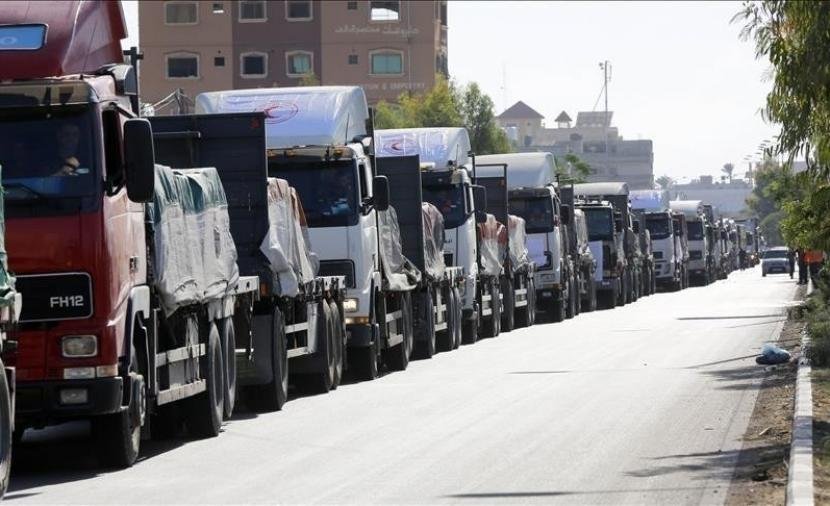
Gaza Herald – The number of humanitarian aid trucks entering the Gaza Strip fell by 43 percent in September compared with the previous month, while commercial goods increasingly dominated the flow of supplies into the territory, according to figures analyzed by Palestinian economic specialist Ahmad Abu Qamar.
Abu Qamar said 1,244 humanitarian aid trucks entered Gaza during September, compared with 2,182 in August, a decline of 938 trucks in a single month, or approximately 43 percent.
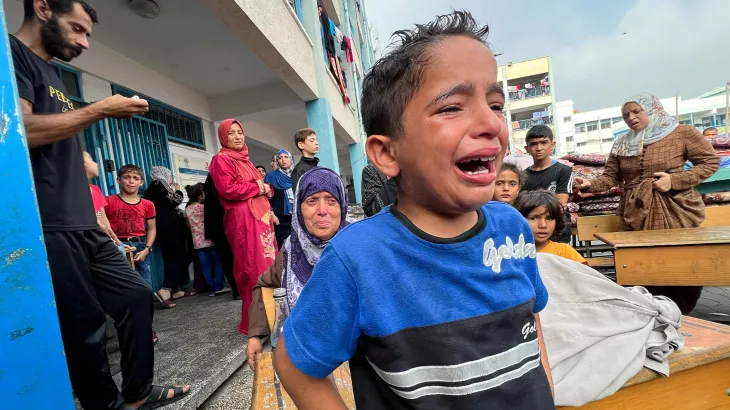
The decline comes as Palestinians across Gaza continue to face widespread humanitarian needs, with large numbers of families dependent on humanitarian assistance after years of displacement, destruction and loss of livelihoods.
While humanitarian aid entries fell sharply, the number of commercial trucks increased slightly. Abu Qamar said 3,781 commercial trucks entered Gaza in September, compared with 3,688 in August, representing an increase of approximately 2.5 percent.
Fuel deliveries also declined. The number of fuel trucks fell from 288 in August to 240 in September, a decrease of 16.7 percent. Fuel remains essential for hospitals, water and sanitation facilities, bakeries, humanitarian operations and other critical services across the Gaza Strip.
The figures show that commercial shipments accounted for approximately 71.8 percent of all truck entries recorded in September. Humanitarian aid represented just 23.6 percent, while fuel accounted for around 4.6 percent.
Overall Truck Entries Fall 14.5 Percent
The decline was not limited to humanitarian aid. Total truck entries fell from 6,158 in August to 5,265 in September, a decrease of approximately 14.5 percent.
For Abu Qamar, however, the composition of those deliveries is as important as the overall number.
He warned that a simultaneous decline in humanitarian aid and increased dependence on commercial imports risks shifting Gaza’s supply system away from relief distributed according to humanitarian need and toward goods that Palestinians must purchase in the market.
That distinction is particularly significant in Gaza, where years of war have destroyed livelihoods, depleted household savings and severely weakened Palestinians’ purchasing power.
The presence of food or other essential goods in markets therefore does not necessarily mean that families can afford them. An increase in commercial imports can improve the physical availability of some products without guaranteeing economic access for families who have lost their incomes or exhausted their financial resources.
Abu Qamar warned that increasing the share of commercial goods while humanitarian aid declines could widen the gap between what is available in Gaza’s markets and what impoverished and displaced families are actually able to obtain.
‘Engineering of Starvation’
Abu Qamar said the September figures should be examined as more than a simple monthly fluctuation in truck numbers, characterizing the changing composition of supplies entering Gaza as an “engineering of starvation.”
He pointed specifically to the sharp contraction in humanitarian aid alongside the growing dominance of commercial goods, warning that the shift places greater pressure on Palestinians to obtain essential supplies through a market system despite widespread poverty and weakened purchasing power.
His characterization reflects an economic analysis of the September figures rather than evidence, from the truck numbers alone, establishing why individual shipments were permitted or prevented from entering.
The 43 percent decline in humanitarian aid entries nevertheless represents a significant change in the composition of supplies reaching Gaza within a single month.
Of the 5,265 trucks recorded entering during September, fewer than one in four carried humanitarian aid, while more than seven in ten were commercial shipments.
Abu Qamar said the figures therefore cannot be understood solely by looking at the total number of trucks crossing into Gaza. The central questions, he said, are what those trucks carry, whether their contents are humanitarian assistance or commercial merchandise, who ultimately receives the supplies and whether Palestinians have the financial ability to purchase what reaches the market.
The September figures show a clear shift: humanitarian aid entries fell by 938 trucks in one month, fuel deliveries also declined and commercial shipments made up nearly three-quarters of recorded truck movement.
For Gaza’s population, the difference between goods being physically present in the territory and families actually being able to obtain them remains critical as humanitarian needs, poverty and the destruction of livelihoods continue across the Strip.