
Gaza Herald — A nine-year-old girl stood outside a shop, her eyes fixed on two colorful school bags, one pink and the other purple, decorated with the cartoon characters she loves.
For her, the bags represented nothing more than the excitement of returning to school with something of her own. But the simple wish quickly turned into tears when she learned that one of them cost 150 shekels.
Nada Abu Ras said she was heartbroken when she realized she could not afford the bag for her daughter amid the family’s worsening financial difficulties.
“I was deeply upset for her, but the price of the bag is unbearable and I simply cannot afford it,” Nada said. “She was crying and telling me, ‘Throughout the war, we have been carrying rice sacks. Don’t you want to fulfill my wish for a school bag?’”
Nada explained that her children have been using empty rice sacks to carry their school belongings after the rice was removed. The makeshift bags have become a symbol of how years of war have stripped away even the simplest parts of childhood.
With the new school year approaching, brightly colored bags have returned to shop windows across Gaza. But for many families, their prices have placed them beyond reach.
A medium-quality school bag costs around 60 shekels, while bags with attractive designs and cartoon characters can cost considerably more.
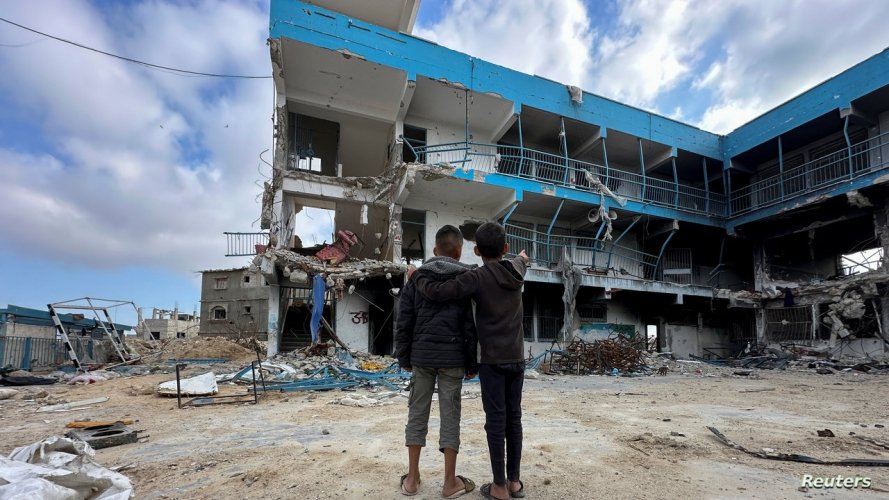
For families already struggling to secure food and other basic necessities, preparing children for school has become another financial challenge. The crisis is even more difficult as thousands of students continue to study in temporary classrooms and plastic shelters after widespread destruction of schools across the Strip.
Water Bottles Become Another Unaffordable Wish
Hanaa Balbal is facing similar difficulties as she tries to prepare her three daughters, who are in kindergarten, fourth and sixth grades, for the new school year.
The girls attend classes in crowded temporary shelters, where temperatures can become extremely high. For Hanaa, water bottles are therefore more than a school accessory; they are an important necessity for her daughters during the school day.
Each girl chose a design she liked. One wanted a dinosaur-shaped bottle, another chose a camera design, while the youngest preferred a strawberry.
But each bottle cost 25 shekels.
Hanaa decided to postpone the purchase because the family has many other school expenses to cover. Her daughters, however, began saving their daily allowances, which amount to no more than one shekel each, hoping to collect enough money before school begins.
They have even planned to share the bottles because they attend school at different times. The youngest will take one in the morning and hand it to her sister when her school day ends and the older girl begins her afternoon classes.
The bottles are only part of the expenses awaiting the family. Notebooks, pens, erasers, sharpeners, geometry tools, drawing supplies and school clothing all require additional money.
Hanaa says the cost of meeting all these needs would amount to roughly the salary an employee earned before the war.
When an Old Pair of Jeans Becomes a School Bag
Dalia Abu Asr has also been forced to reconsider what her children truly need for school.
With the cost of supplies exceeding what she can afford, she decided to prioritize stationery and purchase only limited quantities. New bags, water bottles and even school shoes were placed on hold.
Notebooks alone represent a significant expense. Teachers request notebooks with 60, 80 or 100 pages, and each child may need around a dozen. The cost of even the smallest quantity starts at around 36 shekels, before adding English notebooks, pens, erasers, sharpeners, geometry tools and drawing materials.
Unable to buy a new school bag, Dalia found another solution. She turned an old, worn-out pair of jeans into a handmade backpack for her daughter.
Her daughter had repeatedly cried after becoming tired of carrying plastic bags to school. The homemade bag offered a practical alternative while helping the family reduce its expenses.
A Return to School Shaped by War
The growing cost of school supplies comes as Gaza’s families continue to face severe economic hardship.
Data from the Palestinian Central Bureau of Statistics showed that unemployment in Gaza reached around 68% during the war, while labor-force participation fell to about 25%, compared with roughly 40% before the war.
At the same time, the education system has been devastated. More than 97% of schools in Gaza have been damaged or destroyed, while temporary learning spaces, many of them located in tents, have replaced some of the damaged facilities, according to UNICEF.
For families across the Strip, the return to school is therefore no longer simply about buying notebooks, bags and new clothes.
Parents must calculate the cost of every item, decide what their children can do without, postpone what can wait and find homemade alternatives wherever possible.
A child who dreams of a colorful school bag, three sisters saving one shekel a day for water bottles, and a mother transforming an old pair of jeans into a backpack all tell the same story.
In Gaza, even the most ordinary preparations for a new school year have become a struggle.
Yet despite the hardship, families continue to find ways to keep their children connected to education, preserving a small part of childhood and normal life amid the destruction surrounding them.

