
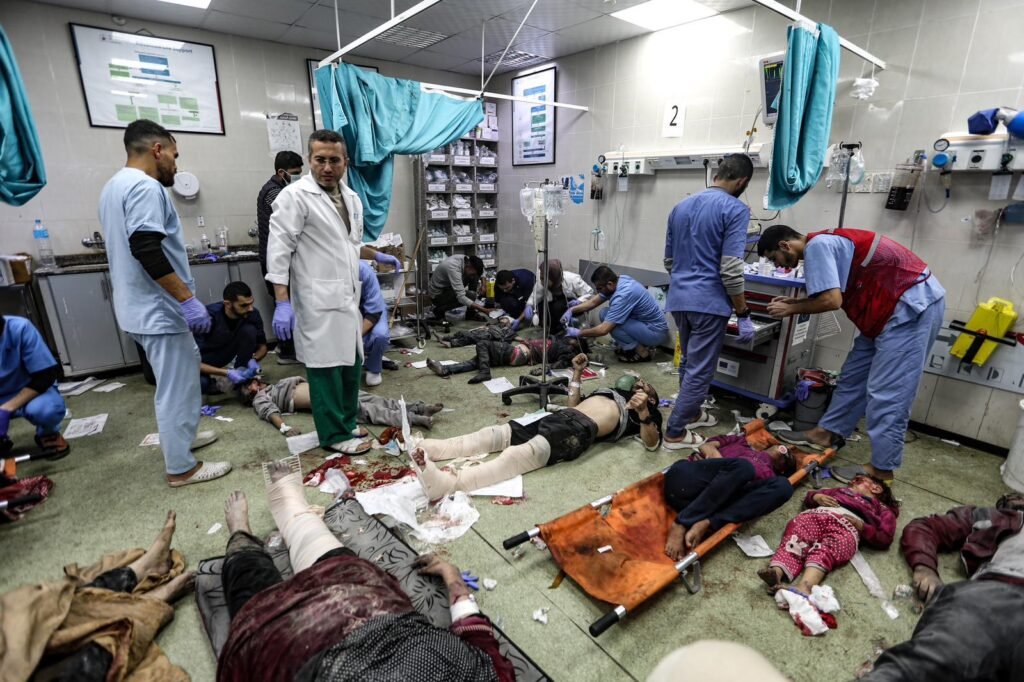
Gaza Herald _ A year after the deadly Israeli strike on Nasser Hospital in Khan Younis, questions surrounding the attack remain unresolved, as a new testimony from within the Israeli military challenges key elements of the explanation provided for the operation.
The attack on August 25, 2025, killed 22 Palestinians, including journalists and medical workers, after the hospital was hit by a series of strikes.
The first strike targeted a camera positioned on the hospital’s roof. Israeli forces later said they suspected that Hamas was using the camera to monitor their movements.
The Associated Press, however, reported that the camera belonged to Reuters photographer Hossam al-Masri, who was killed in the initial strike.
Following the first attack, journalists and medical workers rushed up an external staircase to help the wounded and document what had happened. A second strike then hit the area, killing most of those who had gathered there.
In total, the hospital was hit four times by high-explosive tank shells.
Palestinian journalist Mariam Abu Dagga, who worked with the Associated Press and other media organizations, was among those who went to the site after the first strike. She was killed in the subsequent attack.
A camera, a piece of cloth and a disputed explanation
As international outrage grew, the Israeli military maintained that the camera had been targeted because it believed Hamas was using it to observe Israeli forces.
The military also said six of those killed had links to Hamas, but did not provide evidence supporting the assertion.
One of the reasons cited for viewing the camera as suspicious was the presence of a piece of cloth covering it.
The Associated Press reported that al-Masri routinely placed a white cloth over his equipment to protect it from Gaza’s intense heat and dust, a practice commonly used by journalists working in hot environments.
The agency had also repeatedly informed the Israeli military that its journalists were working at Nasser Hospital. The facility had become an important location for international media organizations, with Reuters and the Associated Press using it to transmit live images from Gaza to newsrooms around the world.
Testimony from inside the Israeli military
A year after the attack, a former Israeli soldier with knowledge of discussions surrounding the military’s response provided a different account.
Speaking to the Associated Press on condition of anonymity because of concerns about possible retaliation, the soldier said the military was unable to find evidence linking al-Masri’s camera to Hamas.
He also said that none of the six Palestinians later described by the Israeli military as being affiliated with Hamas had been deliberately targeted.
The testimony raises renewed questions about the basis for identifying the camera as a military threat and the decision to strike it in the first place.
Searching for justification after civilian deaths
The soldier also described what he said was a broader pattern in the way the military handles incidents involving civilian deaths where an apparent military objective is unclear.
According to his account, military officials may search after such incidents for possible connections between those killed and armed groups.
Breaking the Silence, an organization founded by former Israeli soldiers that recorded the testimony, describes this practice as retrospective criminalization, in which connections to armed groups are sought after Palestinians have already been killed.
Nadav Weiman, the organization’s executive director, said such practices can provide a ready-made justification for the use of force while reducing pressure for genuine investigations.
The Associated Press said it independently verified some elements of the soldier’s account, while Breaking the Silence said the testimony was consistent with information from its other sources.
Why were tank shells used?
The new information also sheds light on the weapon used during the operation.
According to the soldier and a former Israeli military official familiar with the case, a senior commander initially approved the use of a precision weapon to destroy the camera.
A drone was reportedly used in an attempt to carry out the strike, but the operation failed for reasons that remain unclear.
A divisional commander subsequently approved an alternative method.
It remains unclear who ultimately authorized the use of tank shells, which can cause significantly greater damage than the precision strike originally planned.
The change raises questions about the military decision-making process and whether the switch to a more destructive weapon required a fresh assessment of the risks to civilians inside the hospital.
The second strike
The most serious questions concern what happened after the first strike.
Following al-Masri’s death, journalists and emergency workers moved toward the site to assist the wounded and document the aftermath.
A second strike then killed 20 people.
The Associated Press reported that video footage and witness accounts showed no evidence that those killed in the second strike were armed.
The sequence has raised concerns over what is known as a “double-tap” attack, in which a location is struck again after rescuers or first responders have arrived.
If emergency responders are deliberately targeted, such an attack could constitute a war crime.
No final investigation or accountability
A year after the attack, Israel has yet to announce a final investigation into the incident, and no one has been held accountable.
The Associated Press said it submitted detailed questions to the Israeli military regarding the soldier’s testimony and the circumstances surrounding the attack.
The military did not answer the specific questions, saying only that the incident remained under review and that its findings would be forwarded to the military prosecutor, who would determine whether to open a criminal investigation.
No timetable was provided.
On the anniversary of the attack, the Associated Press and Reuters renewed calls for a full and transparent explanation of what happened, while continuing to seek answers over the deaths of their journalists.
Both organizations have also called for international journalists to be allowed access to Gaza to support their Palestinian colleagues, who have carried much of the burden of reporting from the territory throughout the war.
According to the Committee to Protect Journalists, Israeli forces have killed more than 200 Palestinian journalists in Gaza since October 2023.

