
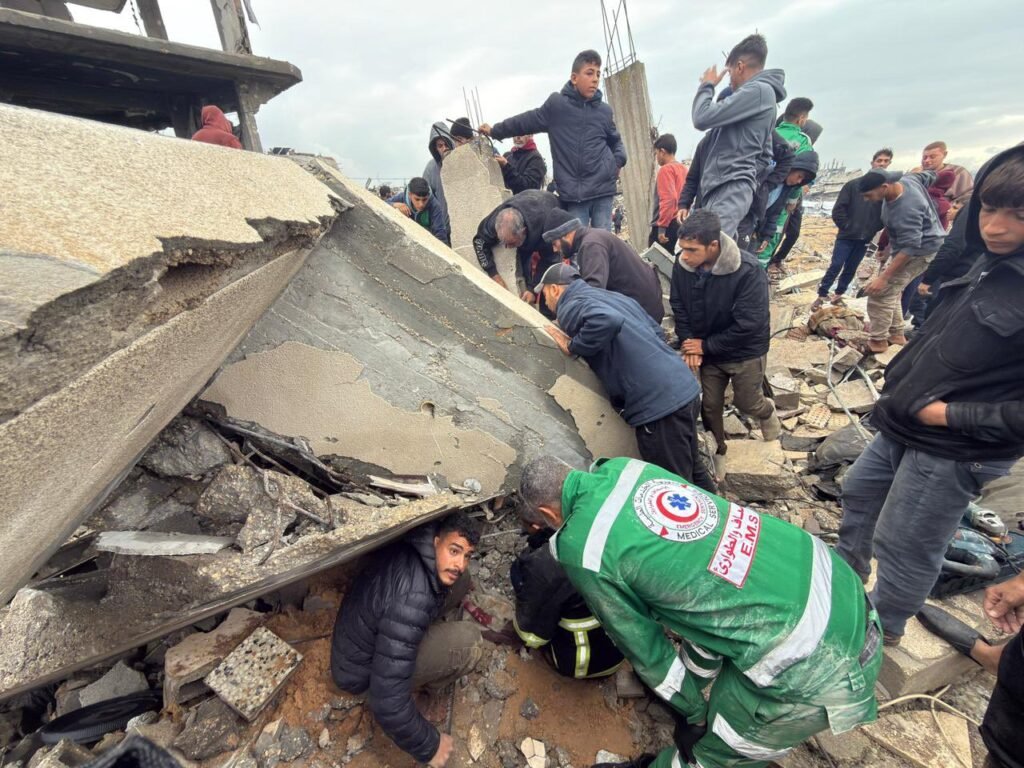
Gaza Herald _For survivors of Israel’s war on Gaza, what remains is a landscape of rubble, grief and unanswered questions. The remains of relatives are still trapped beneath collapsed homes, buried under tons of concrete and debris left behind by the destruction.
For many families, even recovering the bodies of their loved ones has become an almost impossible demand. After enduring the loss of family members, they are now fighting for the basic right to retrieve their remains, identify them and give them a proper burial.
Israeli bulldozing operations, however, are rapidly erasing what remains of the destroyed landscape. Rights groups warn that the systematic removal and relocation of rubble could conceal thousands of bodies while destroying physical evidence that may be crucial to future investigations into alleged war crimes and genocide.
Rights organizations have warned that Israeli forces are removing an estimated 200 truckloads of rubble every day, raising concerns that evidence and human remains are being deliberately displaced or destroyed.
Mohammad Salha, director of the Gaza NGO Network, warned that the large-scale clearing operations could make accountability increasingly difficult by destroying sites and evidence needed to identify victims and establish where they were killed or buried.
According to Salha, the operations have affected more than 93 percent of Gaza’s cemeteries. Human remains, personal belongings and remnants of weapons are reportedly being buried, fragmented or transported along with the rubble into areas under Israeli control, making it increasingly difficult to identify victims or recover their remains.
Rights groups have also warned that humanitarian and international teams are being prevented from reaching areas behind the so-called Yellow Line, further limiting access to potential evidence and burial sites. They have called for international investigators to be granted immediate access to document the destruction and establish the fate of thousands of missing Palestinians.
Civil Defense Blocked From the Rubble
The obstacles facing families are compounded by restrictions on Gaza’s Civil Defense teams, who have been unable to reach large areas under Israeli military control. Around 70 percent of the eastern part of the enclave remains inaccessible to rescue teams, while severe shortages of heavy machinery, fuel and specialized equipment have further crippled recovery operations.
Gaza Civil Defense officials have described the work as extremely difficult even in accessible areas. Reaching locations along the Yellow Line is even more complicated, requiring coordination, equipment and working conditions that are largely unavailable.
The scale of the destruction is staggering. The Euro-Mediterranean Human Rights Monitor estimates that Israeli forces have removed or fragmented around 10 million tons of rubble across Gaza. The scale of the operation has intensified fears that crucial evidence could disappear before investigators are able to examine it.
For families of those still missing, the destruction of the rubble carries another layer of pain.
Abu Asim continues to search for information about relatives believed to remain beneath their destroyed family home in eastern Gaza, inside what is described as the Yellow Zone. He says the tragedy did not end with the deaths of his relatives. It continued with the inability to recover their remains, bury them in known graves or preserve evidence that could establish how they were killed.
For families like his, the destruction of Gaza’s physical landscape is also threatening to erase the final traces of those who died beneath it.
Since October 7, 2023, Israel’s war on Gaza has killed around 73,000 Palestinians and wounded more than 174,000, according to Palestinian authorities. The destruction has also devastated roughly 90 percent of the territory’s infrastructure.
As the rubble disappears, families face a grim possibility: that their loved ones may remain missing indefinitely, and that evidence capable of documenting what happened to them may disappear with them.

