Gaza Herald —Across the crowded displacement camps of the Gaza Strip, the sound of vendors calling out prices has become part of everyday life. Along sandy paths between tents, on damaged sidewalks, and at the entrances of makeshift shelters, small wooden tables, plastic sheets, and improvised stalls display vegetables, canned food, secondhand clothes, household necessities, and whatever other goods their owners can obtain. What once served as residential streets and public spaces has gradually transformed into a network of informal markets catering to a population forced to rebuild its daily life amid destruction and displacement.
In Al-Mawasi, west of Khan Younis, a displaced woman arranges homemade bread and pastries on a small table outside her tent, hoping to earn enough to cover part of her family’s daily expenses. A few streets away, a young man sells vegetables brought from another area, while another vendor displays used clothes and basic household items collected from different sources. Nearby, makeshift phone-charging stations powered by solar panels serve residents who have few alternatives amid the collapse of electricity infrastructure.
These modest commercial activities represent a profound transformation in Gaza’s economic landscape after more than three years of Israel’s genocidal war. With established markets destroyed, commercial facilities reduced to rubble, businesses forced to close, and traditional sources of income disappearing, displaced Palestinians have increasingly turned to small-scale trade and improvised businesses to survive.
The phenomenon goes beyond the appearance of temporary stalls. It reflects the emergence of a parallel survival economy shaped by mass displacement, the collapse of formal employment, restricted supplies, and the urgent needs of communities living in tents and overcrowded shelters. For thousands of Palestinians, these makeshift markets have become both a place to obtain essential goods and one of the few remaining opportunities to generate an income.
Displacement Reshapes Gaza’s Commercial Landscape
Before October 2023, Gaza’s commercial activity relied on established shopping districts, wholesale warehouses, retail stores, factories, and distribution networks connecting different governorates. Markets in Gaza City, Khan Younis, Rafah, and Deir al-Balah served as commercial centers where businesses operated through relatively established supply chains and employment arrangements.
The war dismantled much of this structure. Israeli occupation bombardment and ground operations destroyed commercial buildings, industrial facilities, warehouses, and markets, while repeated displacement forced business owners and workers to abandon their workplaces and relocate alongside hundreds of thousands of families.
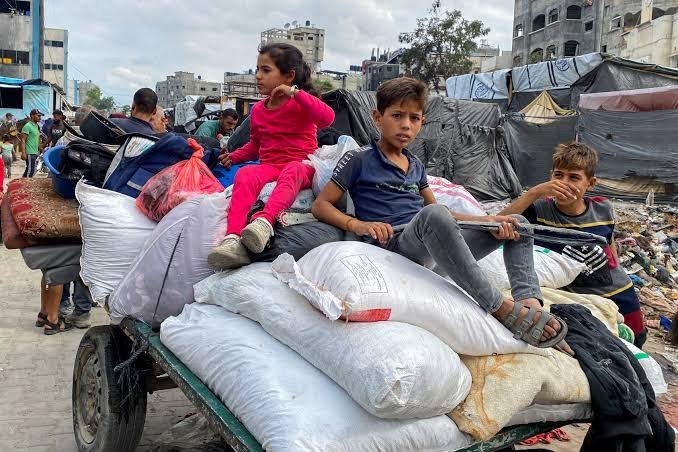
As population concentrations shifted toward central and southern Gaza, commercial activity followed the displaced population. Areas that previously had limited commercial importance became crowded trading points, while narrow streets and open spaces surrounding displacement camps gradually developed into improvised shopping areas.
In Deir al-Balah and the western areas of Khan Younis, temporary markets expanded as residents attempted to secure food and household necessities close to their shelters. Vendors began displaying goods on wooden tables, plastic coverings, and the ground, often without permanent premises, electricity, storage facilities, or any formal commercial infrastructure.
The transformation also changed the nature of the goods being sold. Instead of the diverse products previously available in established shops, many stalls focus on basic necessities, including flour, bread, vegetables, canned food, cooking supplies, detergents, children’s clothing, and secondhand household items.
The United Nations Conference on Trade and Development and the World Bank have documented a contraction of more than 81 percent in Gaza’s gross domestic product, reflecting the scale of economic destruction. Meanwhile, estimates from the Palestinian Central Bureau of Statistics indicate that more than 85 percent of small and medium-sized enterprises have been totally or partially destroyed.
Against this background, the spread of informal markets is not simply a change in shopping habits. It represents the relocation of what remains of Gaza’s commercial activity into the places where displaced people have been forced to live.
From Business Owners to Street Vendors
Behind the expansion of these markets are thousands of Palestinians whose professional lives have been overturned. Former shopkeepers, factory owners, wholesalers, employees, and skilled workers have been forced to abandon their previous occupations and seek alternative ways to earn money.
The experience of 58-year-old Hajj Mahmoud al-Saqqa illustrates the extent of this transformation. Before the war, he was among Gaza’s prominent food importers, operating from an office in the Shuja’iyya neighborhood east of Gaza City. He managed distribution trucks, wholesale warehouses containing thousands of tons of goods, and a workforce of more than 40 employees.
Today, he stands behind a wooden table measuring barely one square meter in Al-Mawasi, displaying a few cans of fava beans and canned cheese bearing international relief agency logos.
His warehouses were destroyed, goods worth approximately $2 million disappeared, and outstanding commercial debts became virtually impossible to recover following the collapse of banking and judicial systems.
“I have not only lost my wealth, but I have also lost my commercial dignity,” al-Saqqa said. “After 40 years in the market, I am now buying aid cartons from brokers I do not know to sell them piece by piece on the pavement to provide the price of a bundle of bread and a sip of water for my grandchildren in the tent.”
His experience reflects a wider phenomenon in which established merchants have become small-scale vendors, purchasing limited quantities of available goods and selling them individually to generate enough money for their families’ immediate needs.
Other former business owners have adopted entirely different occupations. Tariq Hasouna, who previously operated a small sewing and textile factory in Tal al-Hawa, Gaza City, now runs a mobile phone-charging point in Deir al-Balah using a solar panel and an old truck battery.
After his factory was bombed, he attempted to resume production using a single sewing machine he had managed to take with him during displacement. However, the lack of electricity, soaring fuel prices, and the scarcity and high cost of fabrics and threads made returning to his previous profession practically impossible.
“There was nothing left for me except to turn into an energy seller on the side of the road,” he explained.
Such transformations are increasingly visible across Gaza. Skilled workers and business owners who once employed others are now working independently, often with limited equipment and almost no capital. Their businesses may consist of a single table, a small solar panel, a sewing machine, or a few boxes of merchandise.
Women’s Home Businesses and the Economy Inside Displacement Camps
The growth of Gaza’s informal markets has also opened space for small domestic businesses, particularly those operated by women who have lost traditional sources of household income.
Inside displacement camps, primitive mud ovens and improvised bakeries have emerged as families attempt to produce bread, biscuits, pastries, and other basic food products for nearby residents. Women prepare food inside tents or temporary shelters, using limited ingredients and basic cooking equipment, before selling their products to neighbors and passersby.
For many of these women, home-based production offers one of the few available ways to contribute to household expenses while remaining close to their children and other family members.
The same pattern extends to small food stalls, homemade meals, sewing activities, and the sale of clothing and household necessities. Some women have turned part of their tent entrances into tiny commercial spaces, displaying whatever products they can obtain or produce.
Young people have also adapted their skills to the needs of displaced communities. Electronics workers operate phone-charging stations powered by solar panels, while carpenters who previously manufactured furniture have shifted to producing basic wooden structures, tent frames, and other necessities for temporary shelters.
These activities form a fragmented but increasingly visible network of small businesses serving communities where formal commercial services have largely disappeared.
However, the emergence of these opportunities should not obscure the difficult conditions under which they operate. Most vendors lack secure premises, reliable supplies, sufficient capital, and protection against losses. Their earnings are often irregular and depend on the purchasing power of people who are themselves struggling to afford food and other essentials.
The International Labour Organization has reported that unemployment in Gaza has reached approximately 80 percent, with much of the remaining economic activity concentrated in marginal and informal work.
For many displaced families, therefore, opening a small stall is less a business opportunity than an attempt to replace an income that disappeared with their homes, workplaces, and previous lives.
Markets of Survival Amid Scarcity and Unequal Purchasing Power
Despite their expansion, Gaza’s informal markets remain highly vulnerable to supply disruptions, geographical restrictions, and the collapse of household purchasing power.
The military fragmentation of the Strip has created isolated commercial areas in which the availability and prices of goods can differ dramatically. Restrictions on movement between northern Gaza and the central and southern regions have disrupted traditional distribution routes, while transportation risks and limited access to supplies have increased the cost of bringing merchandise into local markets.
During periods of intensified restrictions on northern Gaza, the price of a 25-kilogram flour sack in Jabalia reportedly reached between 500 and 1,000 shekels, compared with approximately 50 to 100 shekels in Deir al-Balah and Rafah.
Such disparities demonstrate how geographical isolation can determine not only what residents can purchase but also whether small vendors can obtain merchandise at prices that allow them to continue operating.
The restrictions imposed on commercial goods and fuel have further complicated the situation. With regular supplies disrupted, vendors often depend on small quantities obtained through intermediaries, individual traders, or available humanitarian goods. This makes the market unstable and leaves small businesses particularly exposed to sudden price increases.
The collapse of formal banking services has created another obstacle. With bank branches and ATMs out of service and physical cash increasingly scarce, vendors and customers have been forced to rely more heavily on electronic payment applications and informal cash-conversion services.
Commissions charged by liquidity brokers have reportedly reached between 15 and 30 percent during periods of severe shortage, reducing the actual value of salaries and financial assistance received by families.
For small vendors, these conditions create a difficult commercial environment. They must purchase goods at inflated prices, cover transportation and transaction costs, and then attempt to sell them to customers who frequently cannot afford even basic necessities.
Consequently, crowded markets do not necessarily indicate economic recovery. Many people walk between stalls comparing prices without making purchases, while others buy vegetables, bread, or household products in quantities sufficient for only one or two days.
A growing number of families have exhausted their savings, accumulated debts, or resorted to selling part of their humanitarian assistance to obtain cash for necessities not included in aid packages. Children have also been pushed into street vending and other forms of informal work as household incomes disappear.
This has created an economic environment in which the ability to purchase essential goods increasingly depends on access to cash rather than the actual level of need.
At the same time, the distinction between survival trade and exploitative commercial practices has become increasingly important. While thousands of small vendors are simply trying to support their families, intermediaries and black-market networks have benefited from shortages and restrictions on the movement of goods. The two phenomena coexist, but they reflect very different positions within an economy shaped by war.
Will Gaza’s Makeshift Markets Survive Reconstruction?
The future of these informal markets remains closely connected to the broader prospects for recovery and reconstruction in Gaza.
Some activities may gradually disappear if crossings reopen regularly, commercial imports resume, electricity supplies are restored, and traditional businesses regain the ability to operate. With greater availability of goods, prices could stabilize and consumers may return to established shops and commercial centers.
However, the disappearance of makeshift stalls will not necessarily be immediate. Thousands of traders have lost their warehouses, shops, equipment, and financial capital. Many workers have spent years outside their original professions, while women and young people have established small businesses that now serve as their primary sources of income.
Restoring the previous commercial structure will require more than rebuilding destroyed storefronts. It will depend on the rehabilitation of banking services, industrial facilities, electricity networks, transportation routes, wholesale markets, and systems of commercial regulation.
The destruction of business records, the accumulation of unpaid debts, and the loss of financial assets have also left traditional merchants facing serious obstacles to restarting their operations. Without accessible financing and compensation mechanisms, many small business owners may remain excluded from the formal economy even after reconstruction begins.
There is also a risk that the wealth accumulated by powerful intermediaries and traders who benefited from wartime shortages could give them an advantage over smaller businesses struggling to return to the market.
Reconstruction efforts must therefore address not only physical destruction but also the economic inequalities and institutional weaknesses that have emerged during the war. Restoring opportunities for small merchants, supporting women-led businesses, and providing affordable financing to displaced entrepreneurs will be essential to rebuilding a functioning local economy.
Ultimately, the wooden tables and plastic-covered stalls scattered across Gaza’s displacement camps tell a story that extends beyond commerce. They reveal how an entire population has been forced to reorganize its economic life around the most basic requirements of survival.
A former importer selling individual cans of food, a factory owner charging phones with a solar panel, and a displaced woman baking bread outside her tent are not examples of economic recovery. They are evidence of a society attempting to preserve its ability to work and provide for itself after the destruction of the structures that once sustained its livelihood.
These makeshift markets demonstrate the resilience and resourcefulness of Palestinians, but resilience must not become an excuse for normalizing deprivation. No population should have to replace factories with roadside stalls, established businesses with wooden tables, or secure employment with the daily uncertainty of selling a few essential goods.
Gaza’s economy cannot be rebuilt simply by allowing its streets to become crowded with vendors again. It requires restoring the conditions that make sustainable economic life possible: freedom of movement, unrestricted access to goods, functioning institutions, productive workplaces, and the right of Palestinians to rebuild their businesses and livelihoods without remaining trapped in an economy of permanent emergency.