Gaza Herald — The United Nations Relief and Works Agency for Palestine Refugees (UNRWA) is facing the most severe existential crisis in its 76-year history as Israeli occupation authorities escalate legislative, financial, and political campaigns aimed at permanently dismantling the agency.
Established by UN General Assembly Resolution 302 following the 1948 Nakba, UNRWA was created to provide essential relief and public services to displaced Palestinians pending a just political resolution under Resolution 194.
Today, as Israeli forces seek to liquidate the agency’s operational infrastructure across the occupied Palestinian territories, human rights advocates warn that the campaign is designed to erase the historical records, international status, and legal right of return for over 6.6 million registered Palestinian refugees.
Over decades of forced exile, UNRWA evolved from a temporary emergency relief organization into the primary provider of essential public services, operating hundreds of schools for over half a million children alongside healthcare clinics, emergency food distribution, and camp infrastructure across Gaza, the West Bank, East Jerusalem, Jordan, Lebanon, and Syria.
Israeli state opposition to UNRWA stems directly from the agency’s role as an international witness to the unresolved refugee crisis. By maintaining registration records spanning generations, UNRWA preserves the legal framework anchoring Palestinian refugee rights, an institutional memory that successive Israeli governments have sought to eliminate to enforce a unilateral political outcome.
Weaponized Funding Cuts, Israeli Legislation, and Unprecedented Staff Losses
The systematic effort to paralyze UNRWA has relied heavily on political funding freezes and direct legislative attacks. After Israeli allegations in early 2024, 16 donor nations suspended $438 million in funding, 51 percent of expected revenues, but independent investigations, including the Colonna report, verified UNRWA’s extensive neutrality mechanisms and led most donors to restore contributions.
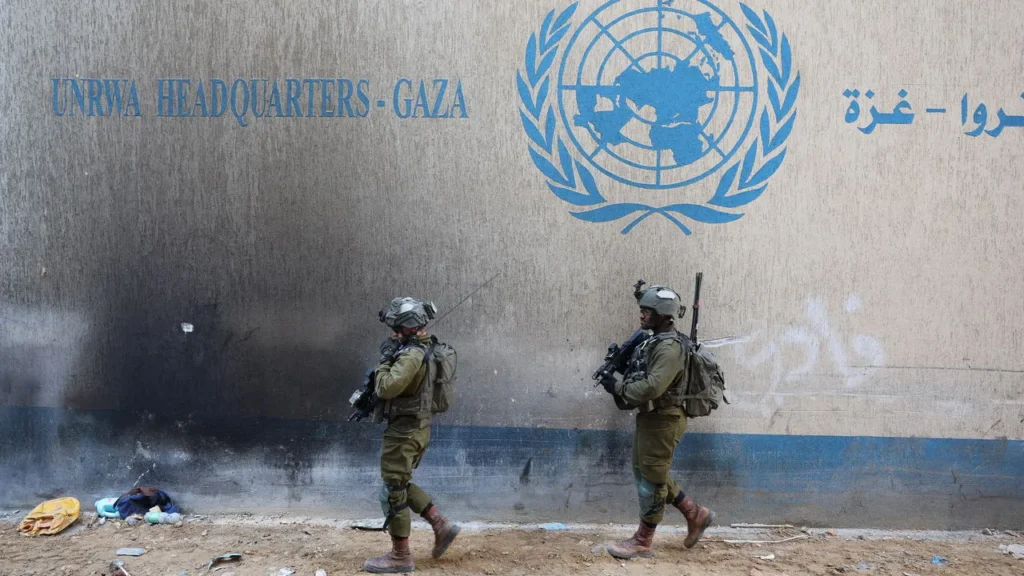
Simultaneously, Israeli military attacks in Gaza deliberately targeted agency infrastructure, killing at least 263 UNRWA personnel and damaging 231 installations sheltering displaced families. The campaign culminated in late 2024 when the Israeli Knesset passed restrictive legislation barring UNRWA operations within territory Israel controls and cutting all official contact. These measures entered into force in early 2025 and stripped the agency of its legal protections in occupied East Jerusalem.
The financial and operational stranglehold has severely eroded the agency’s baseline capacity, turning routine public services into an ongoing struggle for organizational survival. In 2024, temporary donor suspensions froze more than half of expected revenues, forcing emergency cutbacks across healthcare and food distribution networks. Concurrently, the implementation of Israeli Knesset laws in early 2025 prohibited UNRWA from accessing controlled zones and operating its municipal facilities, directly threatening the total paralysis of international humanitarian infrastructure across the occupied territories.
Resistance to Dismantling Proposals and the Preservation of Refugee Rights
The crisis escalated further on November 1, 2026, amid reports of a proposal to gradually liquidate UNRWA and transfer its educational, clinical, and municipal services to the Palestinian Authority in the West Bank and external administrative bodies in Gaza.
Representatives of the Palestine Liberation Organization, UNRWA’s staff union, and nations including Switzerland, Ireland, and Egypt strongly condemned the proposal. Legal rights experts emphasize that while administrative functions could theoretically be transferred, extinguishing UNRWA cannot legally negate or dismantle the Palestinian right of return guaranteed under international law.
In December 2025, the UN General Assembly overwhelmingly renewed UNRWA’s mandate through June 30, 2029, reaffirming international legal authorization despite intense Israeli lobbying. Dismantling UNRWA without a just political settlement would create a catastrophic humanitarian vacuum across Gaza and the West Bank while abandoning the international community’s legal responsibilities toward displaced Palestinians.
Human rights organizations stress that UNRWA did not create the refugee crisis; rather, it remains an indispensable safeguard born of the Nakba, whose protection must be preserved until full repatriation and justice are achieved.