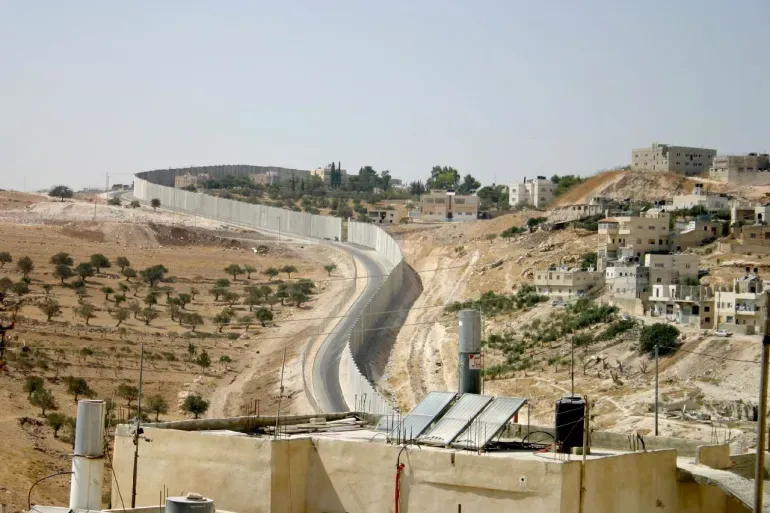
Gaza Herald – Israeli authorities have issued two military orders to confiscate 11.205 dunams of land in the villages of Deir Abu Shueef and Qabatiya in Jenin, citing military purposes. According to the Wall and Settlement Resistance Authority, these measures are part of plans to revive settlements evacuated in 2005 and construct security routes threatening Palestinian agricultural lands and communities.
Jenin governorate is entering a new phase of settlement escalation as occupation authorities intensify land confiscation and road construction. These steps aim to reshape the region’s geography and prepare conditions for reviving settlements that were dismantled in 2005, extending beyond mere territorial expansion.
The first order targets 8.645 dunams in Deir Abu Shueef to complete a security axis and buffer zone around the Ganim settlement, spanning 1800 meters. The second order confiscates 2.560 dunams in Qabatiya to build a security road approximately 500 meters long, referred to in Israeli documents as the Kaddim Emergency Axis.
These orders gain significance due to their link with plans to revive four northern West Bank settlements evacuated in 2005: Homesh, Sa Nur, Ganim, and Kaddim. The occupation government began dismantling legal barriers preventing settlers’ return by amending the Disengagement Law in March 2023, followed by additional administrative steps to solidify their presence.
In August 2026, settler families returned to reside in Ganim and Kaddim, followed by procedures to stabilize their existence. This occurred alongside efforts to provide necessary infrastructure for expanding these settlements, marking a significant shift in regional control dynamics.
Occupation forces recently began constructing a road in the Wadi al-Lizam area on Qabatiya citizens’ lands. This route is scheduled to connect the Doton and Amik Doton settlements near Araba town with the Raba settlement in the Salma Mountains, passing through the lands of Qabatiya and Musliya.
Plans also extended to population centers after occupation forces gave families residing in Khirbet Saroj, near Yamon town west of Jenin, one week to evacuate their homes, structures, and livestock sheds to pave the way for establishing a new outpost in the area.
Tariq Ighbariya, the settlement file official in Jenin, described the situation as a historic turning point in land control. He noted that settlement activity now aims to re-engineer the governorate’s geography and impose a comprehensive control system through bulldozing, uprooting olive trees, and imposing closures.
Ighbariya emphasized that current measures involve increased use of military orders to confiscate land under security pretexts while creating roads and buildings serving settlements, particularly in the south, west, and east of the governorate.
He warned that the danger lies not just in the land area but in cumulative effects on the geographic and economic reality, including fragmenting agricultural lands, blocking access for owners, and expanding areas under military and settlement control.
The targeted lands in Deir Abu Shueef and Qabatiya hold strategic importance. Qabatiya serves as a connection point with southern towns and possesses fertile agricultural lands vital for livelihoods, making confiscation a direct threat to the agricultural sector.
Ighbariya linked the focus on these areas to their location in the northern West Bank and their role in connecting Jenin and Nablus, alongside efforts to control heights and passages surrounding the four evacuated settlements.
Impacts extend beyond farmers losing land to threatening family income sources and community stability. The evacuation notice for Khirbet Saroj exemplifies risks where residents face losing homes and livelihoods, threatening their historical ties to the land.
Continued procedures may lead to further confiscations, outpost establishment, and road construction alongside expanding barriers and surveillance cameras, imposing increasing restrictions on citizen movement and access to their lands.
The expected outcome involves isolating Palestinian communities from each other, separating Jenin from its surroundings, and turning towns into fragmented zones, threatening Palestinian presence and opening avenues for expanded settlement control.
In response, Ighbariya called for activating the Jenin settlement file at official, popular, and international levels to intensify efforts against these developments.
This report was produced in the Gaza Herald newsroom.