
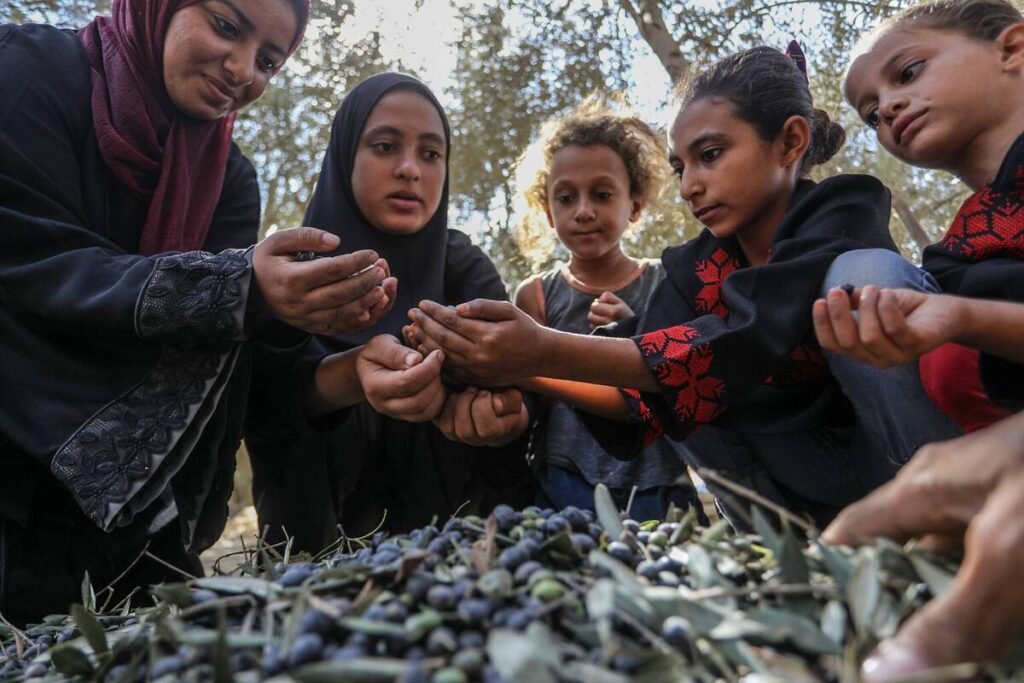
Gaza Herald — In Gaza, the olive harvest is no longer the celebrated annual tradition awaited by families and farmers for generations. The olive trees that once stretched across tens of thousands of dunams, providing food, stable income, and seasonal employment, are now part of an agricultural sector stripped of its core capacity to produce.
The genocidal war has forced approximately 90% of Gaza’s olive-cultivated lands completely out of production, according to data published by the Government Media Office. Oil production has plummeted to just 700 tons, compared to nearly 5,000 tons prior to October 2023. Total olive acreage has collapsed from roughly 50,000 dunams to barely 5,000, while the total number of trees has crashed from two million to around 150,000.
These numbers alone fail to convey the true structural magnitude of the destruction. Every uprooted tree represents far more than the loss of a single seasonal harvest; it signifies the erasure of a long-term resource that requires years of cultivation to replace, while simultaneously shattering the vast network of dependent industries spanning harvesting, transport, pressing, storage, and retail.
From 40,000 Tons to Five Thousand
Before the genocidal war, Gaza produced roughly 40,000 tons of olive fruit annually, with 35,000 tons dedicated to pressing and 5,000 tons earmarked for pickling.
Today, official data reveals a total yield not exceeding 5,000 tons, with 4,000 tons allocated for oil extraction and 1,000 tons for pickling. This represents an 87.5% collapse in fruit yield and an 86% drop in oil output.
The most catastrophic element of this destruction lies in its long-term nature. Unlike seasonal field crops, olive groves cannot be reconstituted in a single planting cycle. When an orchard is bulldozed, restoring it demands land reclamation, securing fresh saplings, establishing irrigation infrastructure, and waiting several years before trees reach productive maturity. For a farmer stripped of all income, surviving those years while attempting to finance agricultural reconstruction poses an almost insurmountable barrier.
When the Tree Collapses, the Entire Ecosystem Follows
The economic devastation extends far beyond landowning farmers. Data indicates that the active farming population connected to the olive sector has plummeted from 20,000 to just 1,000, while the seasonal labor force has shrunk from 3,000 workers to barely 200. Furthermore, operational olive presses have dropped from 40 to seven, while pickling facilities have decreased from 14 to three.
These metrics highlight an integrated economic chain that extended well beyond the fields. The harvest season historically sustained field laborers, transport drivers, press operators, storage technicians, and local market merchants. As raw production collapses, every link in this chain breaks simultaneously.
The loss of the olive harvest functions as a multi-layered financial shock: the farmer loses capital, the worker loses vital seasonal income, the press owner loses business, and the household loses a key staple of its annual food supply. Households that traditionally preserved oil for home consumption while selling surpluses to cover annual living expenses are now forced to purchase what their land once provided, amid severe hyperinflation and collapsed purchasing power.
A Surviving Tree Does Not Guarantee a Harvest
The threat to Gaza’s agricultural sovereignty is not confined to the trees directly uprooted by military bulldozers. The minority of surviving trees require physical access, irrigation, fertilizers, basic equipment, and agricultural workers capable of reaching the fields safely.
In a joint assessment published by the Food and Agriculture Organization (FAO) and UNOSAT, based on satellite data from mid-2026, intact and physically accessible agricultural land accounted for barely 3% of Gaza’s total cultivated area. Out of 4,091 hectares of cultivated land deemed physically accessible, only 448 hectares remained undamaged, with the remainder requiring extensive land rehabilitation.
A tree that survives direct destruction cannot yield fruit if the farmer is barred from reaching, watering, or tending to it. Without sustained access and essential inputs, a standing tree ceases to function as a source of household survival.
Less Oil, Heavy Burdens on the Table
This structural crisis reflects heavily across local markets. While skyrocketing prices for remaining olive oil stocks might superficially appear to compensate surviving farmers, high unit prices do not equal higher net income. When total yield collapses so severely alongside surging production costs, farmers face net financial losses despite high market rates, while consumers are priced out of a basic nutritional staple.
The FAO has repeatedly underscored that restoring food security across the Gaza Strip requires the immediate resumption of local production and the rehabilitation of agricultural livelihoods, alongside unrestricted access to land, inputs, and fuel for irrigation pumping.
Saving the remnants of Gaza’s olive sector requires intervention long before the harvest season begins, through enabling farmers to access their fields, providing water and agricultural inputs, and restoring damaged press infrastructure. The standing olive trees scattered across Gaza are not proof of agricultural resilience; they are the fragile remains of a sector facing total liquidation. Without immediate protection and systematic support, the loss of these trees will continue to ripple from the fields to the presses, from the labor market to the family table, cementing a seasonal catastrophe into a permanent structural deficit.

