
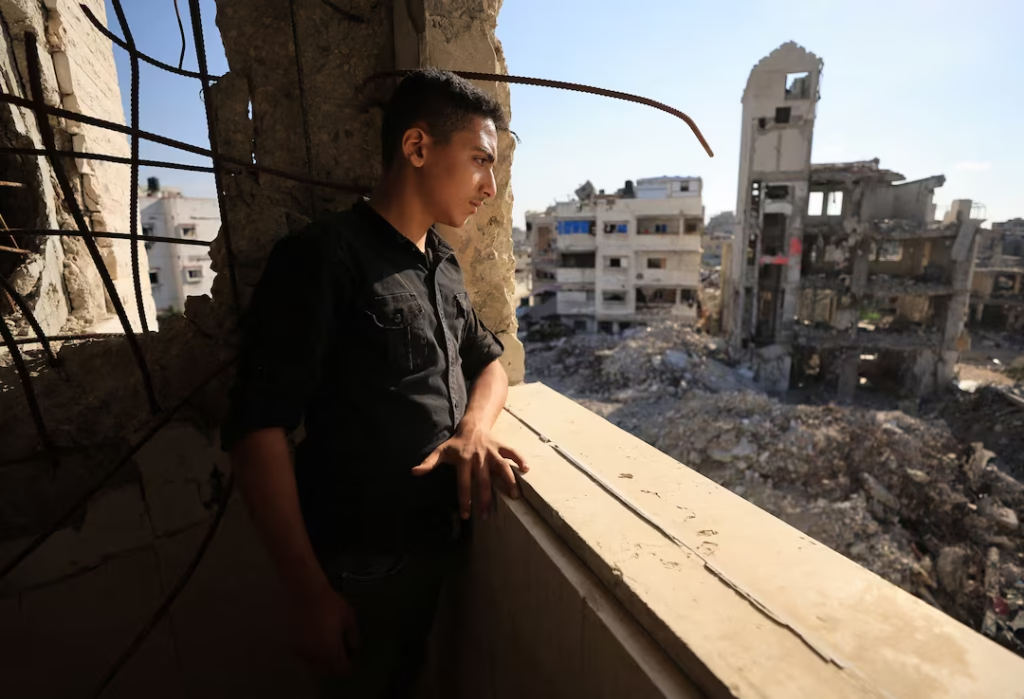
Gaza Herald — Omar Al-Hassaina was forced to leave the Gaza Strip for the Egyptian capital, Cairo, after an Israeli airstrike claimed the lives of most of his family members. Three years into the war, he remains in Cairo, waiting for the day the devastated territory regains enough security, stability, and reconstruction to let him return.
Data from Palestinian authorities indicates that Al-Hassaina, 65, is among more than 100,000 Palestinians forced to flee Gaza during the war that erupted following the Hamas-led attack on Israel on October 7, 2023, and who remain unable to return to their homes. Their suffering is not limited to exile and prolonged waiting; many continue to endure the heartbreak of losing loved ones killed in the conflict while longing for their destroyed homes and neighborhoods.
“I left Gaza, yes, and came to Egypt, the land of refuge, but at the same time, this will never be forgotten, my dear brother, it will never be forgotten,” Al-Hassaina said. “I am waiting for the opportunity, waiting for the moment when Gaza stabilizes, so I can go back to my country, become productive once again, and serve as a constructive member of society.”
Little has changed on the ground in Gaza nearly a year after the announcement of a ceasefire that was intended to pave the way for reconstruction under a technocratic government and a political framework leading to a full Israeli withdrawal. Israeli forces continue to occupy over 60 percent of Gaza, conducting near-daily airstrikes, with no clear signs of reconstruction beginning in the foreseeable future.
A Family Devastated in a Single Strike
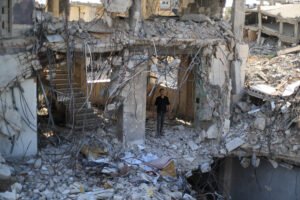
According to Palestinian authorities, approximately 308 members of the Al-Hassaina extended family were killed when Israeli strikes destroyed a complex of residential buildings where they were sheltering in Gaza City on November 22, 2023. Among the dead were Omar’s wife, four of their children, and four grandchildren, including an infant only a few months old.
Today, Omar’s eldest son, Mohammed, lives in Cairo with his four children, along with the widow of another son and her daughter, as well as several of Omar’s brothers. One of his daughters was transferred to Turkey for medical treatment accompanied by her husband and their six children, while another daughter remains in Gaza with her five children, despite her husband having been killed in the same attack.
In August, Al-Hassaina watched a video clip from his residence in Cairo showing relatives burying 112 family members, including his wife, children, and grandchildren, after their bodies were recovered from beneath the rubble. Dozens of other bodies remain trapped under the debris, inaccessible due to ongoing hazards.
Back in Gaza, Al-Hassaina owned a business selling firefighting and safety equipment. Some of his inventory survived the destruction, and he periodically sells portions of it to cover his living expenses in Cairo, where he has since remarried.
Obstacles to Return and the Future of Gaza
All Palestinians who exited Gaza underwent security screening by both Israeli and Egyptian authorities before travel, yet many now find returning extremely difficult. While several Israeli political figures have advocated for policies encouraging the outward migration of Gaza’s population and restricting the return of those who left, roughly 7,000 displaced individuals have managed to return home. Al-Hassaina expresses confidence that Egypt will resist any large-scale permanent displacement of Palestinians from the Strip.
Nevertheless, a mass return of displaced Gazans appears unlikely in the near term until a clearer vision emerges regarding the territory’s governance and political future.
“If Gaza recovers, if there is an international agreement, a comprehensive protective framework for the Palestinian people, and reconstruction begins… why would I delay?” Al-Hassaina asked. “I won’t delay. I will go back and rebuild… We will never lose hope.”

