Gaza Herald — While the U.S.-established “Board of Peace” intensifies its public media campaign against the United Nations Relief and Works Agency for Palestine Refugees (UNRWA), declaring a refusal to deal with the agency in full alignment with the Israeli position, field evidence and private disclosures reveal a starkly different reality behind closed doors.
Between sharp public statements attempting to frame a post-war Gaza managed by foreign contractors and new alliances, and persistent warnings from UN officials that replacing Gaza’s largest humanitarian lifeline is clinically impossible, a profound political and logistical contradiction continues to unfold at the expense of displaced civilians.
Hamas Statement: “Alignment with Occupation and a Machine for Distraction”
The Hamas Movement affirmed that the “Board of Peace” announcement disavowing UNRWA represents complete alignment with Israeli efforts to dissolve the issue of Palestinian refugees. The Movement noted that the repeated operational struggles of the Board and its administrative committee have driven them into a PR campaign designed to exchange self-praise while maintaining continuous attacks on UNRWA.
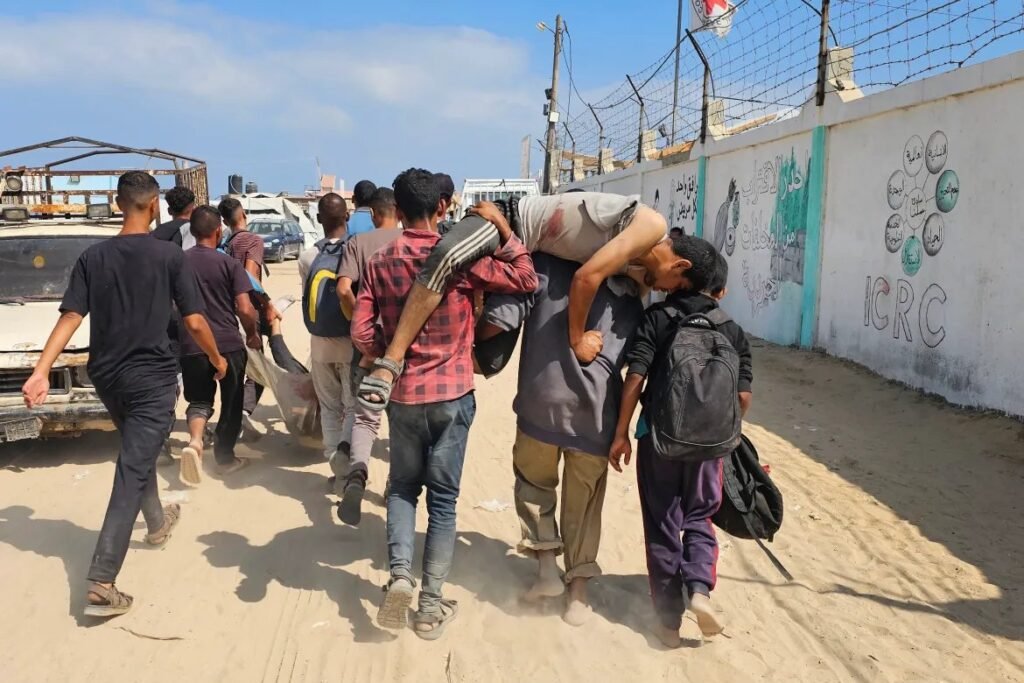
Hamas described the situation as “a machine for extracting funds, propaganda, and deception” that promotes non-existent relief and reconstruction plans on the ground. According to the group, the actual reality remains defined by U.S. military personnel operating alongside local collaborators and foreign mercenaries under Israeli control, while displaced Palestinians remain left to suffer in the open.
Behind Closed Doors: Secret Contacts Between the Board of Peace and UNRWA
Directly contradicting public narratives, private communications and documents obtained by the Associated Press reveal that officials from the Board of Peace have held at least three secret meetings with UNRWA leadership since the implementation of the ceasefire.
In his first interview since stepping down on March 31, former UNRWA Commissioner-General Philippe Lazzarini stated that Ali Shaath, head of the Palestinian technocratic committee designated to manage Gaza, expressed an explicit desire to utilize UNRWA’s vast infrastructure and personnel. Lazzarini recalled Shaath telling him directly, “I don’t know how I will succeed without you.”
Official UN records from a January meeting in Cairo further show that Shaath praised the agency’s programs and acknowledged that his committee’s operations would rely heavily on UNRWA’s established framework, while a Board official acknowledged that discussions centered on adapting UNRWA’s operations rather than eliminating its workforce.
UNRWA: The Essential Infrastructure Nobody Can Replace
These behind-the-scenes consultations highlight an inescapable structural truth: completely dismantling UNRWA is practically impossible, especially as reconstruction efforts stall and Israel continues to prevent the Palestinian technocratic committee from physically entering the Gaza Strip.
UNRWA remains the sole humanitarian body with the scale and operational reach required to sustain daily life across the enclave, employing approximately 11,000 local Palestinian staff members who form the backbone of Gaza’s essential infrastructure. The agency directly oversees roughly half of the enclave’s public healthcare system by delivering over 14,000 medical consultations daily, manages basic education and literacy programs for nearly 280,000 children alongside temporary support centers for another 60,000, and operates and maintains the critical water, sanitation, and hygiene networks that serve more than one million residents.
Political Pressures and Conflicting Global Stances
Israeli authorities continue to press for the complete removal of UNRWA, citing allegations of infiltration by armed groups, claims that the International Court of Justice and independent UN investigations noted were presented without conclusive written proof.
While Israeli foreign ministry and technocratic committee spokespeople declined to comment on the secret talks, international diplomats and regional ministers, including Jordanian Foreign Minister Ayman Safadi during the UN General Assembly, have forcefully reiterated that UNRWA remains an irreplaceable pillar of humanitarian stability in Gaza. They warn that politically motivated attempts to erase the agency will trigger catastrophic fallout across the broader Middle East.