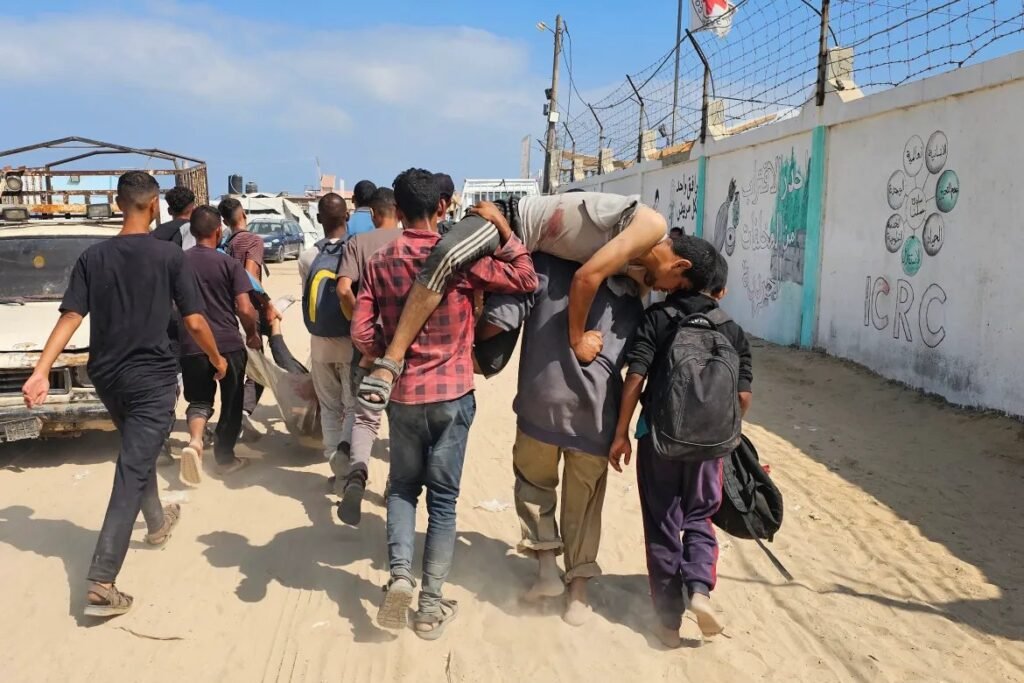
Gaza Herald — In Gaza, remaining on the land has become an act performed through the smallest details of everyday life. A farmer plants seeds beside territory controlled by Israeli forces. A family pitches a tent beside the ruins of its home. Children queue for water and return to makeshift classrooms. Bakers produce bread, community kitchens prepare meals, and Palestinians abroad register to return to a territory from which senior Israeli officials are openly encouraging them to leave.
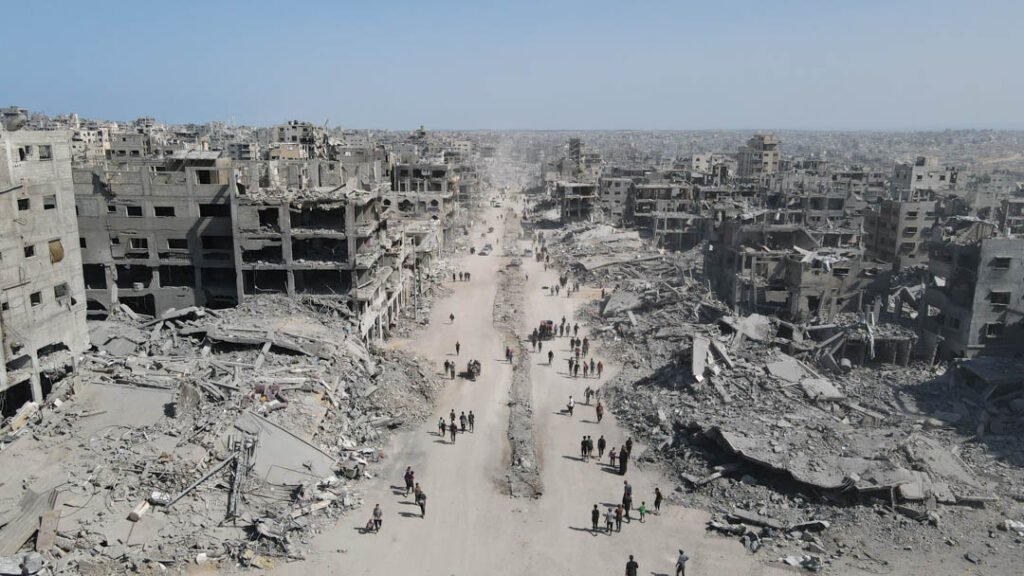
Nearly three years of devastating war have transformed Gaza physically. Homes and infrastructure have been destroyed on an enormous scale, most of the population has been repeatedly displaced, agricultural land has been devastated or rendered inaccessible, and basic systems for water, healthcare and education have been severely damaged.
Yet the destruction has produced something Israeli displacement proposals repeatedly underestimate: Palestinians continue trying to make life possible on the same land.
That determination has assumed greater political significance as Israeli officials revive proposals for the large-scale departure of Gaza’s population. National Security Minister Itamar Ben-Gvir recently presented a seven-year programme aimed at facilitating the departure of approximately 1.86 million Palestinians, while Israeli War Minister Israel Katz renewed his support for what Israeli officials describe as “voluntary migration”.
For Palestinians living among Gaza’s ruins, however, the question is not merely where they can survive. It is whether survival should require surrendering their homeland.
“We Don’t Leave the Place Where We Grew Up”
Abu Mohammed Raed now lives in a tent surrounded by destroyed buildings in central Gaza City. Around him, children wait for water and families cook beside temporary shelters where homes once stood.
Still, he does not speak about leaving.
For Raed, Gaza is bound to his family across generations. Mohammed Abu al-Qumbuz, another displaced Palestinian, expresses the same attachment more directly: his children grew up here, as did their parents and grandparents. Destruction, he argues, does not extinguish that relationship.
Their testimonies reveal something easily lost in discussions of Gaza as a humanitarian emergency. A homeland is not interchangeable with another piece of territory. It is composed of homes, streets, cemeteries, schools, family histories and memories. Even when a house disappears, the relationship with the place where it stood can remain.
This helps explain why hundreds of thousands of Palestinians returned to northern Gaza when movement became possible in early 2025, many knowing that they would find their homes damaged or completely destroyed. They returned before reconstruction because, for many, recovering the land came before recovering the house.
The same dynamic continues today.
Planting Seeds Where Leaving Would Be Safer
Perhaps nowhere is Gaza’s attachment to land more tangible than in its devastated agricultural sector.
Farmer Khaled al-Astal continues cultivating land close to the so-called “Yellow Line”, despite the dangers associated with working near areas under Israeli military control. His reasoning is simple: whatever land remains accessible must continue to be cultivated.
Behind his story is an extraordinary attempt to preserve Gaza’s agricultural memory.
Before the war, 71-year-old farmer Salama Muhanna managed a seed bank in al-Qarara containing roughly 70 tonnes of seeds representing 42 local crops. The facility was destroyed during the war.
Muhanna and other farmers did not abandon the project. They began gathering seeds again and have reconstructed a much smaller collection of local varieties in a makeshift tent in Deir al-Balah.
The sacks inside that tent represent more than agriculture. Local seeds can be harvested, preserved and replanted, allowing farmers to reproduce crops without becoming entirely dependent on imported seed supplies. Preserving them therefore preserves part of Gaza’s ability to feed itself.
The project cannot compensate for the enormous destruction inflicted on Palestinian agriculture, and much of Gaza’s farmland is now inaccessible or dangerous to cultivate. Yet its significance lies precisely in its apparent modesty: after losing a seed bank, farmers built another one; after losing access to fields, they cultivated what remained.
This is sumud stripped of romanticism. It is not the absence of suffering. It is the decision to continue producing life within it.
A Society Rebuilding Daily Life
That struggle extends beyond agriculture.
As of early September, UN humanitarian partners were preparing about 734,000 meals every day through 103 community kitchens across Gaza. Twenty-two supported bakeries were producing around 90,000 bread bundles daily.
These numbers do not represent recovery. They demonstrate the scale of dependency created by the destruction of ordinary economic life. But they also reveal the enormous civilian network required simply to keep society functioning.
The same contradiction exists with water. UN monitoring found that 91% of assessed Gaza households faced moderate to high water insecurity. Families therefore queue for something that should arrive through household taps, while humanitarian workers struggle to maintain wells, pumps and sanitation facilities amid shortages of fuel, engine oil and spare parts.
Women increasingly carry much of this burden. UN Women estimates that approximately 86,000 households in Gaza are now headed by women—nearly one-quarter of all families—after deaths, disappearances, detention, injuries and separation radically altered household structures.
Women who lost husbands or whose husbands remain missing are now simultaneously securing food, finding water, protecting children and trying to hold fragmented families together.
This, too, is Palestinian steadfastness. It is not only refusing a bus or plane out of Gaza. It is keeping a family alive when the systems that once supported ordinary life have collapsed.
Classrooms Among the Ruins
Perhaps the most striking expression of this determination came this September, when hundreds of thousands of Gaza students began returning to in-person education for the first time in nearly three years.
They returned despite UNICEF estimates that approximately 98% of Gaza’s schools have been damaged or destroyed.
For many children, “school” now means temporary classrooms assembled from tents, tarpaulins and whatever materials educators can obtain. Hundreds of thousands have been deprived of consistent classroom education, while thousands of students and hundreds of education workers have been killed.
Yet classrooms reopened.
That matters because rebuilding Gaza is not only about concrete. A society survives through the transmission of knowledge, memory, skills and identity from one generation to another. Every improvised classroom therefore represents an attempt to prevent destruction from stealing not only Palestinian children’s present but their future.
The same logic runs through the seed bank, the bakery, the community kitchen and the family tent. Each is an attempt to reconstruct a fragment of ordinary life before comprehensive reconstruction has even begun.
The Problem With Calling Displacement “Voluntary”
This reality also exposes the central problem with Israeli proposals for “voluntary migration”.
A decision cannot be understood outside the conditions under which it is made.
If a family has lost its home, livelihood, school, hospital and access to reliable water, then offering that family financial assistance to leave Gaza raises a fundamental question: how voluntary is departure when the conditions required to remain have been systematically devastated?
This does not mean every Palestinian wants to stay.
Some Gazans understandably want to leave temporarily or permanently after years of war, bereavement and deprivation. Young people may seek education abroad; parents may seek medical treatment or safety for their children; families may simply feel they can endure no more.
Their choices should not be romanticised or condemned.
But neither should individual desperation be converted into political consent for the mass removal of a population.
Wanting safety is not the same as surrendering a homeland. Seeking medical treatment abroad is not endorsing permanent displacement. Leaving because life has become unbearable is fundamentally different from freely deciding that Gaza no longer matters.
And Palestinians are moving in the opposite direction too. Thousands have returned through the Rafah crossing since it reopened, while Palestinians in Egypt have sought opportunities to return despite the destruction awaiting them.
That fact complicates the assumption underlying displacement schemes: that sufficient devastation will eventually make Palestinians abandon Gaza altogether.
Israel Can Destroy a Home. It Cannot Erase Where It Stood
The struggle over Gaza is therefore increasingly a struggle over permanence.
Buildings can be demolished rapidly; belonging cannot.
A Palestinian family living in a tent beside its destroyed house is displaced, but it has not necessarily surrendered its claim to the neighbourhood. A farmer working a diminished field has lost agricultural capacity, but not his relationship with the land. A child studying beneath canvas has lost a school building, but not necessarily the expectation of a future in Gaza.
This distinction is politically profound.
Physical destruction can change Gaza’s landscape. Permanent displacement would change its demography.
That is why Palestinian return—even return to rubble—carries significance far beyond the humanitarian story. Remaining prevents destruction alone from determining who ultimately inhabits the land.
It also explains why sumud cannot simply be translated as endurance. Endurance suggests passivity. What is happening across Gaza is often active: planting, teaching, cooking, returning, repairing, caring and rebuilding.
None of this diminishes the catastrophe Palestinians are experiencing. Steadfastness should never become an excuse for the international community to expect Palestinians to survive indefinitely under intolerable conditions. People should not have to prove their attachment to their homeland by living without safe water, functioning hospitals or adequate shelter.
The responsibility is not simply to admire Palestinian resilience, but to create conditions in which resilience is no longer required merely to survive.
Yet Gaza continues to demonstrate something that plans drawn up in government offices repeatedly fail to understand.
A homeland is not measured only by the condition of its buildings.
It exists in the farmer who saves a seed because he expects another planting season; in the mother who raises her children beside the ruins because she still calls the place home; in the teacher who opens a classroom beneath a tent; and in the family returning from abroad even when what awaits them is devastation.
Nearly three years of destruction have made Gaza extraordinarily difficult to inhabit. They have not made Palestinians cease to belong there.
And that may ultimately be the greatest obstacle facing every plan designed around the assumption that Gaza can be emptied of its people: Palestinians are not simply surviving on their land. They are continually reconstructing the reasons to remain.