
Gaza Herald — Every evening, as bombs shook southern Gaza and electricity became a rarity, 24-year-old Mahmoud Aldaya would leave his family’s displacement tent searching for something increasingly precious: enough internet signal to submit his university assignments.
Despite studying through displacement and the destruction of Gaza’s education system, Aldaya graduated at the top of his class from Gaza University and secured a scholarship at the University of Limerick in Ireland. But when the new academic year began, he remained trapped in Gaza. Ireland had refused his student visa.
His story exposes another barrier confronting Palestinian students who have managed to preserve their academic ambitions through nearly three years of destruction. After surviving the physical devastation of Gaza’s universities, they increasingly encounter a second wall: immigration systems designed for ordinary circumstances but imposed on people living through extraordinary destruction.
The Administrative Wall
Aldaya is not alone. By August 21, Ireland had refused 103 Palestinian long-stay study visa applications in 2026 while approving just 39, producing an approval rate of 27.5% among decided applications. In 2025, the rate was 83.8%.
Students and their lawyers say applicants inside Gaza are being asked to produce certified bank statements, educational records and evidence of sufficient finances despite the destruction and severe disruption of the institutions normally responsible for providing those documents.
Even challenging a refusal can become an obstacle. Irish visa appeals require original supporting documents to be submitted by post, yet Gaza has no functioning internationally recognised postal service through which students can reliably satisfy that requirement.
The contradiction is stark: Palestinians are expected to meet conventional bureaucratic standards while living in conditions in which the basic infrastructure needed to meet those standards has been devastated.
Penalized for Surviving Destruction
The problem extends beyond Ireland. In Canada, Palestinian students with university offers and scholarships have faced lengthy delays, while biometric requirements create another obstacle for applicants unable to leave Gaza. Canadian authorities themselves acknowledge that many Palestinians have been unable to exit the enclave to provide biometrics and complete their applications.
In the United States, the barrier is even broader. Since January 2026, Washington has suspended visa issuance, with limited exceptions, to people applying using travel documents issued or endorsed by the Palestinian Authority. For Palestinian students relying on those documents, admission to an American university may therefore offer no meaningful route to the classroom.
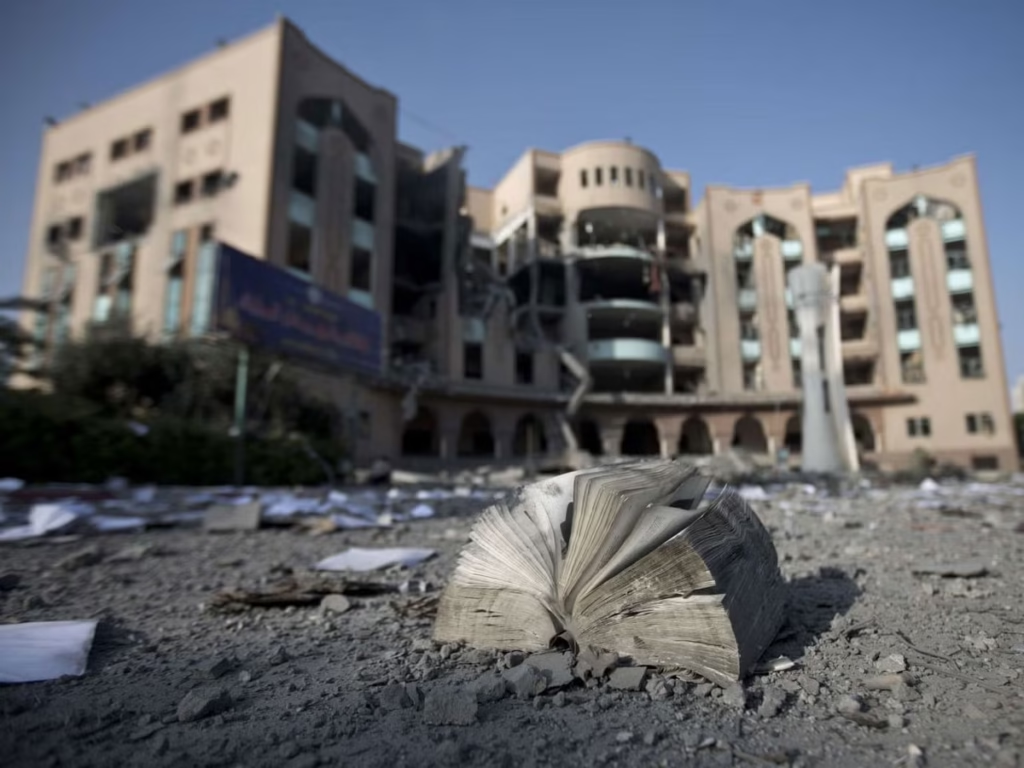
These restrictions come as Gaza’s education system has been devastated. UN figures show that nearly all school buildings have been damaged, while approximately 95% of higher-education campuses have been damaged or destroyed. UN experts have previously warned that the systematic destruction of schools, universities, teachers and students raises serious concerns about “scholasticide.”
Yet students surviving that destruction can still be asked to explain gaps in their education, provide records from devastated institutions or demonstrate financial and administrative stability that the war itself has made extraordinarily difficult.
The result is a cruel paradox: the consequences of Gaza’s destruction become additional obstacles for the Palestinians who have managed to continue studying despite it.
A Second Siege on Palestinian Education
Western governments did not destroy Gaza’s universities, and visa bureaucracies are not equivalent to Israeli bombs. But treating Palestinian students as ordinary applicants while ignoring the extraordinary conditions imposed upon them risks reinforcing the educational devastation they are attempting to escape.
A scholarship means little if its recipient cannot reach the university. An admission letter offers little protection when a student cannot satisfy documentary requirements made nearly impossible by war. Academic solidarity becomes symbolic when the bureaucratic system surrounding it prevents the scholar from entering the classroom.
This is where the idea of a “second siege” becomes meaningful. The first barrier is physical: destroyed universities, displacement, bombardment and closed crossings. The second is administrative: visa refusals, inaccessible biometrics, documentary requirements and immigration rules that frequently fail to account adequately for the conditions under which Palestinian applicants are living.
The effect is to further isolate a generation whose educational institutions have already been devastated.
Palestinian students such as Aldaya have demonstrated extraordinary determination simply by continuing their education. Their ability to study from tents, damaged homes and displacement camps should be recognised as evidence of resilience, not converted into another bureaucratic disadvantage.
If Western governments genuinely believe education is a lifeline for Palestinians, exceptional circumstances require exceptional procedures: flexible documentation requirements, remote alternatives where possible, expedited visa processing and safe mechanisms allowing scholarship students to reach their universities.
Otherwise, Western universities may continue offering Palestinians scholarships while Western governments build administrative walls that prevent them from ever reaching the classroom.
Israel has already devastated much of Gaza’s educational infrastructure. Western governments should ensure their bureaucracies do not help complete the isolation of the generation determined to rebuild it.

