
Gaza Herald — As Israeli occupation forces launched heavy airstrikes and opened fire indiscriminately to cover an operation targeting the head of Gaza’s Internal Security Service, Moein al-Arabid, some 200 children were trapped inside a nearby kindergarten, with their lives suddenly at risk.
The operation unfolded under an intense barrage of Israeli strikes involving dozens of warplanes of different types. The bombardment killed several Palestinians, including children, and wounded many others.
The situation could have turned into a massacre. Kindergarten director Doaa Qdeih found herself trapped with around 200 children as explosions and gunfire shook the area.
In a video recorded during the attack, Qdeih can be seen trying to calm the frightened children while helping move them away from the danger.
“We evacuated the school we were in. Is this the war they say has ended?” she said.
“These are children who want to live in peace and safety. They want to learn. Should they really have to face bombs and explosives?”
Holding On to Education
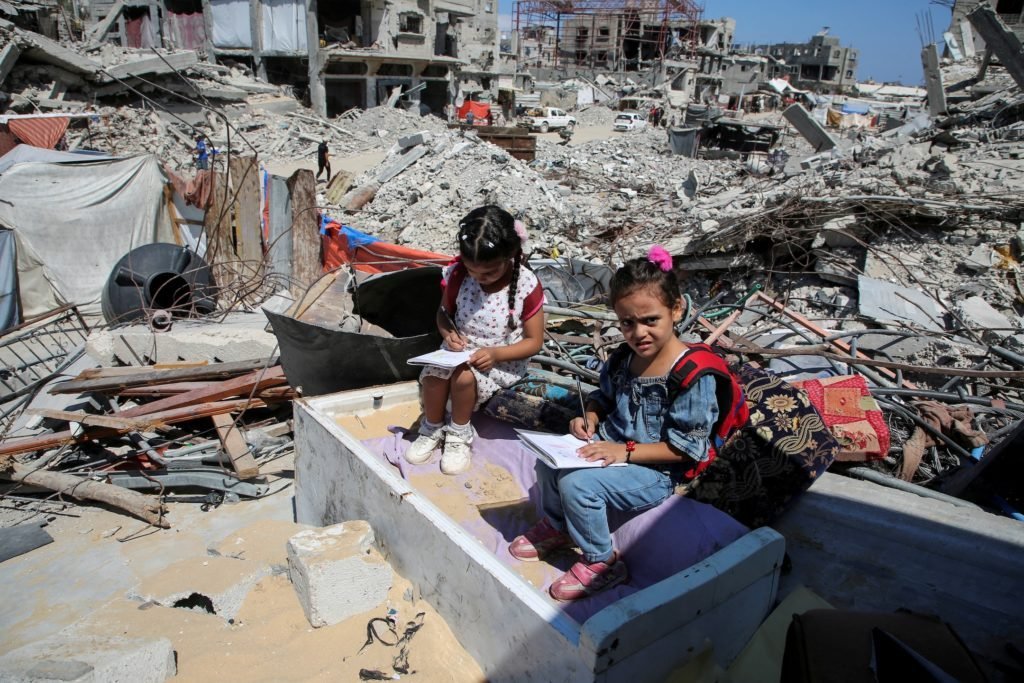
After Israeli attacks destroyed dozens of schools across Gaza, while others were turned into shelters for displaced families, Qdeih launched an educational initiative to keep children connected to learning.
Nearly two years ago, she turned a simple fabric tent in Deir al-Balah, central Gaza, into a classroom, seeking to preserve some form of education for children living through war and displacement.
As she worked to keep education going, Qdeih also sought to place the children as far as possible from areas exposed to direct danger. She eventually opened a kindergarten in the al-Katiba area west of Gaza City, a residential area near the Rimal neighborhood.
The kindergarten was intended to provide children with a place where they could continue learning despite the destruction and displacement surrounding them.
The story quickly drew widespread attention on social media.
Nada wrote, “Terrifying moments for Gaza’s children, who were inside a kindergarten near the site of this morning’s incident in Gaza City. This is how Gaza’s children live; there is no safe place for them.”
Saleha wrote: “The war in Gaza has not ended. The blood of Gaza’s children is mixing with their toys as aircraft randomly bombed the area where the operation took place.”
Aisha said the world “continues pretending that things are getting better, but nothing is normal. People are still being killed, and Gaza is still bleeding. We are tired of this illusion. We are tired of these excuses. How much longer can this continue?”
Another commenter, Kata, wrote: “An Israeli army that targets children is mentally disturbed; the Israeli army is a war criminal.”
Back to Square One in Treating Children’s Trauma
Speaking to the Arabic television program Tawasul, Qdeih recounted what happened during the attack and described the desperate decisions teachers had to make to protect the children.
She said the teachers’ first priority was to get the children away from danger and minimize the harm around them.
The kindergarten includes orphaned children and children who have been injured in the war, many of whom have been struggling with severe psychological trauma.
“Our first thought was to move the children inside the kindergarten, have them lie down and crawl on the ground, and then get them out of the area safely with as little harm as possible,” Qdeih said.
“These children are entrusted to our care. The school itself clearly bears the signs of being an educational institution, but none of that stopped the occupation from carrying out its actions.”
Qdeih said the incident also erased much of the psychological progress the children had made.
She explained that teachers and caregivers had spent three years helping the children cope with the psychological effects of war, only for the latest attack to push many of them back to where they had started.
“We have to go back to square one in treating the psychological effects of the war,” she said.
She concluded with a warning that the reality facing Gaza’s children remains unchanged despite repeated declarations that the war has ended.
“The war has not ended in Gaza. The bleeding continues, and danger is everywhere, especially for children,” Qdeih said.

