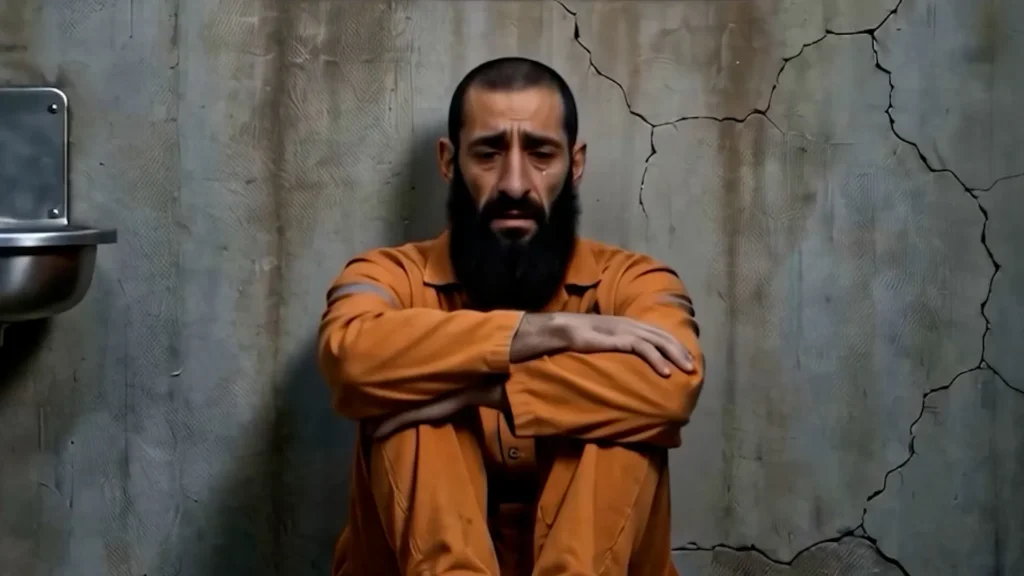
Gaza Herald — When a government minister uses artificial intelligence to celebrate the starvation of prisoners, the line between governance and cruelty disappears. This week, Israeli National Security Minister Itamar Ben Gvir crossed that line publicly. In a video generated by AI and posted to his official channels, he did not deny accusations of mistreatment inside Israeli prisons. He embraced them. With the slogan “We promised, and we delivered,” Ben Gvir turned a policy of deprivation into campaign content. The clip garnered over 2 million views and ignited global outrage, not just because of what it showed, but because of what it admitted.
This is the story of how Palestinian prisoners have been turned from human beings into props in a far-right political performance and how technology is now being used to make that performance go viral.
This is no longer policy. It’s theater. It’s cruelty packaged as a campaign ad.
This morning, Israeli National Security Minister Itamar Ben Gvir posted an AI-generated video to his social media. He was not explaining. He was not making a legal argument. He was celebrating.
The caption attached to the clip left no room for ambiguity: “We promised, and we delivered.”
We promised to starve Palestinian prisoners. And we delivered.
In the video, Ben Gvir appears proud of what he calls the “hardening” policy inside Israeli prisons. The policy is simple and brutal: cut the food. Cut the basic supplies. Make conditions harsher. For more than 9,500 Palestinian prisoners, including 90 women, this is now daily life. And Ben Gvir wants the world to see it, to know it, and to applaud it. The video crossed 2 million views within hours, and the comments section became a battlefield.
This is not a mistake. This is not a misstatement. This is the core of his political brand.
Just 24 hours earlier, Ben Gvir was staging a different scene in the same story. At Damon Prison near Haifa, he entered the cells of Palestinian women prisoners. He walked in with a full security escort, cameras rolling. The women were behind bars. They were isolated. He was not.
He addressed them with degrading language. And yet, the cameras he brought to humiliate them captured something else: their voices. The women spoke about the details of life they have been denied, about food, family visits, and dignity.
Khaled Mahajneh, a lawyer with the Palestinian Prisoners’ and Ex-Prisoners’ Affairs Authority, said the footage showed women “with no fear and no brokenness.” That is the image Ben Gvir did not intend to create.
Here is the contradiction he is trying to sell as strength. He stands protected by armed guards inside a prison, talking down to women who have nothing but their words. They speak. He boasts. They describe deprivation. He calls it an achievement.
What Ben Gvir is doing goes beyond prison administration. He is turning incarceration into a political stage. He is turning suffering into content. And now, with AI, he is giving that cruelty a polished, celebratory look. The goal is transparent: to market himself to Israel’s far-right as the minister who is “toughest on the enemy.” In a crowded field of hardliners, he is competing to be the most extreme.
Using artificial intelligence to produce this video adds another layer. It is not just that he is boasting about starving prisoners. It is that he is using new technology to normalize it, to make it shareable, to make it meme-able. Activists and human rights groups called it out immediately. They said it reflects how central the issue of prisoners has become in Israeli right-wing discourse, not as a humanitarian issue, but as a tool for political mobilization.
When a senior government official documents his own policy of deprivation and posts it with a slogan of fulfillment, he is not denying wrongdoing. He is owning it. He is turning alleged violations of international law into a campaign promise kept.
One activist addressed British officials directly in response to the video: “When Israel tells you it is not starving Palestinians in Gaza, this is proof of intent. They are boasting about it. Now tell me again, why are you arming Israel?” The question cuts to the heart of the international response. Documentation is no longer coming from victims’ groups alone. It is coming from the officials themselves.
Human rights organizations have repeatedly warned about conditions in Israeli prisons since October 2023. Reports have cited reduced food, restricted family visits, solitary confinement, and lack of medical care. The Israeli government denies systematic abuse. But videos like this make that denial harder to sustain. You cannot claim there is no policy of starvation when the minister in charge posts a video celebrating it.
The prisoners themselves have become characters in an election campaign. For Ben Gvir, their suffering is not a problem to solve. It is a message to send. “Look how tough I am,” the video says. “Look what I did for you.” And the audience is not the prisoners, their families, or international law. The audience is the Israeli voter who wants more punishment, more deterrence, and more vengeance.
That is why Damon matters. That is why the AI video matters. Together, they show a pattern. First, the physical intrusion into the private space of women prisoners. Then, the digital production celebrating the broader policy against all prisoners. One is raw and direct. The other is curated and technological. Both serve the same purpose: to project power and to dehumanize.
The international community has a choice. It can treat this as domestic politics. Or it can recognize it for what it is: an open admission of a policy that targets a protected population. More than 9,500 people are in Israeli custody. They have legal rights. They have families. They have names. Reducing them to props in a video does not erase that.
Ben Gvir is not hiding Israel’s vengeful face. He is putting it in 4K, adding music, and asking for shares. But the voices from Damon Prison, the numbers, and the slogan “We promised, and we delivered” do something else. They provide evidence.
The question is no longer about prison policy. The question is about the line between governance and sadism, between security and collective punishment, and whether the world will treat a boast about starvation as just another post, or as what it is: a confession.