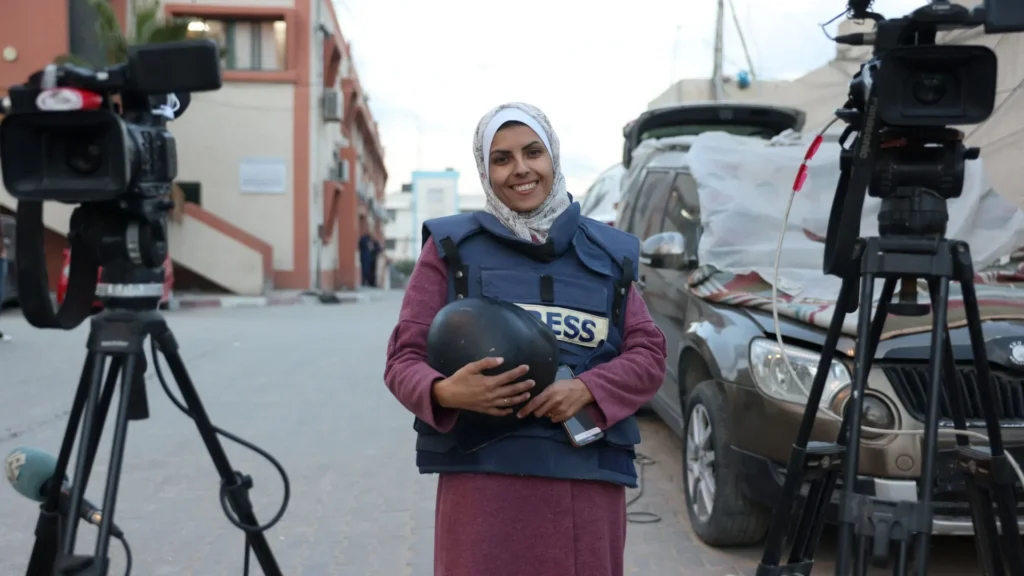
Gaza Herald — A year after Palestinian journalist Mariam Abu Dagga was killed while reporting from Gaza’s Nasser Medical Center, questions surrounding her death remain unanswered. Her killing was part of the mounting toll paid by journalists working to document the war, while calls continue for an independent investigation into the circumstances that led to her death.
A journalist killed inside a hospital
Mariam, 33, was working for Independent Arabia and the Associated Press when she was killed at Nasser Medical Center in Khan Younis.
She was among journalists and medical personnel struck by successive rounds of Israeli tank fire. The sequence of the attacks raised serious questions over whether the incident involved a deliberate second strike on people who had already been targeted.
Mariam’s death left behind her teenage son, whom she had sent to the United Arab Emirates in an effort to keep him safe as the war intensified.
Despite the dangers surrounding her, she continued reporting from Gaza and documenting the realities faced by Palestinians.
A life marked by loss
Mariam’s commitment to journalism came amid profound personal hardship.
In 2024, her mother died of cancer during the war, with access to medical treatment severely disrupted. Mariam had also donated one of her kidneys to her father when he was ill.
Like countless Palestinian families in Gaza, her family experienced repeated displacement and loss as Israeli military operations expanded across the territory.
Mariam understood the risks surrounding her work. She had already prepared her will and was aware of the growing danger facing journalists and medical workers at Nasser Medical Center as Israeli forces moved closer to the hospital.
Yet she continued doing her job.
A journalist who refused to stop
Mariam was described by those who knew her as a devoted journalist who remained determined to tell the story of Gaza despite the dangers.
Her work placed her directly in the path of a war in which journalists have faced extraordinary risks while attempting to document events and provide information to the outside world.
Her death has therefore raised not only questions about what happened at Nasser Medical Center but also broader concerns over the safety and protection of journalists working in Gaza.
Questions surrounding the investigation
The circumstances of Mariam’s death remain contested, and her family and colleagues have continued to seek clear answers.
Detailed findings concerning the incident were presented to the Israeli military, including questions surrounding the sequence of fire at the hospital. The military did not provide substantive responses to the specific findings, saying only that its review remained ongoing through its General Staff Fact-Finding and Assessment Mechanism.
For Mariam’s family and colleagues, an internal military review is not enough.
An independent international investigation is needed to establish what happened, determine responsibility and ensure that the death of a journalist reporting from a medical facility does not disappear without accountability.
Part of a devastating toll on Gaza’s journalists
Mariam was not the only journalist killed or injured while covering the war in Gaza.
At least five journalists were killed during the attack on Nasser Medical Center a year ago, while the Committee to Protect Journalists has documented the deaths of more than 200 Palestinian journalists since the war began in 2023.
The scale of these deaths has placed Gaza among the most dangerous places in the world for journalists.
For Palestinian reporters, the danger is compounded by the fact that they are documenting events in their own communities while living through the same displacement, destruction and loss as the people whose stories they cover.
The importance of independent reporting
Journalists play a vital role in documenting conflicts, particularly when access to information is restricted and international reporters face difficulties entering the affected areas.
Gaza has remained largely inaccessible to international journalists for extended periods, placing even greater responsibility on Palestinian reporters who continue working under extraordinary conditions.
Independent journalism allows the outside world to see what is happening on the ground and gives a voice to civilians whose experiences might otherwise remain undocumented.
A demand for transparency
The circumstances surrounding Mariam’s death cannot be separated from the broader concerns over the safety of journalists in Gaza.
Her family deserves answers. Her colleagues deserve answers. And the public has a right to know what happened to a journalist who was carrying out her work inside a hospital.
An investigation must establish the facts independently, examine the sequence of events and determine whether anyone should be held responsible.
Mariam’s work was built around documenting the reality of Gaza. A year after her death, the responsibility to uncover the truth about what happened to her remains.
She was killed while telling Gaza’s story. Her story should not end without justice.