
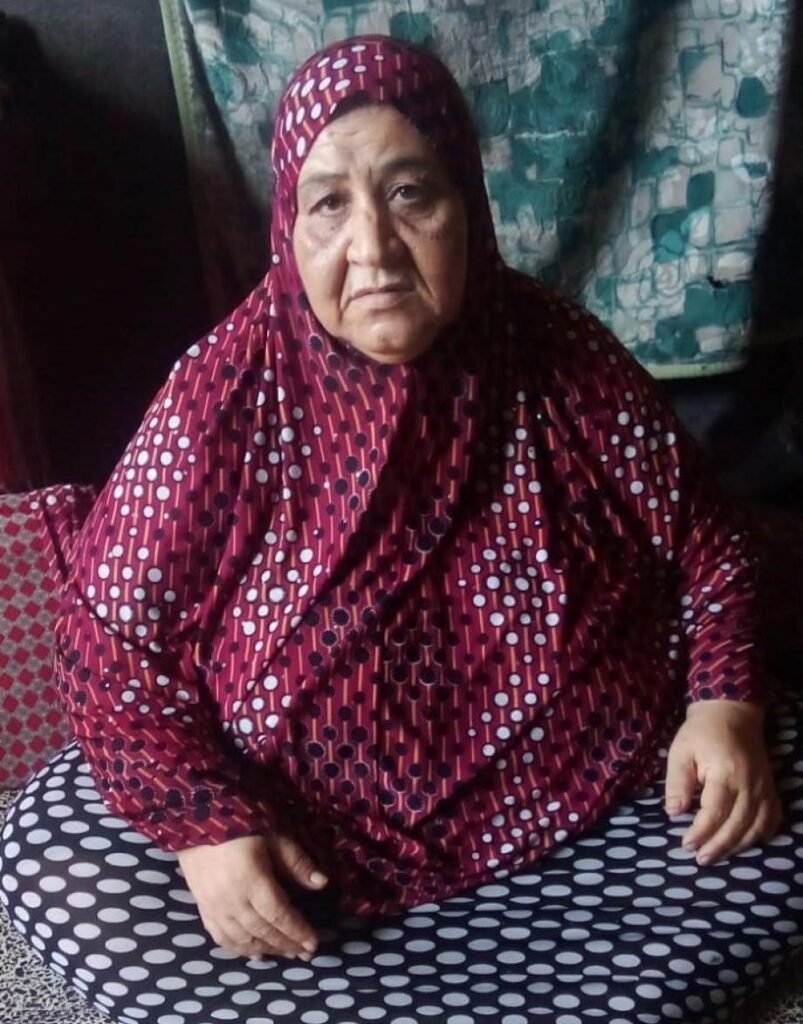
Gaza Herald _For more than a year, Umm Khaled Tafesh has remained confined to the same spot, trapped by illness, displacement and the loss of the wheelchair that once gave her some independence.
Now in her 60s, she lives inside a classroom at Khalil al-Wazir School in Gaza after being forcibly displaced there. Her dreams have been reduced to simple things many people take for granted: stepping outside, feeling the sun and seeing other people.
Before the war, Umm Khaled already faced serious health challenges. She has lived with severe obesity and thyroid-related problems for decades, but she could still move around with the help of her wheelchair.
For her, the wheelchair was more than a medical device. It was her connection to the outside world.
That connection disappeared during the repeated displacement caused by the war.
“I’ve been sitting in the same place for a year and two months. I don’t see anyone,” she said, describing the isolation that has defined her life since losing her wheelchair.
Decades of illness, compounded by war
Umm Khaled says she has struggled with severe obesity for more than 30 years, dating back to her twenties. At one point, she weighed around 162 kilograms, making movement increasingly difficult and forcing her to depend on others for many everyday tasks.
But illness was only part of the burden.
The war brought repeated displacement, disrupted access to basic necessities and ultimately took away the mobility aid that allowed her to leave her surroundings and maintain some independence.
She spent time in a school shelter before returning to Gaza, but the life she once knew did not return with her. During the upheaval, her wheelchair was lost.
“I want to go outside and see people”
For someone able to walk out of a room, Umm Khaled’s wish may sound ordinary.
For her, it has become almost unreachable.
“I want to go out, walk around and see people outside,” she said.
Then she described the reality she has endured: “For a year and two months, I’ve been sitting in the same place. I don’t go anywhere and I don’t see anyone.”
She wants to feel the sunlight, see familiar faces and sit somewhere outside the room, to feel that the world beyond her walls still exists.
Her son has become her lifeline
Without her wheelchair, Umm Khaled has been forced to rely heavily on her family, particularly one of her sons who lives with her.
She has five children, three sons and two daughters. One of her sons lives in southern Gaza, while another, who is unmarried, remains with her and has become her primary caregiver.
“He is the one who takes care of me. He washes me and helps me with everything,” she said.
But caring for someone with severely limited mobility is difficult under any circumstances. In Gaza’s displacement shelters, where privacy, hygiene supplies and adequate facilities are scarce, even basic personal care can become an exhausting daily struggle.
Umm Khaled says she needs continuous assistance with hygiene and caring for her body, needs that would normally be routine but have become complicated by displacement and the loss of her mobility aid.
Pain beyond the loss of a wheelchair
Her suffering does not end with being unable to move.
Spending long periods in the same position and having little opportunity to move has contributed to skin problems, particularly around her lower body and beneath her chest.
She needs regular cleaning and care, as well as creams, powders and other hygiene products to protect her skin.
Yet amid all these hardships, one need stands above the rest: the ability to move.
For Umm Khaled, a wheelchair is not simply a piece of medical equipment. It represents independence, dignity and a way back into the world.
One wheelchair could give her something she has been denied for more than a year: the chance to leave the room, see the sun and feel part of life again.

