
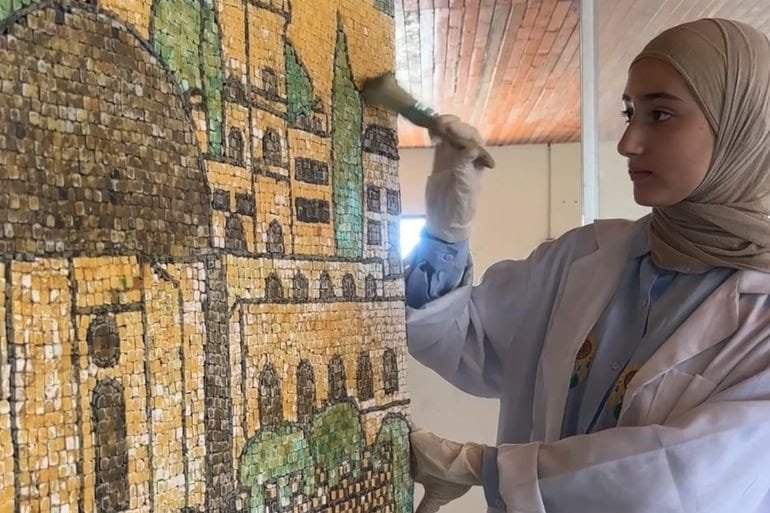
Gaza Herald – Inside a makeshift workshop that miraculously survived the onslaught of the ongoing Israeli genocide, 14-year-old Kinan Mustafa Ramadan meticulously arranges tiny stone fragments onto a mosaic board. Her scarred, disfigured hand moves with deliberate caution, while her leg remains encased in a heavy orthopedic fixation device.
Kinan is not using ordinary art supplies; the stones she carefully places are fragments harvested from the ruins of her own home, shattered by an Israeli airstrike.
Through the ancient art of mosaic, she and dozens of other traumatized children are literally rebuilding the pieces of their broken lives.
 Healing Through Art: Kinan’s Journey
Less than a year ago, an Israeli bombardment completely leveled Kinan’s family home in the Al-Mawasi region of Khan Younis.
The attack left her with catastrophic injuries, forcing her into absolute immobility for six months due to multiple metal plates and rods surgically implanted into her body.
“My hand is permanently disfigured and my leg is still bound to a medical device,” Kinan said, her eyes fixed on her artwork. “But when I work with these stones, when I breathe life into this mosaic, the horrific memories of what happened to me begin to fade, even if just for a moment.”
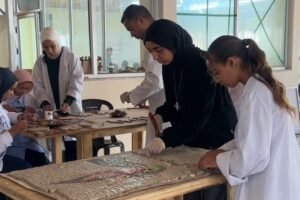
Housed within the Culture and Free Thought Association in the Gaza Strip, this mosaic workshop has become a sanctuary for children and adolescents seeking to reclaim their stolen childhoods.
By reviving an art form that dates back thousands of years, these young Palestinians are turning the literal remnants of the genocide into timeless statements of cultural survival.
 Preserving Palestinian Identity Amidst Genocide
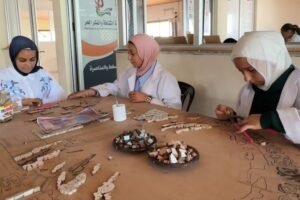
After being forced to shut down due to the intense bombardment, the association successfully reactivated the workshop to provide a safe space for psychological relief and artistic expression.
Mohammad Abu Lahiya, a prominent Palestinian fine artist and the workshop’s supervisor, conducts intensive training sessions to teach the children the complex precision required for mosaic crafting.
“This art form requires immense patience, precision, and months of dedication,” Abu Lahiya explained. He emphasized that traditional Palestinian heritage remains the beating heart of the children’s creations.
The young artists vividly render scenes of Palestinian life before the 1948 Nakba, immortalizing indigenous women in traditional embroidery, hardworking farmers, ancient olive trees, and the sea of Gaza.
“Mosaics defy time,” Abu Lahiya added. “These murals will endure for decades, preserving our cultural memory even under the harshest conditions of erasure.”
Creating Beauty Out of Defiance and Scarcity
The continuation of this artistic defiance faces severe obstacles due to the suffocating, weaponized Israeli blockade. Raw materials are almost entirely nonexistent, forcing the artists to innovate at every single stage of production.
For 15-year-old Inaya Abu Hadrous, the workshop is an indispensable escape from the psychological terrors of the relentless airstrikes. Alongside her peers, Inaya works to create new pieces while painstakingly restoring older murals damaged by shelling, despite a severe shortage of tools and pigments.
“We use whatever we can find beneath our feet,” Inaya said defiantly. “Sometimes a piece cannot be completed exactly how we envisioned it because we lack the colors or the materials. But we fight to finish it in the most beautiful way possible, proving that from the ashes of our homes, we can still create life.”

