
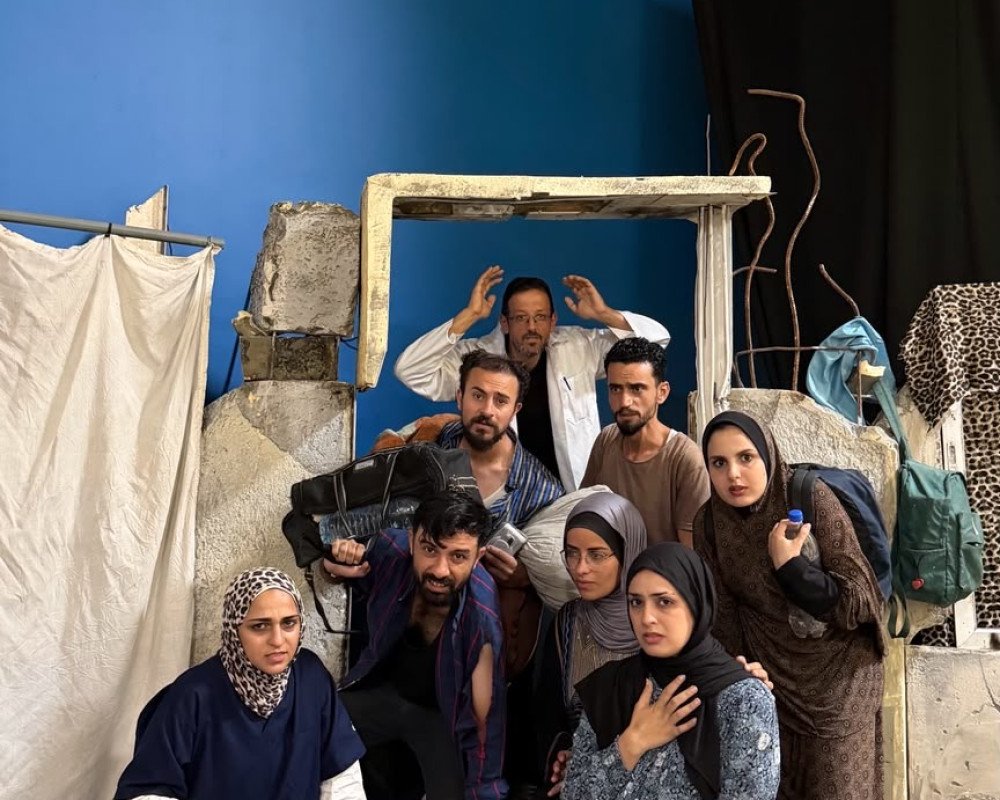
Gaza Herald _ In a displacement camp, a piece of fabric becomes a curtain, an empty can of peas is transformed into a puppet, and a narrow dirt street or patch of open ground serves as a stage. With Gaza’s theatres, cultural centres, and performance spaces systematically destroyed or severely damaged by bombardment, Palestinian artists are rebuilding their craft using whatever materials remain.
Theatre has not disappeared from Gaza. Instead, it has shifted its setting, its form, and its fundamental purpose, evolving into a vital sanctuary where traumatized children can play, breathe, and express emotion, while offering artists a powerful medium to preserve Palestinian identity, stories, and memory amid displacement and loss.
The central question is no longer simply where Palestinian performers can stage their productions, but how cultural expression can survive when the physical stage itself has been targeted and destroyed.
For actor and drama trainer Tamer Najm, the destruction of conventional venues forced him to seek out new spaces among displaced communities. Working with children in refugee camps, Najm uses theatre-based activities as a form of psychological release, drawing on techniques including Theatre of the Oppressed, puppetry, and psychodrama.
In Gaza today, Najm explains, theatre is no longer merely an artistic performance; it has taken on a critical therapeutic role. It provides children living under intense trauma a chance to release fear, anger, and grief through movement, play, and sound.
“I do not claim that we achieved complete recovery—that is impossible after two years of destruction,” Najm says. “But we gave children a moment to breathe amid the rubble.”
For Najm, the survival of theatre demonstrates the profound adaptability of Palestinian culture. A stage can become a tent, and a theatre hall can become a street, but the purpose remains unchanged: creating a small opening toward life and hope for children living through war.
Director Mehdi Karira also refused to let the destruction of his home and workshop end his artistic mission. With conventional theatre equipment gone, he began transforming discarded household items into hand-carved puppets, turning empty food cans and cardboard boxes into characters with distinct personalities.
Working alongside his children and members of the Khuyout troupe, Karira staged puppet performances for displaced children across the camps, where surrounding families gathered to share rare moments of laughter and relief.
“Death is present everywhere in Gaza, but I believed we had to keep working and make people happy, even if death came while we were laughing,” Karira says.
Karira treats his puppets as living characters rather than simple objects, bestowing each with its own presence. The puppets fashioned from discarded food tins serve as a metaphor for Gaza itself: even from the debris of destruction, Palestinians turn scrap into something that creates life, imagination, and defiant hope.
For artist and director Raafat al-Aydi, theatre has never been defined solely by a physical stage, complex lighting, or scenery. He describes it as an unconfined space shared between performers and audiences, a place where voices meet and collective stories endure.
Before the war, Gaza’s theatre scene had been active despite limited resources and a suffocating blockade, with performances routinely staged in schools, streets, and community centers. The war took a devastating toll on the artistic community, resulting in the deaths of prominent artists, mass displacement, and the destruction of cultural spaces.
Yet performers continued taking their work directly to refugee camps and ruined streets.
“Theatre today has become memory and a voice,” al-Aydi says. “It is a way of preserving people’s dreams, names and stories. Sometimes, simply having an actor tell a story inside a tent is an act of resistance.”
Despite losing their traditional venues, Gaza’s audience has remained steadfast and present, which al-Aydi says places an even greater responsibility on artists to help people find hope and imagine a future beyond the devastation surrounding them.
Gaza’s theatrical tradition did not begin with the current war. Documented theatrical activity in the Strip dates back to 1911, when Shakespeare’s Hamlet was notably performed on a stage in Gaza, establishing a deeply rooted cultural tradition that initially relied on passionate amateur performers and translated works.
Over subsequent decades, Gaza developed a thriving national theatrical movement. During the 1990s in particular, several influential groups emerged, including al-Shumou’, al-Amal for Art and Theatre, Hanadela, and the al-Karama Complex, relying heavily on personal initiative and scarce local resources.
Ali Abu Yassin, director of the al-Bayader Association for Theatre and Arts, stresses that Palestinian theatre has always persisted despite extreme adversity.
“Theatre did not begin with the current war,” Abu Yassin says. “It was never easy or surrounded by roses. It has always moved between struggle and joy, happiness and grief.”
Abu Yassin notes that while theatre requires stability to fully develop, pointing to how Palestinian productions actively participated in regional and international festivals before the blockade, its infrastructure has been repeatedly damaged during successive wars.
Among the landmark works associated with this tradition are Gaza Monologues, created following the 2008–2009 war, and The Cage, produced after the 2014 war and later translated into several languages for the Edinburgh Festival. Abu Yassin also wrote Gaza: Milk of Sorrows, alongside other Palestinian productions exploring historical memory and political divisions.
Theatre, Abu Yassin argues, possesses a unique ability to preserve collective memory, from works addressing the 1948 Nakba to modern stagings of Romeo and Juliet in Gaza that confronted political division and called for national unity.
“Theatre in Gaza is not a luxury,” Abu Yassin asserts. “It is an act of life, a message of resilience and pride. It is a space for expression and preserving memory. It confronts bombing and destruction with laughter and storytelling, giving people the feeling that they still exist despite everything.”
Ashraf Sahweil, director of the Gaza Center for Culture and Arts, explains that the systematic destruction of cultural infrastructure has forced artists to pioneer entirely new approaches. Theatre of the Oppressed, street theatre, and puppet performances have become primary mediums because they require no conventional stages, specialized equipment, or formal venues.
These flexible forms have become the only practical options remaining after Gaza’s cultural infrastructure was devastated. Sahweil points to the destruction of major cultural landmarks over the years, including the Palestinian Red Crescent Theatre in 2008, the al-Mishal Cultural Centre in 2018, the National Library, and the landmark Rashad al-Shawa Cultural Centre.
The result is a landscape stripped of physical venues capable of supporting regular productions. Yet theatre in Gaza remains completely free, open, and accessible to the public, offered not as a commercial product tied to ticket sales, but as an essential cultural right and human need.
In Gaza, theatre did not end when its buildings disappeared; it moved into refugee tents, open streets, and small spaces between displaced families. Puppets crafted from food tins and cardboard now share the stage with oral histories told to ensure that memories are not erased by war.
Through every performance, artists offer children brief moments of laughter while preserving the names, experiences, and history of a society living amid devastation. The destruction of Gaza’s physical theaters represents far more than the loss of concrete buildings; it is the loss of spaces that carried generations of collective heritage.
For the artists who persist in creating, performing, and telling stories among the rubble, keeping theatre alive is an indispensable effort to keep that memory alive until Gaza’s stages can be rebuilt, its audiences can return to their seats, and Palestinian culture can reclaim a home of its own.

