
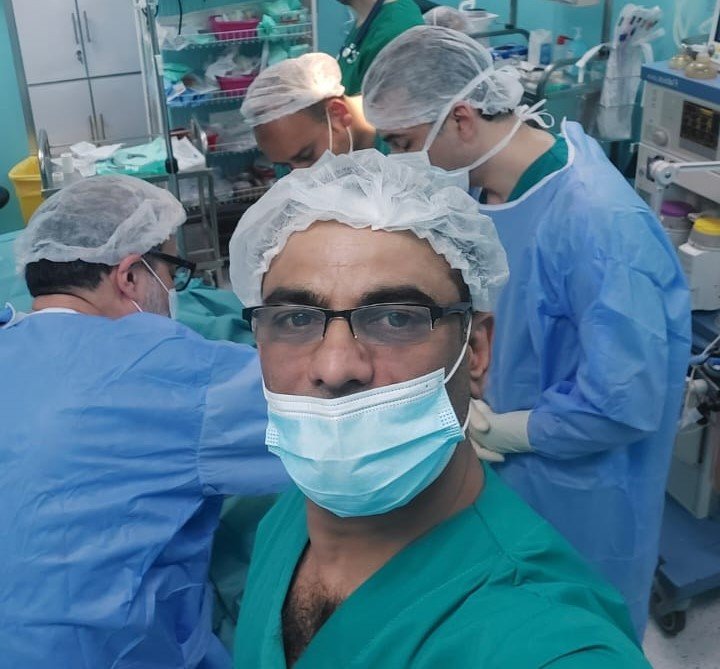
Gaza Herald – After five days of anxiety and anticipation, Manar was surprised to see her husband, plastic surgeon Dr. Medhat Seidem, unexpectedly return home. The doctor had been on duty at Al-Shifa Medical Complex but temporarily left work because of a family matter. As the family reunited after days apart, their time together was heartbreakingly brief. Just hours later, Israeli airstrikes shattered the evening, turning his unexpected return into a final farewell.
“He never left his hospital shift,” Manar said. “Except for that day.” It was October 13, 2023, the eighth day of Israel’s genocidal war on Gaza.
Dr. Seidem, a leading specialist in Al-Shifa’s burns unit, had returned home after escorting his sister, who had been forcibly displaced from Gaza City’s Zeitoun neighborhood, to their family home in the same building where he lived in Tel al-Hawa.
Recalling the day, Manar says with a trembling voice, “His work was based on hospital shifts. During the war, he stayed at the hospital for several days because he feared that if he came home, he wouldn’t be able to find transportation back.”
His absence weighed heavily on the family as Israeli missiles rained down on Gaza. The days passed slowly for Manar and their children, Mahmoud, Mena, Maram, and Malak. During that time, they stayed connected only through intermittent phone calls.
“We suffered and worried about him,” she says. The children, accustomed to their father’s long hospital shifts, were not prepared for his absence amid a genocidal war.
Despite her fear, Manar never asked him to stay home.
“His place was with the wounded,” she recalls saying. “If every doctor stayed home out of fear for their family, who would save the people?”
The Last Dinner
Earlier that afternoon, Dr. Seidem called his colleagues at Al-Shifa and informed them that he was exhausted and would not return to the hospital. Manar did not know this.
When she called to check on him, she was surprised when he answered, “I’m home.”
She asked how he had left work, and he explained that he had taken his sister to the family home and was spending a little time with his parents.
His parents lived on the lower floor of the building, while Manar and their children lived on the top floor. Shortly afterward, he came upstairs to their apartment, where Manar was hosting her own displaced family after Israeli threats forced them to flee the residential tower where they had been living.
He sat with them for a while and spent time repairing LED lights during one of Gaza’s many power outages.
The doctor moved between his family’s apartment and his own. After dinner, Israeli aircraft suddenly bombarded the residential building with three consecutive missiles, hitting its foundation and reducing the four-story building to rubble without any prior warning.
“We were sitting together before the strike,” Manar recalls. “It was completely dark, and we couldn’t see anything.” She explains that whenever nearby bombardments occurred, her husband would usually step onto the balcony to determine where the strike had landed. He did the same that night, believing the attack had hit a neighboring building, not their own home.
Dr. Seidem was killed alongside 22 members of his extended family and displaced relatives sheltering in the building. Manar, her children, and several relatives were pulled alive from beneath the rubble, while one of her sisters was also killed.
Among those killed were Dr. Seidem’s mother, his brothers, their wives and children, his sister and her children, as well as his maternal uncle’s wife and her children.
A Passion for Medicine
Dr. Seidem was 47 years old when he was killed. He left behind his wife and four children, who had always been the center of his life.
His eldest son, Mahmoud, is now taking his secondary school examinations. Twins Mena and Maram are in the eleventh grade, while the youngest, Malak, is in sixth grade.
Having survived beneath the rubble, the family continues to carry the values and dreams he instilled in them. He encouraged his children to pursue education with dedication and inspired Mahmoud to follow his path into medicine.
“Mahmoud has loved medicine since he was a child,” Manar says. “Watching his father work inspired him. Today, he hopes to study medicine and continue the journey his father began.”
For Dr. Seidem, medicine was never just a profession; it was a way of life.
He maintained close ties with his extended family and was deeply involved in their daily lives. Whenever anyone became ill or needed medical advice, he was always the first person they turned to.
“Everyone loved him,” Manar says. “He was social, generous, and always willing to help or give his time to anyone who needed him.”
An Irreplaceable Loss
At Al-Shifa Hospital, his colleagues still remember his calm presence.
Dr. Mohammed Abu Salmiya, Director-General of Al-Shifa Medical Complex, describes his late colleague as “one of the finest people I have ever known,” praising both his professionalism and the respect and affection he earned from everyone around him.
He says Dr. Seidem’s killing was a devastating loss for the hospital’s plastic surgery and burns department, which had only a handful of specialized physicians.
Today, Dr. Medhat Seidem remains vividly present in the memories of his family, though absent from the home that will never be the same. At Al-Shifa Medical Complex, his colleagues continue to remember a doctor whose compassion and dedication left a lasting mark long after his final shift ended.

