
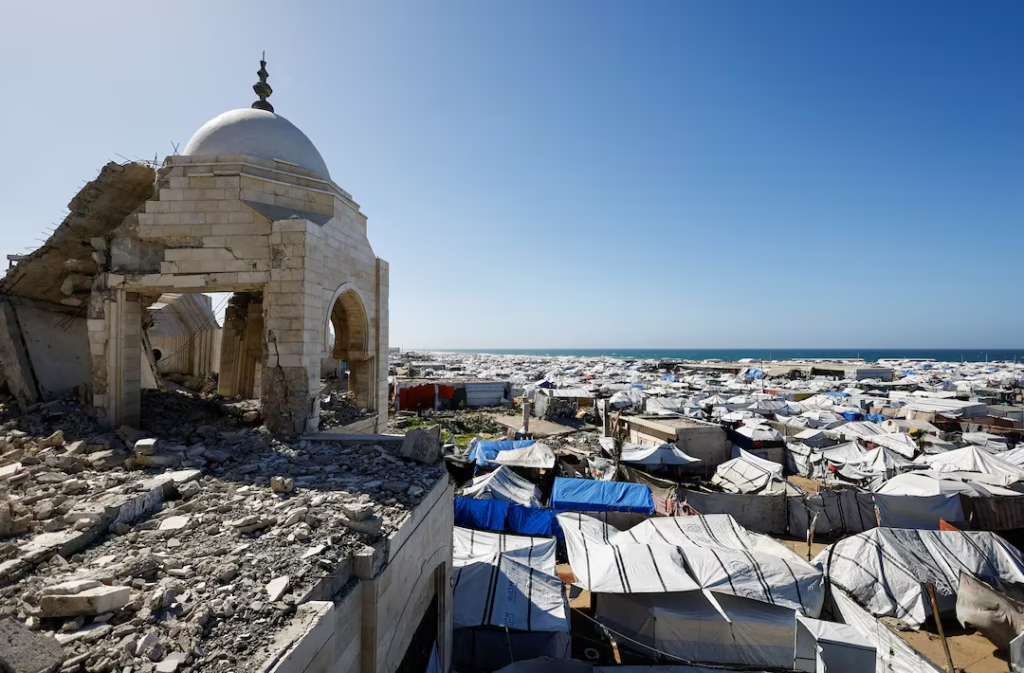
Gaza Herald _Besides causing immense human suffering, Israel has destroyed museums, religious buildings, historic artefacts, and archaeological treasures.
The devastation of Israel’s war on Gaza has not spared the besieged strip’s cultural heritage and museums, mosques, churches, and archaeological sites have been destroyed or heavily damaged.
As of September, Unesco confirmed damage to 69 cultural heritage sites since the war started on 7 October 2023.
These include 10 religious sites, 43 buildings of historical and artistic interest, two repositories of movable cultural property, six monuments, one museum, and seven archaeological sites.
Unesco told Middle East Eye that its preliminary assessment using satellite imagery shows that out of these sites, 29 per cent (20 sites) appear destroyed, 20 per cent (14 sites) severely damaged, and 51 per cent (35 sites) moderately damaged.
The UN agency said that it has only been able to conduct remote assessments of the damage due to the war. That could mean the extent of the damage on the ground may be more severe.
Earlier this year, reports surfaced confirming that Israel had also looted Palestinian artefacts in Gaza.
Researchers at Birzeit University in the occupied West Bank accused Israeli forces of looting more than 3,000 artefacts from Gaza’s Al-Israa University earlier this year before demolishing the site to cover up the theft.
Today, Israel’s military campaign has been so catastrophic that Gaza’s urban landscape has become nearly unrecognizable.
Gaza, situated between Egypt and the Levant, has historically served as a crossroads for empires, with each leaving its mark.
The cultural remnants of ancient civilizations, such as those left by Egyptians, Assyrians, Romans, Christians, and Muslims, are either destroyed, damaged, or at risk.
“This cultural erasure is a deliberate part of the Zionist project, aiming to disconnect the Palestinians from their historical and cultural roots while promoting a narrative that denies Palestinian history altogether,” said Dr Yakoob Ahmed, an Ottoman historian, speaking to MEE.
He warned that Israel is carrying out “cultural genocide,” erasing the past and the potential for future generations to maintain their heritage.
Omar Abd Al Hakem Hamad, a Palestinian writer who was forcefully expelled from his home in Beit Hanoun in northern Gaza believes Israel’s aim is to erase all Palestinian connections to the land.
“Israel deliberately targets and destroys all landmarks related to the Palestinian people’s rightful claim to Palestine, attempting to erase and obliterate Palestinian identity,” said Hamad.
“Israel employs all possible means, both strong and subtle, to erase anything connected to the spirit of the Palestinian people and to undermine any argument or means for us to defend ourselves,” he added.
Omar has lost his business and seen countless family members and friends killed by Israel’s year-long war but is adamant that Palestinians will rebuild what Israel is seeking to erase.
“We will tell our children and future generations all that they have done to us. A cultured, vengeful Palestinian generation will rise, holding a pen in their left hand to expose the occupation and a rifle in their right hand to fight and take revenge against this vile Zionist enemy,” he told MEE.
What follows is a summary of some of the historic sites that have been destroyed or damaged in the last year.
Mosques
The Israeli army has razed 814 of Gaza’s 1,245mosques and severely damaged 148 since October 2023, Gaza’s Ministry of Religious Affairs said earlier this month.
Destroyed mosques include the Othman bin Qashqar Mosque in Gaza City’s Zeitoun neighborhood.
Built in 1220 at the site where Prophet Muhammad’s great-grandfather is believed to have been buried, the site was destroyed in an Israeli air strike on 7 December.
The Great Omari Mosque, a cherished landmark in Gaza and one of the oldest mosques in the region, was largely destroyed by Israeli bombardment on 8 December, 2023.
Originally built in the early seventh century, the mosque was named after Umar ibn al-Khattab, the second caliph of Islam and a successor to the Prophet Muhammad.
The mosque’s elegant design featured white stone, pointed arches, and a tall octagonal minaret encircled by a carved wooden balcony, topped with a crescent.
Early during the war, Israeli forces targeted the Sayed al-Hashim Mosque, which featured an open courtyard surrounded by four canopies.
Inside the western section of the mosque was the tomb of Hashim bin Abdul Manaf, the grandfather of the Prophet Muhammad, who passed away in Gaza during a summer journey.
Originally built by the Mamluks, the mosque was restored in 1850 by the Ottoman sultan, Sultan Abdumecid I.
Under the 1954 Hague Convention for the Protection of Cultural Property in the Event of Armed Conflict, which Israel ratified, nations are committed to safeguarding cultural sites during conflicts.
Israel has largely disregarded this commitment.
Churches
The Gaza Strip’s ancient churches have not escaped the fallout of Israel’s military campaign and since the conflict began, all three of Gaza’s churches have been struck and damaged by Israel.
Dating back to the fifth century, the Greek Orthodox Church of Saint Porphyrius is one of the oldest places of worship in Gaza and is considered to be one of the oldest in all of Christendom.
It dates back to around 407CE and was converted into a mosque in the 7th century before being restored to its earlier status by crusaders in the 12th century.
The church was damaged during a deadly Israeli air strike on the adjacent 141-year-old Ahli Baptist Hospital, the oldest hospital in the strip.
At least 18 Christian Palestinians were killed and dozens wounded following the attack on 19 October 2023.
The Greek Orthodox Patriarchate of Jerusalem said the targeting of the church “constitutes a war crime”.
Its neighboring Ottoman-style Katib al-Wilaya Mosque, built in the 15th century, also sustained damage in the same attack.
Saint Porphyrius was targeted again on 30 July of this year, in an attack described as a “crime against religions,” by Ismail Thawabteh, director of Gaza’s government media office.
Following the 2024 attack, the World Council of Churches (WCC), of which the Church of Saint Porphyrius is a member, issued a statement condemning the attack.
There are around 1,000 Christians in Gaza, most of them Greek Orthodox, but the church has been a vital sanctuary for both Christians and Muslims during Israeli assaults on Gaza.

