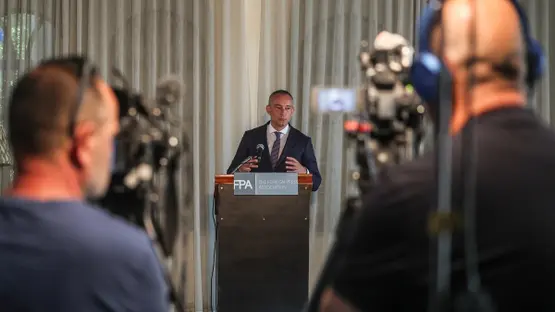
Gaza Herald- The top diplomat overseeing the United States-brokered “ceasefire” in Gaza as part of US President Donald Trump’s International Board of Peace Nickolay Mladenov’s latest remarks on Gaza have sparked growing criticism for a deeply unbalanced approach to the ongoing crisis. While calling on Hamas to disarm, Mladenov failed to clearly identify Israel as the party repeatedly violating the ceasefire agreement through daily military attacks on the Gaza Strip.
This omission is not a minor diplomatic detail. It goes to the heart of how the international community frames the war, assigns responsibility, and ultimately shapes public understanding of what is happening in Gaza.
A Ceasefire Violated Every Day
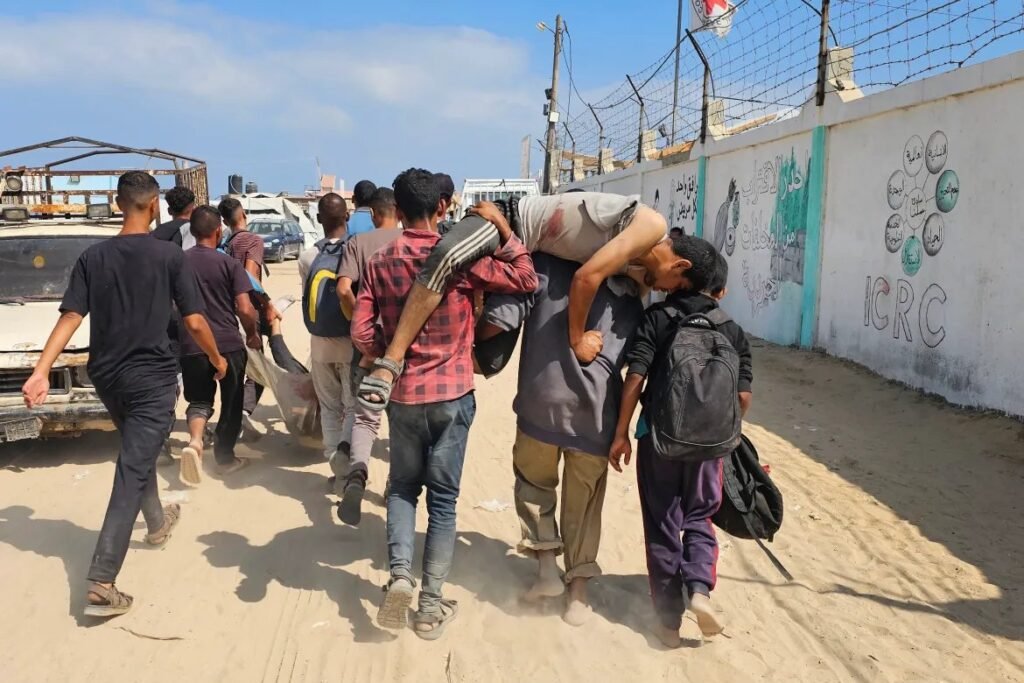
Since the ceasefire agreement came into effect, Palestinians in Gaza have continued to face Israeli airstrikes, artillery shelling, drone attacks, gunfire, home demolitions, and strikes targeting civilian gatherings. Medical sources in Gaza have repeatedly reported dozens of victims resulting directly from these attacks.
Entire neighborhoods remain under constant surveillance by Israeli drones. Civilians have been killed while attempting to retrieve belongings, gather near aid points, or move through areas arbitrarily designated as restricted zones. Displaced families sheltering in tents continue to live under the threat of bombardment despite the supposed truce.
Yet in Mladenov’s statements, these realities are either minimized or omitted altogether. Instead of addressing the ongoing violations undermining the ceasefire, the focus remains overwhelmingly centered on Hamas and disarmament.
Silence That Protects Power
Failing to name the party violating a ceasefire does not amount to neutrality. In practice, it protects the stronger actor from accountability.
Israel controls Gaza’s airspace, borders, coastline, population registry, aid access, and large portions of territory through military force. It possesses overwhelming military superiority and continues to conduct operations inside the Strip despite the truce. Ignoring these facts while discussing “security” creates a false symmetry between occupier and occupied.
This imbalance becomes even more troubling when international figures speak about Palestinian disarmament without first demanding an end to Israeli attacks, collective punishment, and the blockade that has devastated civilian life in Gaza for years.
A ceasefire cannot meaningfully exist when one side continues military operations with near-total impunity.
Disarmament While Bombing Continues
Calls for Hamas to disarm while Israel continues daily military violations send a dangerous political message: that Palestinians are expected to surrender all means of resistance while remaining exposed to ongoing attacks.
For many Palestinians, this reinforces the perception that international mediation is less concerned with protecting civilians than with securing Israeli military dominance under the language of “stability.”
The issue is not whether armed groups should be discussed in political negotiations. The issue is the sequencing and selective outrage. Demanding disarmament while civilians are still being bombed effectively asks Palestinians to trust a process that has failed to guarantee even the most basic protections for their lives.
The Problem With “Balanced” Language
International officials often rely on carefully crafted language designed to appear balanced. But when language avoids acknowledging clear realities on the ground, it ceases to be balanced and instead becomes politically enabling.
There is nothing neutral about refusing to identify repeated ceasefire violations. There is nothing balanced about discussing Gaza’s future without addressing the ongoing killing of civilians, restrictions on aid, destruction of infrastructure, and forced displacement.
Diplomatic caution should not come at the expense of truth.
Credibility of International Mediation at Stake
Statements like Mladenov’s also damage the credibility of international mediation efforts. Ceasefires survive through accountability and mutual obligations, not selective pressure directed only at one side.
When international mediators avoid criticizing Israel despite documented daily violations, Palestinians increasingly view diplomatic initiatives as structurally biased. This weakens confidence in negotiations and reinforces the belief that international law is applied selectively depending on who commits the violations.
The result is not stability, but deeper mistrust and further erosion of faith in international institutions.
Peace Requires Accountability, Not Selective Silence
If the international community genuinely seeks stability in Gaza, it must begin by addressing the immediate reality: civilians continue to die despite the ceasefire agreement.
Any serious conversation about Gaza’s future must include a clear acknowledgment of Israel’s ongoing violations, the humanitarian catastrophe caused by the blockade and bombardment, and the legal obligations imposed under international humanitarian law.
Peace cannot be built on selective silence. A ceasefire that is violated daily while the violations go unnamed is not a genuine ceasefire at all.