
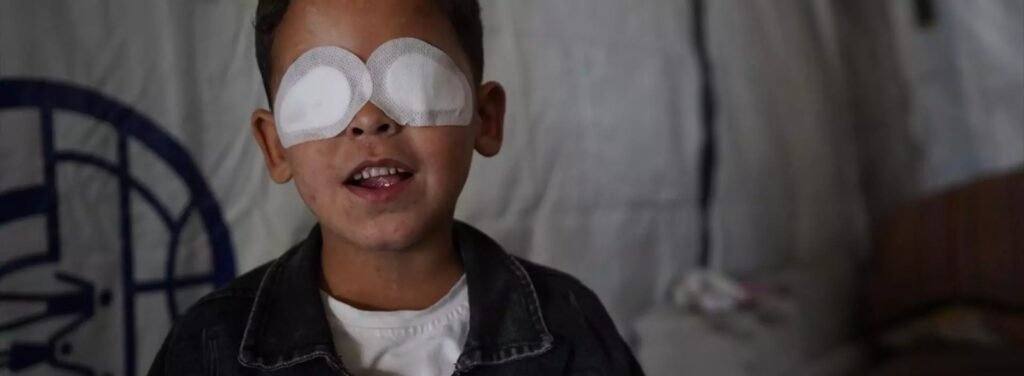
Gaza Herald – The metallic object that seven-year-old Mohammad Hijazi picked up among the rubble of his home in Jabalia refugee camp was not harmless debris. It was a deadly remnant left behind by the Israeli army in the devastated streets of northern Gaza.
In early March last year, Mohammad’s childhood curiosity turned into a lifelong tragedy. The object exploded in his hands, tearing apart his face and stealing the light from his eyes, plunging him into darkness amid the ongoing genocide in the Gaza Strip.
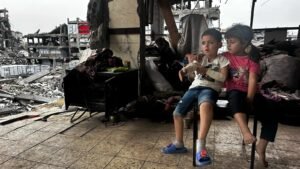 A Childhood Turned Into a Minefield
After returning with his family from repeated displacement, Mohammad tried to reclaim fragments of the childhood war had stolen from him. While playing near their heavily damaged home in Jabalia, he discovered a strange object believed to have been dropped by Israeli drones.
Unaware of the danger posed by unexploded war remnants, the child picked it up. Seconds later, it detonated violently in his small hands, transforming his laughter into screams that echoed through the camp.
His father, Khaled Hijazi, recalled the horrifying moment: “My son was only playing. He carried no weapon and committed no crime. I found him covered in blood. No human being could bear such a scene. His face was completely soaked in blood, and at that moment, I knew the light in his eyes had gone out.”
Between Amputation and Fading Hope
Under relentless bombardment and amid Gaza’s collapsing healthcare system, Mohammad was rushed to Kamal Adwan Hospital in Beit Lahia. Doctors initially considered removing both eyes due to the severity of the injuries. Eventually, they managed to preserve a small chance of vision in his left eye after his right eye was completely removed.
Speaking in a trembling voice, Mohammad said: “I was playing. I touched something and it exploded in my face. I can no longer see my friends.”
The boy, who once dreamed of going to school, now fears the silence of the night and cannot bear to be separated from his father even for a moment. The psychological trauma he carries runs deeper than his physical wounds.
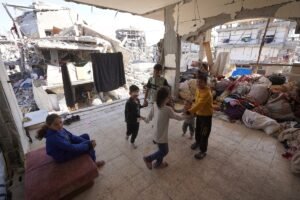 Gaza Among the Most Contaminated Areas in the World
According to the United Nations Mine Action Service (UNMAS), by May 2026 Gaza had become one of the most heavily contaminated places in the world with unexploded ordnance.
Reports indicate that nearly 20,000 unexploded bombs and shells remain scattered across the Strip after Israeli attacks, posing a direct threat to civilians. Children account for nearly half of all victims, as they are naturally drawn to unfamiliar objects amid the ruins.
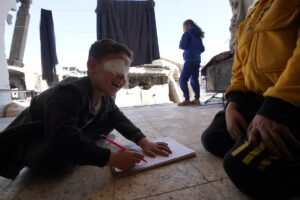 A Race Against Total Darkness
Although Mohammad was recently transferred to King Khalid Eye Specialist Hospital in Riyadh for treatment, doctors warn that time is running out. His remaining eye requires highly complex retinal and corneal surgeries to save what little vision may still be preserved.
His father ended with an emotional plea: “I am not asking for a miracle. I only want Mohammad to see again, to live independently like any child in the world. Every day without proper surgery brings us closer to complete darkness.”
Meanwhile, Gaza’s director general of the Eye Hospital, Dr. Abdel Salam Sabbah, warned of a growing blindness crisis in the Strip. Since the beginning of the genocide, more than 1,500 Palestinians have lost their eyesight, while over 4,000 others remain at risk of blindness due to the lack of laser equipment and retinal treatments caused by genocidal war and blockade.

