
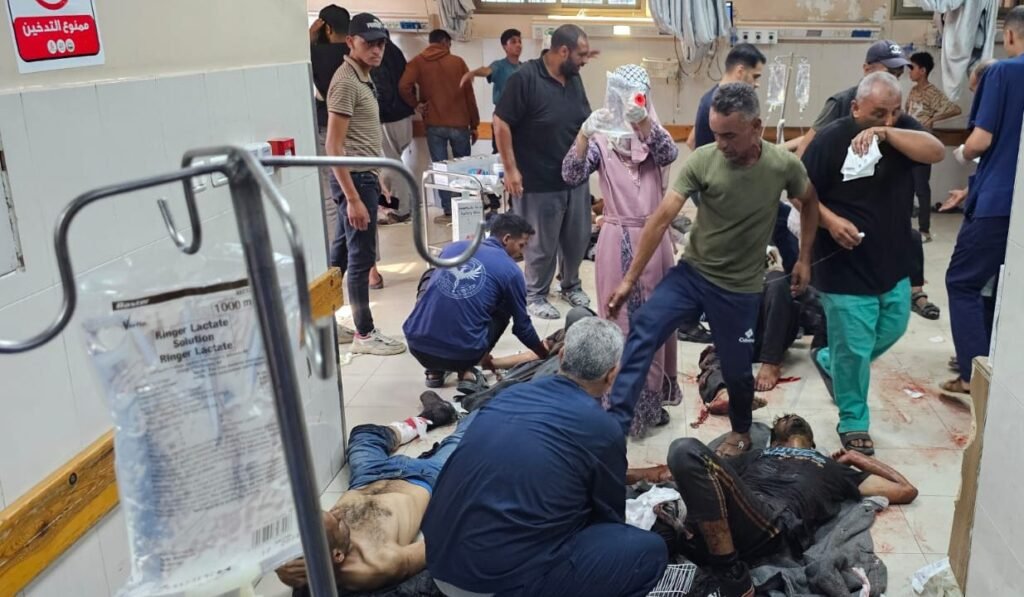
Gaza Herald – “The pain is unbearable and impossible to live with.”
With these words, 27-year-old Ayman Al-Asatal describes his condition after being struck by a bullet that became lodged in his right ear, causing him to lose hearing in it and part of the vision in his right eye. The injury also led to a 20% fracture of his skull bones, resulting in partial paralysis.
Ayman was injured while trying to secure food for his family from a US aid distribution center in Al-Tina area of Khan Younis. A bullet penetrated the right side of his head, causing severe bleeding that required three months of hospitalization at the Red Cross hospital. He eventually became unable to walk or even sit, now depending on others for the most basic daily tasks.
He continues to suffer recurring health crises. He explains that the bullet has affected his nerves, saying:
“I am living the life of a 60-year-old while I am still in my twenties. I pray while lying on my back, I cannot go to the bathroom without someone helping me, and I fear losing the sight in my right eye if I don’t receive treatment.”
Ayman also suffers continuous bleeding from his right ear due to the bullet still lodged inside his head for over a year. Doctors have been unable to remove it because of the lack of medical resources in Gaza’s hospitals, placing him at risk of complete paralysis.
His only option is treatment abroad, which is obstructed by the Israeli blockade and strict travel restrictions on patients. Despite reports of mistreatment of patients during travel, Ayman says:
“It doesn’t matter what happens to me on the way, what matters is to return to normal life, even partially. I suffer constantly, my nervous system is deteriorating, and I have severe pain in my teeth and body.”
Ayman spends around 1,000 shekels (350$) monthly on physiotherapy and takes heavy painkillers, yet he still experiences intense pain in his head, described as “knife-like stabbing,” while remaining severely disabled.
In the prime of life: shrapnel threatening her future
The same “knife-like pain” described by Ayman is also felt by 21-year-old Dhuha Hatem, preventing her from sleeping. She describes it as constant headaches, blurred vision, numbness in limbs, and severe pain in her back and abdomen.
Dhuha receives no treatment except painkillers, which provide little relief. Due to medicine shortages and the high cost of neurological care, her condition has worsened, leading to weakened arm function, frequent fainting from sleep deprivation, and complications affecting her nervous system, eyesight, and reproductive health.
She was injured during an airstrike in the “Netzarim” area while attempting to return to her home in northern Gaza. She sustained a deep head and flank wound, while additional injuries melted parts of her fingers, leaving holes in her hands and feet, and swelling across her body. Shrapnel remains scattered throughout her body.
Dhuha never imagined she would watch her fingers disintegrate before her eyes, nor that she would become a wounded patient instead of a nursing student. Today, she is repeatedly forced into hospitals not as a caregiver, but as a patient.
She still carries multiple pieces of shrapnel: a 4 cm fragment near her uterus, another in her pelvis, one in her foot, one in her chest and hand, and another near her eye.
Her condition requires multiple specialists, orthopedics, gynecology, urology, general surgery, internal medicine, and ophthalmology, to remove the shrapnel near her uterus.
Beyond the shrapnel itself, she now suffers complications due to a weakened immune system, making her vulnerable to infections and other serious conditions.
She also lives with emotional distress. After losing fingers, she wondered:
“How will I perform the testimony in prayer without my finger?”
She now fears for her future motherhood and reproductive health, as well as the risk posed by the shrapnel near her eye.
Her injuries have turned her from an active young woman into someone overwhelmed by physical limitation, forgetful, exhausted, dependent on specific nutrition that is often unavailable in Gaza due to shortages, and in need of a prosthetic limb to regain basic function.
Loss of organs and possibly life
More than 10,000 wounded people in Gaza require advanced surgeries in neurology, vascular surgery, orthopedics, and other specialties, according to the director of Al-Shifa Hospital, Mohammed Abu Salmiya.
He warns that any delay in treatment leads to loss of limbs or even death.
He explains that patients with retained shrapnel suffer repeated complications because the body continuously reacts to foreign objects, potentially causing infections, poisoning, and organ failure.
He adds that Gaza’s health sector is critically lacking medical supplies, with shortages reaching 80% in surgical tools for brain, bone, vascular, heart, and chest operations. More than 50% of essential medicines and 40% of emergency life-saving drugs are also unavailable.

