
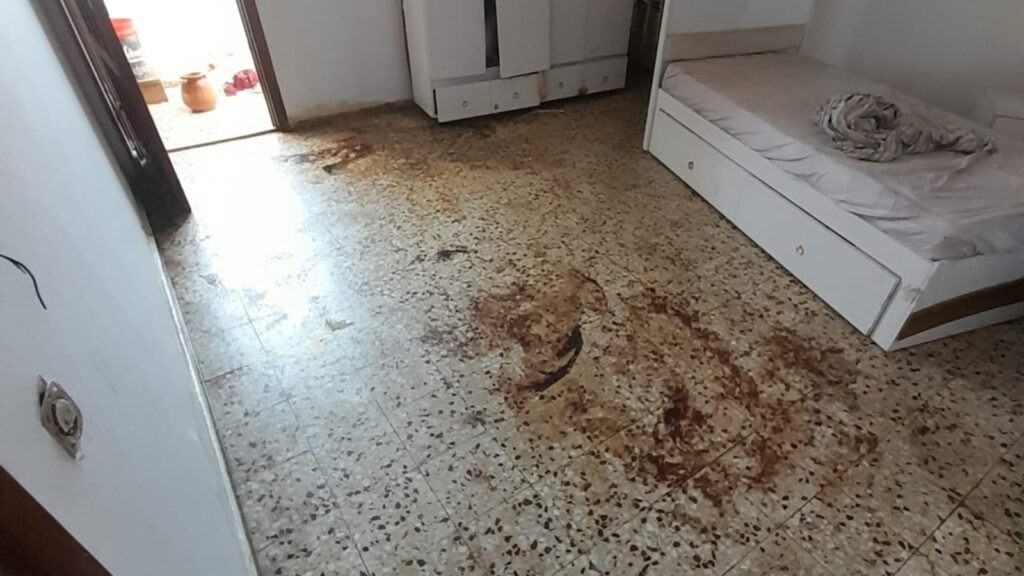
Gaza Herald – In the Shuja’iyya neighborhood, east of Gaza City, specifically on July 3, 2024, the Bahar family did not know they were about to face one of the most horrific crimes and brutal violations witnessed in the Gaza Strip.
The story began as the Israeli occupation forces escalated their operations in Shuja’iyya, one of the most densely populated areas of the city, continuing heavy bombardment for days, storming homes, and forcing tens of thousands of Palestinians to flee.
A compounded crime
The Bahar family was trapped inside their home for a week, like dozens of other families in the neighborhood, as Israeli tanks approached and gunfire continued, making movement impossible, until forces stormed the home.
There were 16 civilians inside the Bahar family home. The children hid in the bathroom to avoid gunfire. Mohammed, the central figure in this tragedy, remained in a corner of the living room where he usually sat, refusing to move and unable to do so due to his condition.
Mohammed Bahar (24 years old), who had Down syndrome and autism, could not run with the others or comprehend evacuation orders or the chaos of war.
His world was small, structured by routine and total dependence on his family. In a war zone, that vulnerability became a death sentence.
 His mother, Nabila (70), said: “Mohammed was like a one-year-old child. He didn’t understand anything; he only knew fear.”
The Storm
On July 3, Israeli occupation forces stormed the home. According to the family, a military dog was sent in before the soldiers and immediately attacked Mohammed.
His mother said: “The dog bit Mohammed’s chest and then his arm. He was screaming and trying to escape while blood was pouring out.”
Mohammed, who rarely spoke, said words the family had never heard from him before: “Stop .. my dear .. stop, leave me.”
His mother added that she pleaded with the soldiers: “I told them he is disabled… have mercy on him.”
The soldiers separated Mohammed from his family and moved him to another room, while the family was prevented from approaching him. His mother said she could hear his voice behind the door: “I could hear him groaning in pain, and every time they opened the door, they would tell him to be quiet, then close it again.”
At some point, a doctor entered with the soldiers. After that, as his mother recounts, “Mohammed suddenly went silent.”
When she asked about him, the soldiers said: “Mohammed is gone. There is no Mohammed.”
Seven Days of Waiting
The family was forced to leave the home at gunpoint, leaving Mohammed behind. During this time, two of his brothers were abducted by the Israeli occupation forces.
For seven days, the family tried to contact humanitarian organizations, including the Red Cross, to find out his fate or save him, but without success.
After the Israeli army withdrew, the family returned home. What they found was shocking and horrifying.
 Mohammed was lying on the ground, his body in a state of decomposition, with worms already eating his face, according to his brother. There was a bandage on his arm, apparently an attempt to stop the bleeding, but no further treatment had been given.
“From his condition, it was clear he had died days earlier,” a family member said.
His mother said: “I cannot bear to think about what they did to him or how they left him to die like that.”
A Systematic and Widespread Pattern
This was not an isolated incident. The Euro-Med Human Rights Monitor reported that the Israeli army has systematically and widely used police dogs to attack Palestinian civilians, as well as to intimidate, maul, and assault detainees in Israeli detention centers.
The organization stated that it documented dozens of cases of dogs being used during raids on Palestinian homes, hospitals, and shelters, noting that the dogs are not only used for reconnaissance but also for directly attacking civilians.
Euro-Med stressed that these violations and brutal assaults against Palestinian civilians, amounting to torture and inhumane treatment, have constituted war crimes and crimes against humanity under the Rome Statute of the International Criminal Court.

