
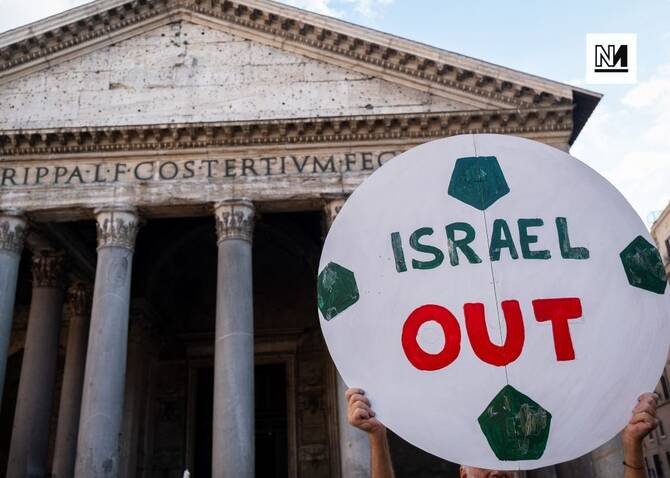
Gaza Herald- Senior officials at the governing bodies of world football are facing renewed pressure from human rights organizations and legal advocates calling for Israel to be expelled from international competitions. The push comes after five organizations formally contacted senior decision makers within UEFA and FIFA, urging them to suspend Israeli teams and the national association over alleged violations of international law and football governance statutes.
The organizations behind the letters say their demands are linked to a broader legal complaint recently submitted to the prosecutor of the International Criminal Court. The complaint accuses senior football administrators, including Gianni Infantino and Aleksander Čeferin, of facilitating or enabling what they describe as serious violations of international law by allowing Israeli football institutions to remain fully integrated in global competitions.
According to the organizations, UEFA leadership had previously considered holding an extraordinary meeting to discuss suspending Israeli clubs and the national team from UEFA competitions. However, those plans were cancelled earlier this year.
In their letter to members of the UEFA Executive Committee, the groups claim that the decision to abandon the meeting was justified internally by the expectation that diplomatic developments in Gaza linked to proposals associated with Donald Trump could reduce tensions.
The organizations strongly reject that explanation. They argue that linking a sports governance decision to a political initiative in the Middle East was inappropriate and misleading. In their view, football governing bodies should evaluate membership strictly on the basis of their own statutes concerning territorial integrity and human rights.
The letter also references reports that Benjamin Netanyahu personally contacted Čeferin during the period when UEFA was considering the extraordinary meeting. Netanyahu is currently the subject of legal proceedings related to the war in Gaza at the International Criminal Court, which has added further controversy to the issue.
The organisations argue that continuing to include Israeli teams in European competitions undermines UEFA’s credibility as a sports institution committed to ethical governance. They contend that if alleged violations of territorial integrity and human rights provisions in the UEFA statutes are not enforced in this case, the rules themselves risk becoming meaningless.
A separate letter sent to members of the FIFA Council raises similar concerns but focuses particularly on the participation of football clubs located in Israeli settlements in the occupied West Bank.
According to the groups, these settlement clubs are integrated into the Israeli Football Association while operating on territory internationally recognised as Palestinian land. The organisations argue that this situation directly conflicts with FIFA statutes requiring member associations to respect the territorial integrity of other associations.
The critics also accuse FIFA of delaying action on the issue for more than a decade. They say the matter has repeatedly been postponed through internal procedures since it was first raised in 2013.
In their letter, the organizations claim that these delays amount to what they describe as a denial of justice. They warn that if FIFA continues to avoid a decision, the dispute could eventually be brought before Swiss courts, including the Swiss Federal Tribunal, which has jurisdiction over disputes involving international organizations headquartered in Switzerland.
The issue of settlement clubs was formally referred by the FIFA Council in late 2024 to the organization’s Governance Audit and Compliance Committee. That body was tasked with examining whether the clubs violate FIFA rules.
However, after many months without a public conclusion, critics believe the committee may now declare that the matter falls outside its jurisdiction. If that happens, opponents say it would represent another step in a pattern of institutional delay.
Human rights organizations supporting the campaign argue that the broader context of the war in Gaza makes the issue particularly urgent. They say football organizations cannot remain neutral when member associations are accused of participating in or supporting actions that violate international humanitarian law.
Supporters of Israel within international sports institutions have countered that suspending a national association would amount to politicizing sport and could set a controversial precedent for international competitions.
The coming months could therefore prove decisive. If FIFA’s governance committee declines to rule on the settlement club issue, pressure on the FIFA Council itself to intervene may increase.
For now, the organizations behind the letters say their objective is to force the leadership of world football to confront what they describe as a test of the sport’s ethical credibility.
Whether FIFA and UEFA respond by opening disciplinary proceedings or continuing their current approach of procedural review remains an open question that could shape the future relationship between global sport and international human rights law.

