
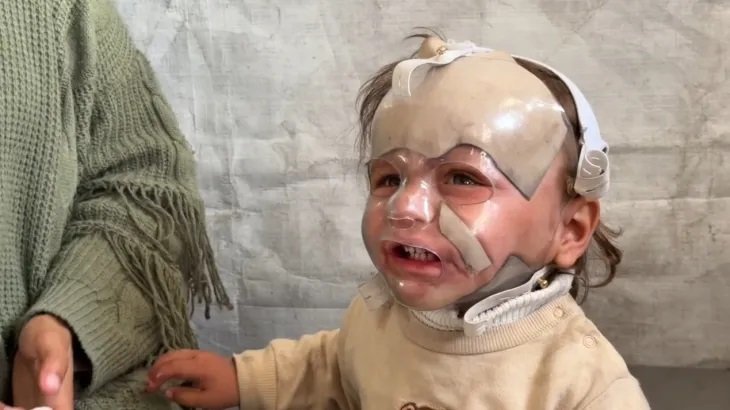
Gaza Herald _The human toll of the war in Gaza is visible in bodies marked by fire. Deep burn wounds remain as painful evidence of attacks that have struck displaced families’ tents and civilian homes. Among thousands of injured people, the story of journalist Ahmed Mansour stands out. His body was severely burned after a missile strike targeted a tent used by journalists in Khan Younis. Images of his injuries represent only a glimpse of the suffering endured by many wounded survivors whose stories rarely receive attention.
In northern Gaza, five-year-old Rital Halawa is living through a harsh reality inside a displacement tent. Severe burns cover the left side of her face and chest. Rital was injured when a quadcopter drone dropped an explosive device while she was playing, igniting flames that engulfed her small body and caused second and third-degree burns.
Her family now faces serious medical challenges. Doctors have stopped performing treatment sessions under anesthesia out of concern that it could damage her brain cells. As a result, hardened scar tissue and severe infections have begun to develop. Her mother says the only care currently available is basic pain relief, while the child urgently needs treatment abroad to preserve both her appearance and vital bodily functions.
Elsewhere in the displacement camps, young man Kamal Nseir recounts how he was injured in Beit Hanoun when an airstrike directly hit his home and triggered a massive fire. He tried to extinguish the flames with his own hands, but the fire consumed his leg, leaving deep scars that refuse to heal under the harsh living conditions and the lack of proper medical supplies.
Nseir says even the most basic medical materials, such as burn ointments and sterile bandages, are unavailable. His health condition continues to worsen as he lives in the difficult environment of displacement. Doctors have recommended that he travel abroad for reconstructive treatment, but the closure of Gaza’s crossings and strict movement restrictions prevent him from reaching specialized hospitals.
Another child, Raneen Jundiya, has also seen her life dramatically altered. She suffered severe burns to the lower half of her body while trying to escape bombardment that struck the Al-Mawasi area. The injuries have caused the skin on her legs to tighten gradually, threatening her ability to walk normally. Now she remains confined to a tent, enduring constant pain that rarely subsides.
According to Dr. Mahmoud Mahani, head of the plastic surgery department at Al-Aqsa Martyrs Hospital, many burn victims are suffering from complex complications, including thickened and fibrotic scars. Treating such injuries requires delicate surgical procedures and advanced medical techniques, including corticosteroid injections and silicone sheets used to reduce scarring. However, these treatments are largely unavailable in Gaza due to the severe shortage of medical supplies caused by the ongoing blockade.

