Gaza Herald_ The continued standstill in the work of the National Committee for Gaza Administration, a full month after its formation was announced, has sparked mounting political and legal debate over the scope of its granted powers and whether it is genuinely capable of steering a transitional phase in a territory weighed down by ongoing Israeli aggression and an unprecedented humanitarian catastrophe. Conflicting narratives persist: some accuse the committee of being stripped of substance and reduced to symbolism. At the same time, official statements maintain that it is merely awaiting real empowerment to begin exercising its mandate.
Establishment and Political Context
The announcement of the National Committee for Gaza Administration came in mid-January, amid growing international pressure to establish a transitional governance framework for the Strip aligned with post-war arrangements, reconstruction requirements, and guarantees for sustained humanitarian aid delivery.
The committee’s formation was also linked to broader diplomatic and negotiation tracks, including United Nations decisions such as Security Council Resolution 2803, which stressed the need to improve humanitarian conditions in Gaza and ensure unimpeded access for relief assistance.
Although the committee publicly declared its official launch and readiness to assume control of public institutions and facilities, it has so far been unable to enter Gaza due to Israeli refusal. Moreover, it has not assumed responsibility for supervising the administrative and governmental apparatus, nor has it been provided with an operational budget or institutional infrastructure to function effectively. As a result, its presence remains closer to a theoretical framework than to an active executive authority.
Accusations of Turning the Committee into a Formal Façade
Rami Abdu, head of the Euro-Mediterranean Human Rights Monitor, revealed, based on what he described as a confidential document, a strategic plan outlining the committee’s first 100 days. He argued that the framework does not prioritize empowering the committee as an independent national body but instead confines it to a symbolic government-in-exile model, serving as a Palestinian cover for security and political arrangements led by international actors.
According to Abdu’s account, shared on Facebook, the actual US-Israeli planning centers on establishing a transitional governance system with a security-military character, administered through a US-led civil-military coordination center. Financial resources and expenditures, he noted, appear to be directed more toward the office of the High Representative, referring to international diplomat Nikolay Mladenov, than toward the national committee itself.
Abdu cautioned that the proposed framework lacks clear priorities for halting the aggression or launching comprehensive reconstruction. Instead, it focuses on what political science experts term “civil-military transitional governance,” a model often deployed in post-conflict settings where security arrangements take precedence over rebuilding civilian institutions.
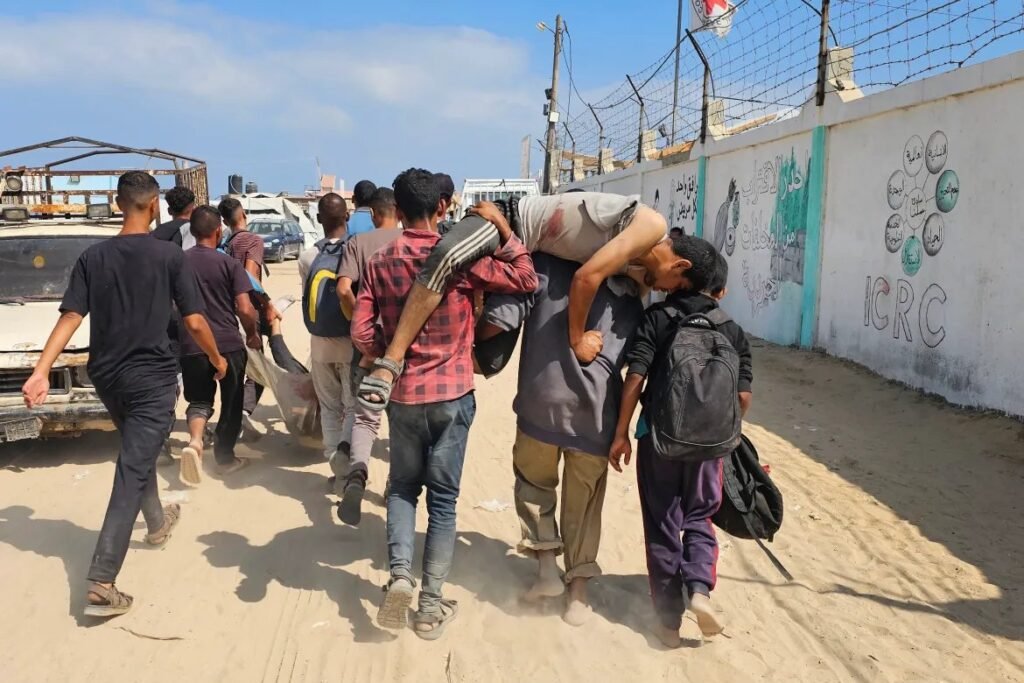
Since the ceasefire on October 10, 618 Palestinians have been killed and more than 1,602 injured by Israeli fire in Gaza.
Financial Control and Reshaping the Administrative Apparatus
A major concern raised by critics of the committee’s trajectory relates to salaries and human resource management. Observers warn that financial mechanisms could be used to restructure Gaza’s administrative body through extensive financial and employment audits, potentially excluding some employees while integrating others according to political or security considerations.
Abdu classifies this approach within political science literature as “financial capture of institutions,” where salary systems and funding channels become instruments for reengineering administrative structures, fostering long-term financial dependency and constraining local decision-making autonomy.
Human rights circles also express concern that Gaza’s economic and administrative planning may ultimately be designed in accordance with Israeli security restrictions rather than the genuine needs of the population, thereby entrenching a governance model focused on population control and reshaping public space instead of empowering residents.
“New Rafah Ghetto” and Fears of Forced Isolation
Among the most contentious issues raised is what has been described as the “New Rafah Ghetto,” according to Abdu’s characterization. The project, reportedly financed by the United Arab Emirates, involves the establishment of container-style camps subject to strict regulatory controls.
Analysts suggest that if accurate, such initiatives reflect a tendency to manage civilians within confined and tightly controlled environments, approaching models of enforced segregation. This raises serious legal concerns under international humanitarian law, particularly regarding prohibitions against forced transfer or concentration of civilian populations.
The Committee: We Await Full Powers
For its part, the National Committee for Gaza Administration maintains that the declared readiness, issued by Hamas and Gaza’s governmental bodies, to hand over institutional management represents a constructive step toward enabling it to begin its responsibilities. It asserts that its primary priorities include ensuring the steady flow of humanitarian aid, launching reconstruction efforts, and reinforcing national unity.
In a statement released Saturday by its chairman, Ali Shaat, the committee emphasized that it cannot effectively fulfill its duties without being granted full administrative and civil authority, in addition to policing powers. It considers genuine empowerment essential to unlocking meaningful international support, paving the way for a complete Israeli withdrawal, and restoring normal daily life.
The committee also called on mediators and relevant stakeholders to accelerate the resolution of outstanding issues, warning that continued delays exacerbate humanitarian deterioration and undermine prospects for an orderly transition.
Nevertheless, it has not presented a clear stance regarding Israel’s ongoing refusal to permit its entry into Gaza, nor offered a detailed explanation for its inability thus far to assume the responsibilities assigned to it.
The chairman and members were expected to arrive on the first day of the Rafah Crossing’s reopening on February 2. However, this was postponed due to Israeli impediments, along with administrative and technical arrangements related to work mechanisms, teams, reference authorities, and operational priorities, according to multiple sources.
Failures Hindering the Committee’s Work
Political writer and analyst Wissam Afifa stated, in remarks shared on Facebook and with Al Jazeera, that Israeli obstruction remains the primary factor preventing the committee from assuming its duties, citing field-level disruptions, procedural hurdles, and control over border crossings and handover processes.
At the same time, Afifa argued that attributing the crisis solely to Israel is insufficient to explain the full picture, particularly given the readiness achieved within Gaza and the significant Egyptian efforts invested in facilitating the transfer of authority.
He drew attention to deeper structural concerns connected to the authority overseeing the technocratic committee, including the Peace Council, the Executive Authority, and the leadership of Nikolay Mladenov, outlining a range of significant gaps.
Foremost among them is the incomplete organizational structure, as the committee’s internal framework remains unfinished and several crucial appointments, particularly in sensitive portfolios, have yet to be settled. He also emphasized the absence of firm financial backing, with no transparent funding source identified and no concrete plan to cover salaries, outstanding dues, previous commitments, or urgent operating costs, effectively depriving the committee of the tools needed to function.
He further noted the limited political pressure placed on Israel to finalize arrangements for the committee’s entry, despite Cairo’s stated readiness to supervise the transfer of authority in coordination with Hamas and Gaza’s existing institutions. At the same time, key administrative questions remain unresolved, especially regarding the management of current governmental bodies and the precise scope of the committee’s mandate.
The security portfolio, he warned, continues to represent a potential flashpoint due to the lack of a clearly articulated framework for a transitional security system. In addition, unresolved logistical issues cast doubt on preparedness, including where the committee would be based in Gaza, what headquarters it would use, how those facilities would be secured, and the mechanisms to ensure members can safely enter the Strip.
Between Legitimacy and Effectiveness
As the aggression continues and humanitarian conditions deteriorate further, the central question remains whether the committee will evolve into a credible national framework capable of administering a transitional phase with transparency and independence, or remain suspended between calculations of control and the demands of legitimacy — reflecting the deep complexities surrounding Gaza’s governance at a pivotal moment in its political history.