
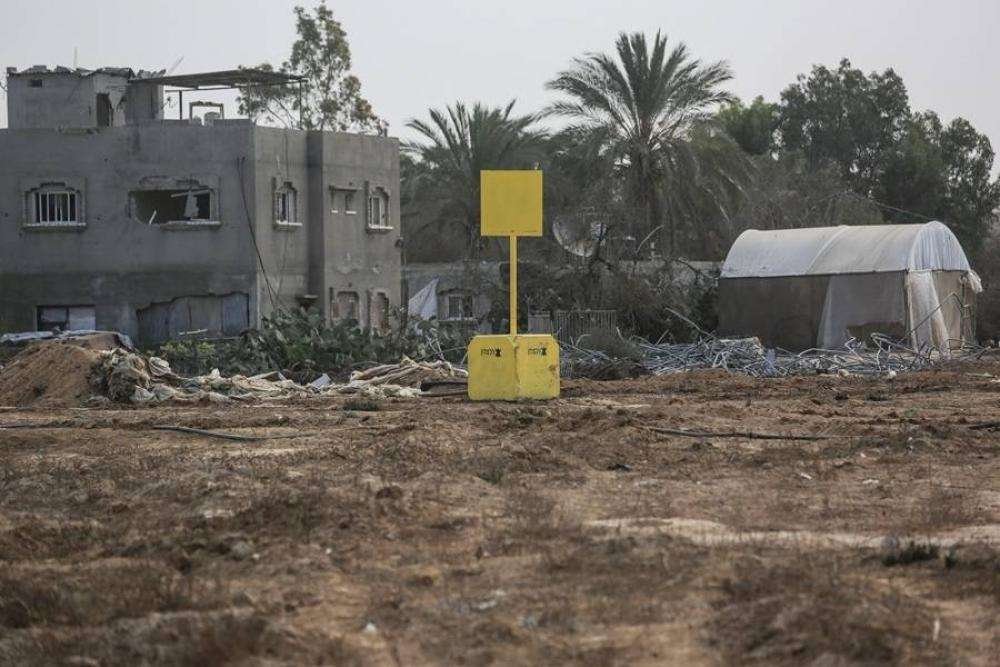
Gaza Herald _For Palestinians living near Israel’s self-declared “Yellow Line” in Gaza, nights rarely bring rest. Residents describe a relentless pattern of gunfire, explosions, and demolitions that repeatedly shatter any sense of calm, despite a ceasefire announced months ago.
Hamed, a young man from Khan Younis who asked not to be identified for security reasons, says sleep is constantly interrupted by the sounds of Israeli tanks and gunshots. According to him, firing typically begins in the evening and continues until dawn, often accompanied by the thunder of homes being destroyed beyond the boundary.
On one occasion, Hamed narrowly survived when a bullet struck his home. The projectile hit a wall rather than tearing through the plastic covering the house. He says that had it passed through, someone inside would likely have been killed.
Since the ceasefire agreement came into effect in October, Israeli forces have continued air strikes, shootings, arrests and home demolitions across Gaza. Palestinian health officials report that at least 591 Palestinians have been killed since the truce began, many of them in areas close to the Yellow Line.
The Yellow Line runs across northern, eastern, and southern Gaza and was meant to mark a temporary withdrawal boundary under the ceasefire. Israeli troops remain positioned behind it, maintaining control over roughly 58 percent of the territory while awaiting a next phase of negotiations brokered by the United States.
Residents on the ground say the reality is far harsher. The boundary has steadily moved deeper into Gaza, cutting Palestinians off from their homes and farmland and forcing repeated displacement. Hamed explains that what was once nearly two kilometers away is now less than one, bringing tanks and gunfire visibly closer to civilian homes.
He describes the fear as both physical and psychological. Neighbors have been wounded by bullets while inside their houses, pushing families to crowd into rooms facing away from Israeli positions. Rooftops are avoided entirely out of fear of being targeted while cooking or hanging laundry.
Human rights organizations have condemned Israeli actions along the Yellow Line. Euro Med Human Rights Monitor has described the situation as an illegal seizure of occupied land and systematic plundering of its resources in violation of international law.
Similar experiences are reported elsewhere in Gaza. In al Bureij in the central part of the Strip, residents say the shifting boundary has triggered another wave of displacement. Khaled, who also requested anonymity, says indiscriminate shooting forced his relatives to abandon their home after it became adjacent to the Yellow Line.
He recounts visiting the area to check on the house when sudden gunfire erupted. Families hid in rooms shielded from Israeli positions and waited for a brief pause to flee. According to him, this pattern has become routine whenever shooting starts.
In the nearby al Maghazi refugee camp, Houida Salim, a mother of six, says bullets pass over her home almost daily. She insists the war never truly ended. Tank movements confine her family indoors, and gunfire regularly strikes the house. For her, the idea of a ceasefire feels meaningless.
Salim says the Yellow Line is now less than a kilometer away. Drying clothes on the roof or letting children play outside has become too dangerous. At times, she notes, Israeli forces use silenced weapons, heightening fear because shots arrive without warning.
After being displaced five times since the war began, Salim says there is nowhere left to run. Other areas where family members live are even closer to danger. For many like her, life near the Yellow Line has become a daily struggle for survival under constant threat, with no safe refuge and no real truce in sight.

