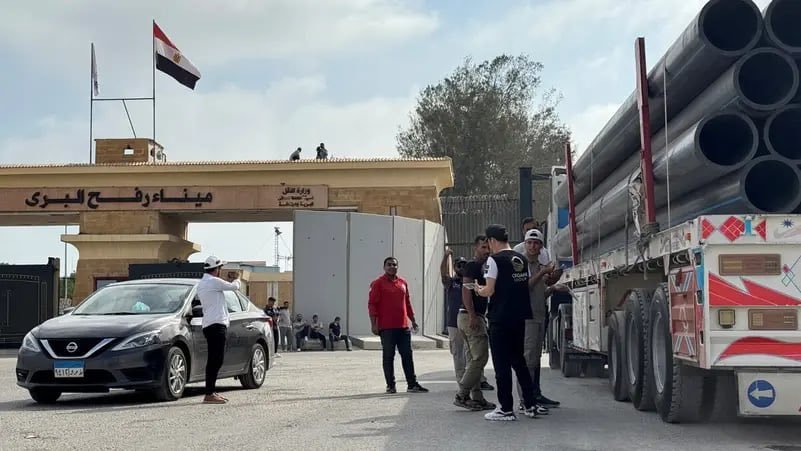
Gaza Herald _ The recently revealed US-backed proposal for a so-called “planned community” in Rafah signals a major transformation in how Israel exercises control over the occupied Palestinian territories. Rather than relying solely on physical barriers and military checkpoints, this plan advances a more entrenched form of domination: financial occupation.
At the core of the proposal is the replacement of Gaza’s cash-based economy with electronic wallets denominated in Israeli shekels. This system would integrate Palestinians directly into an Israeli-controlled financial framework, turning everyday economic activity into a mechanism for surveillance, dependency, and political containment.
Leaked documents from the US-led Civil-Military Coordination Center (CMCC), obtained by Drop Site News, describe the “Gaza First Planned Community” as a tightly controlled environment combining biometric monitoring, physical checkpoints, and real-time financial oversight through digital wallets. Under this structure, Israeli authorities would be able to track purchases, map economic relationships, and flag transactions deemed politically undesirable, particularly those alleged to benefit Hamas.
By embedding Gaza’s economy within Israeli financial infrastructure, the plan would effectively eliminate what little remains of Palestinian monetary autonomy. Economic life would no longer function independently, but instead operate under constant external scrutiny and conditional approval.
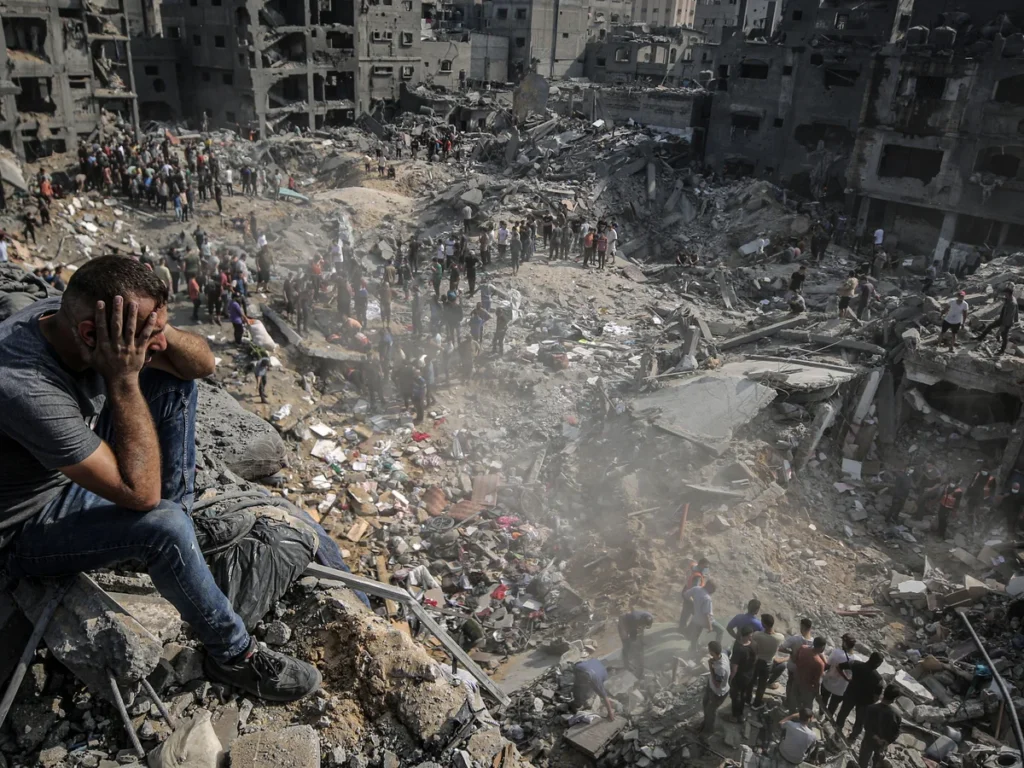
This shift did not emerge in a vacuum. It was made possible by more than two years of Israel’s devastating war on Gaza, during which banks, ATMs, and financial institutions were systematically destroyed. Unlike the Bank of Israel’s proposed digital shekel for domestic use, which claims to include privacy safeguards, the electronic wallets envisioned for Gaza would function primarily as tools of control, linked to biometric identification and military vetting.
Engineered Dependency
Particular attention must be paid to the proposed role of the Bank of Palestine. According to the plan, a branch inside the Rafah community would facilitate “secure and transparent commerce.” A Palestinian financial institution that played a crucial role during the war, especially through the PalPay digital wallet, would thus be repurposed as an intermediary within an Israeli-dominated financial system.
Surveillance would not stop at individual consumers. Merchants, suppliers, and entire supply chains would fall under monitoring to prevent what Israeli authorities describe as “diversion” of goods or funds. The ambiguity surrounding where wallet funds would actually be held raises serious concerns that they could be routed through Israeli or military-linked financial institutions, granting Israel the power to freeze accounts or halt transactions at will.
Geopolitically, the project reflects a convergence of American strategy and Gulf financing. Funding is reportedly tied to the UAE and channelled through US President Donald Trump’s so-called “Board of Peace,” with the Rafah project informally dubbed the “Emirati compound.” This aligns with broader regional initiatives such as the India–Middle East–Europe Economic Corridor (IMEC), into which Gaza is meant to be absorbed.
However, Gaza’s inclusion in these trade networks would come at a steep price: surrendering monetary sovereignty, accepting biometric surveillance, and conducting all economic activity under systems overseen by the Israeli military. The UAE’s involvement would further entrench its role as a financial backer of occupation policies, echoing its past investments in West Bank checkpoints and its participation in the Abraham Accords.
The Rafah pilot project extends the economic logic of normalization into Gaza itself, using reconstruction funding and technology to lock Palestinians into long-term dependency. Similar dynamics can already be seen in Israel’s use of water and gas supplies to pressure neighboring states like Jordan and Egypt into political silence.
At the individual level, every resident of the Rafah community would become economically captive within Israeli financial networks, where dissent carries a tangible cost: exclusion from commerce and livelihood.
Surveillance as Governance
The transition from cash to digital payments would have far-reaching consequences for Palestinian resilience. Cash-based economies allow anonymity and enable informal networks to function beyond state surveillance. During the war, Gaza relied heavily on informal cash brokers, despite exorbitant fees, because they provided essential liquidity.
The electronic wallet system would dismantle these networks entirely, exposing all economic activity to monitoring. This control would be reinforced by a captive labor market, where employment and income depend on compliance with Israeli-approved authorities. At the same time, education would be reshaped under externally imposed “Culture of Peace” frameworks, while an international force would oversee security, layering foreign control over every dimension of life.
The Rafah model explicitly rules out meaningful Palestinian monetary independence. While alternative global systems, such as BRICS-based or Chinese and Russian payment networks, exist, access to them requires political sovereignty that Palestinians are denied. Without statehood or recognition, Palestinian institutions are locked out.
The model bears troubling resemblance to China’s system in Xinjiang, where biometric surveillance and economic coercion were combined to produce political compliance. Rafah is being positioned as a test case, one that could later be replicated across Gaza, the occupied West Bank, and potentially beyond, allowing Israel to claim withdrawal while maintaining total control through digital oversight.
For the UAE and other regional actors, the project represents an experiment in using capital and technology to manage post-war populations in alignment with Israeli interests. If successful, the model could be exported to other conflict zones, expanding the economic architecture of normalization.
History suggests, however, that Palestinians may adapt by developing new informal systems, barter economies, or underground transfer mechanisms. Technology may evolve, but resistance often does as well.
In the end, no amount of financial engineering can replace political legitimacy. What is being constructed in Rafah is a system where basic survival is conditioned on submission to surveillance. The unanswered question is whether Palestinians will accept a reconstruction model that demands the permanent surrender of their economic freedom.