Gaza Herald _ At international forums, Gaza is increasingly spoken of as a “post-war opportunity” rather than a devastated homeland. In Davos last month, Jared Kushner, billionaire real estate heir and son-in-law of US President Donald Trump, presented glossy visions of a “New Gaza”: high-rise towers, luxury waterfront developments, industrial corridors, and a supposedly demilitarised enclave integrated into global markets.
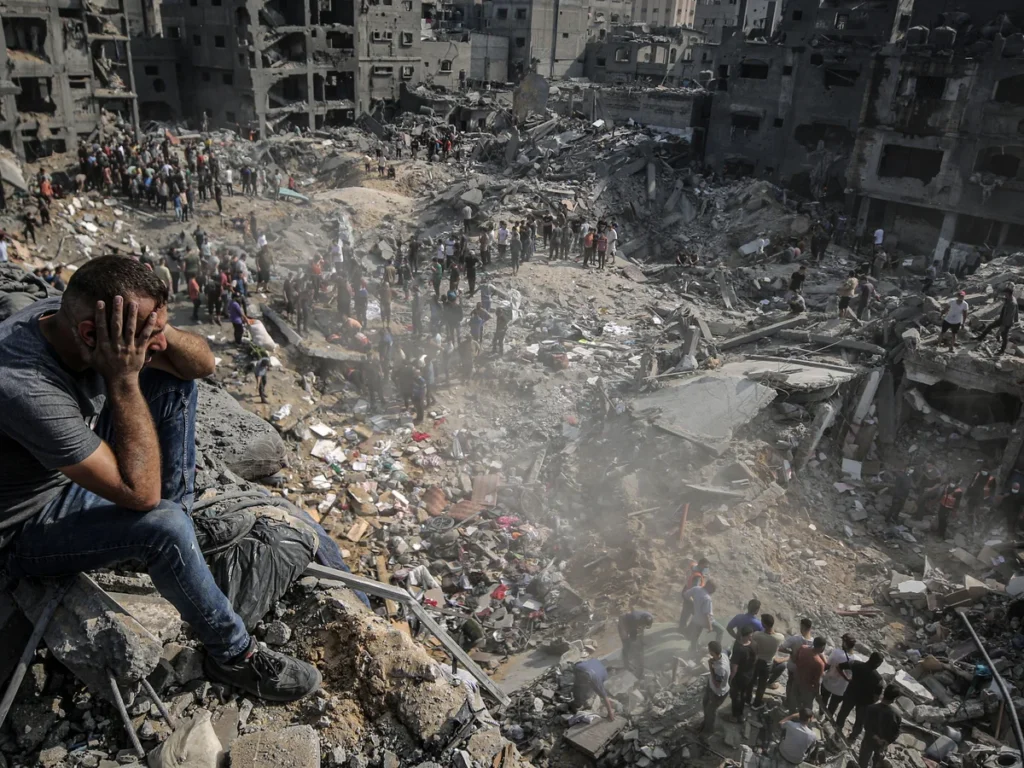
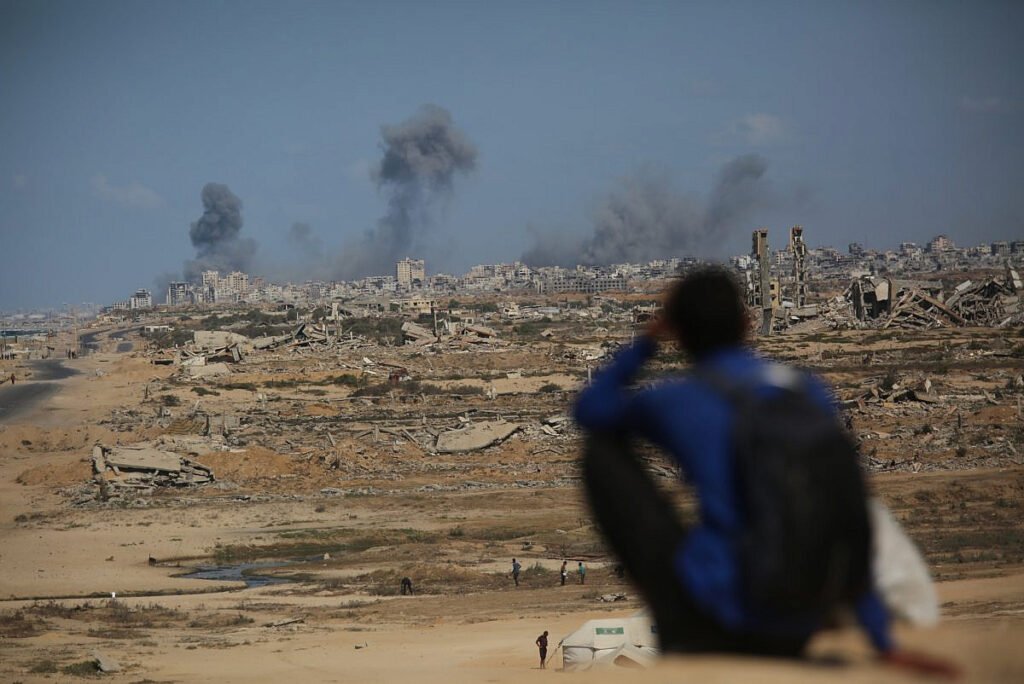
But on the ground in Gaza, there is no “day after”. There is only rubble, displacement, and an absence of even the most basic conditions required for life. More than 61 million tonnes of debris blanket the Strip, a physical testament to over two years of relentless Israeli bombardment. According to the United Nations, approximately 92 percent of Gaza has been destroyed, and the cost of reconstruction is estimated at more than $70bn — assuming rebuilding is even allowed to begin.
What is emerging instead, Palestinian analysts warn, is not reconstruction as recovery, but reconstruction as a continuation of war by quieter, bureaucratic means.
A ceasefire without relief
Although a fragile ceasefire was reached in October, the end of large-scale aerial bombardment has not translated into safety or stability. Israeli military operations, targeted killings, arrests, and territorial control have continued. The blockade remains intact, and there is no clear mechanism for the entry of construction materials, heavy machinery, or infrastructure equipment.
Cement, steel rods, electrical systems, and water-treatment components — all essential for rebuilding- remain subject to Israeli approval, with no transparent criteria and no binding timelines. As a result, Gaza remains frozen in a state of suspended destruction: neither actively bombed nor permitted to recover.
This limbo, analysts argue, is not accidental.
Reconstruction as a form of governance
Palestinian researcher Ihab Jabareen describes Israel’s approach as a shift from overt military occupation to what he terms “sovereignty by flow”, control exercised through regulation of materials, aid, and time.
In this model, Israel avoids the formal legal obligations of occupation while retaining decisive power over Gaza’s political and social future. By controlling what enters Gaza, when it enters, and under what conditions, Israel determines not only the pace of reconstruction, but its political meaning.
“Reconstruction is not the end of war,” Jabareen argues. “It is war conducted through permits, inspections, and donor fatigue.”
The politics of the “cement faucet.”
Central to this system is what analysts call the “cement faucet”: Israel’s ability to turn reconstruction on or off at will.
This power operates on multiple levels. First, materials are framed as security risks, tying their entry to surveillance regimes and long-term monitoring. Gaza may be rebuilt only to an extent that can be easily reversed.
Second, reconstruction is linked to governance. Who distributes cement, who manages aid, and who oversees rebuilding becomes a question of political legitimacy. In this framework, technocratic or externally approved administrations are favoured over the representative Palestinian authority.
Third, basic shelter is transformed into leverage. Housing, infrastructure, and services are no longer rights, but conditional privileges, granted in exchange for compliance and silence.
Buried under debris, trapped by policy
Even without political constraints, Gaza faces an unprecedented physical challenge. A UN Development Programme report released in November described the debris as an “unparalleled obstacle” that could take at least seven years to clear under ideal conditions.
But conditions are far from ideal. Equipment to recycle rubble or reclaim land cannot enter freely. Environmental hazards, including unexploded ordnance and toxic materials, compound the danger.
Local Palestinian planners have proposed alternatives to externally imposed visions. The “Phoenix Plan,” developed by Gaza’s municipal bodies, emphasises community-led reconstruction and the reuse of debris as a resource. Rather than erasing Gaza’s urban fabric, it seeks to rebuild from within it.
Architecture professor Abdel Rahman Kitana warns that reconstruction imposed from above — without Palestinian participation- will produce alien spaces disconnected from social reality. “You cannot rebuild a society without its people,” he says.
The expanding “dual-use” regime
Yet even locally driven plans face a formidable barrier: Israel’s “dual-use” list. Originally limited to materials with plausible military applications, the list has expanded dramatically.
Today, it includes items essential for civilian survival: oxygen cylinders, water filters, medical imaging devices, cancer medications, and sanitation equipment. Project-by-project approval is required for each shipment, turning reconstruction into an endless administrative maze.
Critics argue that the dual-use regime has evolved into a philosophy of governance. Delays become indefinite, donors become exhausted, and Palestinian institutions are trapped in a cycle of dependency and pleading.
Reframing Gaza as a real estate problem
While Gaza is immobilised on the ground, international discourse increasingly shifts toward speculative futures. Kushner’s proposals promise economic growth, tourism, and industrial development, projecting a vision of prosperity detached from political reality.
Palestinian analysts see this as a deliberate reframing of the Palestinian cause — from a struggle for rights, return, and self-determination into a technical problem of investment and urban design.
By focusing on GDP figures and infrastructure models while ignoring mass displacement, destruction, and occupation, these plans normalise the conditions that produced Gaza’s devastation in the first place.
“They want a Gaza that is economically functional but nationally emptied,” Jabareen argues.
The privatisation of occupation
Even if Israeli companies do not directly rebuild Gaza, analysts warn of a “privatised occupation” emerging through logistics, security inspections, insurance frameworks, and aid coordination, sectors dominated by Israeli or allied firms.
Reconstruction contracts themselves become political filters. Donors who challenge Israeli control are excluded; contractors who raise questions of sovereignty are replaced. Compliance becomes the price of participation.
Time as a weapon
Perhaps the most insidious element of this strategy is the weaponisation of time. UN projections suggest full reconstruction could stretch into the 2040s. For a population living in tents, ruins, and uncertainty, waiting becomes unbearable.
This prolonged stagnation, analysts warn, is designed to produce what they call “rational emigration”, people leaving not under direct force, but under the exhaustion of endless delay.
Bombing provokes outrage. Bureaucracy provokes silence.
Conclusion: Rebuilding without freedom is another form of war
For Palestinians, reconstruction cannot be separated from justice, sovereignty, and accountability. Towers built under siege, ports controlled by occupiers, and housing granted as conditional rewards do not constitute recovery.
Without an end to occupation, the lifting of the blockade, and Palestinian control over land and resources, reconstruction risks becoming a refined instrument of domination, quieter than bombs, but no less destructive.
Gaza does not need a “New Gaza” designed abroad. It needs the freedom to rebuild itself.