Gaza Herald _ Behind diplomatic language about ceasefires and border reopenings, Israel is quietly laying the physical foundations for what may become Gaza’s most dangerous chapter yet: a permanent system of military control, population filtering, and enforced displacement. In Rafah, under the guise of security coordination, Israel is constructing a massive compound that human rights advocates warn will transform Gaza’s southern gateway into a high-tech instrument of domination. Far from a humanitarian solution, the emerging reality points toward a long-term strategy to reshape Gaza’s geography, demography, and political future through surveillance, coercion, and forced exile.
While global attention focuses on the recovery of the last Israeli captive’s remains and tentative plans to partially reopen the Rafah crossing, a far more alarming project is unfolding quietly on the ground.
Retired Israeli General Amir Avivi, who continues to advise the military, revealed that Israel has cleared vast areas of land in Rafah — already devastated by more than two years of genocidal warfare, to construct what he described as a “large, organized camp” capable of housing hundreds of thousands of people. According to Avivi, the facility will be equipped with advanced biometric surveillance, including facial recognition technology, to monitor every Palestinian entering or exiting Gaza.
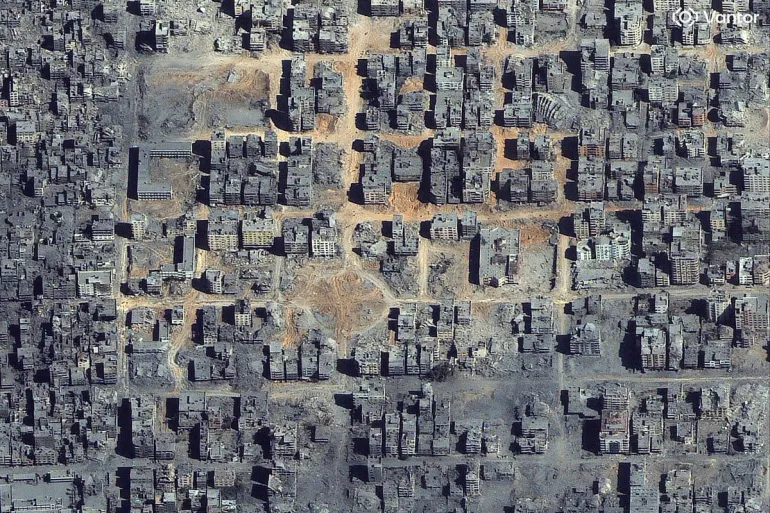
Satellite analysis by Al Jazeera’s Digital Investigations Team confirms that large-scale ground preparations are already underway. Imagery captured over recent weeks shows systematic leveling of approximately 1.3 square kilometers in western Rafah, an area adjacent to two Israeli military posts. Investigators note that this operation extends beyond debris removal, suggesting deliberate construction planning rather than emergency humanitarian preparation.
Analysts say the location and scale of the site indicate that it is designed not as a shelter, but as a controlled processing center, a holding zone governed by Israeli military authority.
A Mechanism of Population Control
Palestinian analysts in Gaza describe the facility as a sophisticated tool of demographic engineering.
“What Israel is building is not a humanitarian structure, it is a human-sorting complex,” said Gaza-based political analyst Wissam Afifa. “This system echoes some of history’s darkest moments, where populations were categorized, filtered, and discarded under military rule.”
According to Afifa, Palestinians attempting to return to Gaza will be subjected to invasive security screening, interrogation, biometric data collection, and the constant threat of detention.
“The goal is deterrence,” he explained. “By turning return into a humiliating and dangerous ordeal, Israel is pressuring people into permanent exile.”
This strategy, analysts argue, advances Israel’s longstanding objective of reducing Gaza’s civilian population by making displacement appear voluntary.
Permanent Control Inside the ‘Yellow Line’
The Rafah project forms part of a broader Israeli strategy to entrench permanent military control across much of Gaza. Israeli forces currently occupy approximately 58 percent of the Strip, particularly within the so-called “yellow line” buffer zone established under ceasefire terms.
“This is not temporary security management,” Afifa said. “It is the systematic re-engineering of Gaza’s territory and population.”
Israeli Prime Minister Benjamin Netanyahu reinforced this interpretation in remarks to the Knesset, emphasizing that Gaza’s next phase would focus on “demilitarization” rather than reconstruction, signaling an indefinite extension of military dominance.
By prioritizing security infrastructure over civilian rebuilding, Israel is effectively institutionalizing occupation under a new framework.
A Performance of Peace
For Gaza’s two million residents, the international celebration surrounding diplomatic breakthroughs offers little relief.
“There is profound bitterness,” Afifa said. “The world applauded the recovery of a single Israeli body while millions of Palestinians remain trapped inside an open-air prison.”
He warned that global silence toward Israel’s expanding system of biometric control and military checkpoints risks normalizing a future where Palestinian movement, identity, and survival depend entirely on Israeli surveillance mechanisms.
“If this model is allowed to stand,” he said, “Gaza will become a laboratory for technological domination, where freedom of movement is replaced by permanent digital captivity.”
What is unfolding in Rafah is not security reform; it is the architecture of forced displacement. Through surveillance, biometric control, and militarized infrastructure, Israel is building a system designed to manage, filter, and ultimately shrink Gaza’s population. The tragedy is not only in the machinery of domination, but in the world’s willingness to accept it as normal. As prison walls rise under the banner of peace, Gaza is being reshaped into a controlled zone where human existence itself becomes conditional. History will judge not only those who built this system, but those who watched it happen and remained silent.