
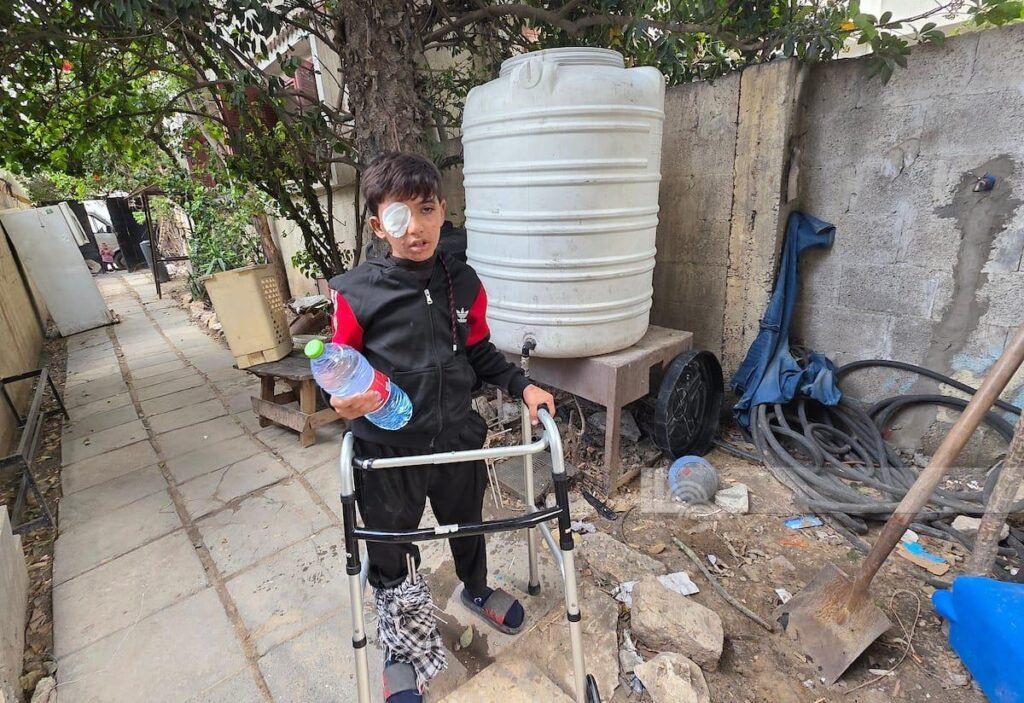
Gaza Herald _ In one of Gaza’s devastated neighborhoods, 10-year-old Mohammad Abu Mohsen stands as a living witness to an unbearable tragedy. He was pulled alone from the rubble of his family’s home in the Sabra area following an Israeli attack. His parents and siblings were all killed, leaving him with nothing but loss and pain.
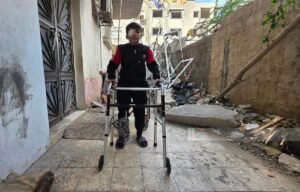
Mohammad lost one of his eyes and suffered severe fractures in both legs. His small body now carries the weight of both disability and grief. Today, he struggles to survive under harsh living conditions, clinging to a single hope: to continue his medical treatment outside Gaza.
Speaking in a broken voice, Mohammad recounts how he lost his entire family. His injured eye no longer sees at all, while his remaining eye perceives the world in a distorted, blurred way. His only wish is to receive proper treatment so he can walk again and regain his sight. He appeals to the world to allow him to travel for medical care, as life inside Gaza offers neither adequate medicine nor healing.
 Broken Body, Deep Trauma
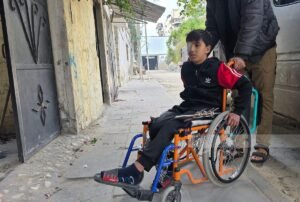
With tearful eyes, Mohammad’s uncle, Rami Abu Mohsen, describes the scale of the tragedy. He explains that the bombardment caused Mohammad to fall from the fifth floor, resulting in severe fractures in his legs that required metal plates. The injury to his eye led to surgery that ultimately failed to restore his vision.
Mohammad now faces daily suffering in the simplest aspects of life, from using the bathroom to traveling for physiotherapy and wound care. His uncle adds that the child endures severe psychological trauma and recurring nightmares, trapped in an environment unable to meet the needs of a child who lost his family and sense of safety in a single moment.
He urges the international community to intervene urgently and allow wounded patients like Mohammad to leave Gaza for treatment before their injuries worsen and turn into slow death sentences.
Closed Crossings and Lives on Waiting Lists
In the same context, Ismail Al-Thawabta, head of the Government Media Office in Gaza, said that the continued closure of the Rafah crossing represents a real catastrophe for patients, the wounded, and the entire health system. He noted that approximately 22,000 patients and injured people urgently need to travel outside Gaza for surgeries and treatments unavailable locally, in addition to more than half a million medical procedures required inside the Strip, far exceeding the capacity of exhausted hospitals.
Al-Thawabta stated that the closure of the crossing is being used as a tool to increase death rates. He called on the U.S. president, mediators, and guarantor states of the ceasefire agreement to exert pressure to reopen the crossing in both directions. He also pointed to more than 80,000 requests from Palestinians stranded outside Gaza seeking to return, as well as thousands of students unable to continue their education, warning of policies aimed at entrenching displacement and restricting Palestinian movement.
For his part, Mohammad Abu Salmiya, director of Al-Shifa Hospital, confirmed that the medical situation has not seen any real breakthrough since the ceasefire. He said that the medicines entering Gaza do not exceed 20 percent of actual needs and often fail to address urgent cases. More than 20,000 patients have completed travel procedures but were not allowed to leave, resulting in the deaths of around 1,200 patients so far, including children and cancer patients, a stark reflection of the cost of closure and siege on innocent lives.
 A War That Continues
Since October 7, 2023, Israeli forces, with U.S. and European support, have carried out what Palestinian sources describe as a genocide in Gaza, involving killing, starvation, destruction, displacement, and detention, in defiance of international appeals and orders from the International Court of Justice.
The toll exceeds 242,000 Palestinians killed or injured, most of them women and children, with more than 11,000 missing. Hundreds of thousands have been displaced, famine has claimed many lives, especially children, and widespread destruction has erased most of Gaza’s cities and neighborhoods.
Israeli forces continue to violate the ceasefire that came into effect on October 10 through ongoing shelling, gunfire, and the demolition of Palestinian homes across the Gaza Strip.

