
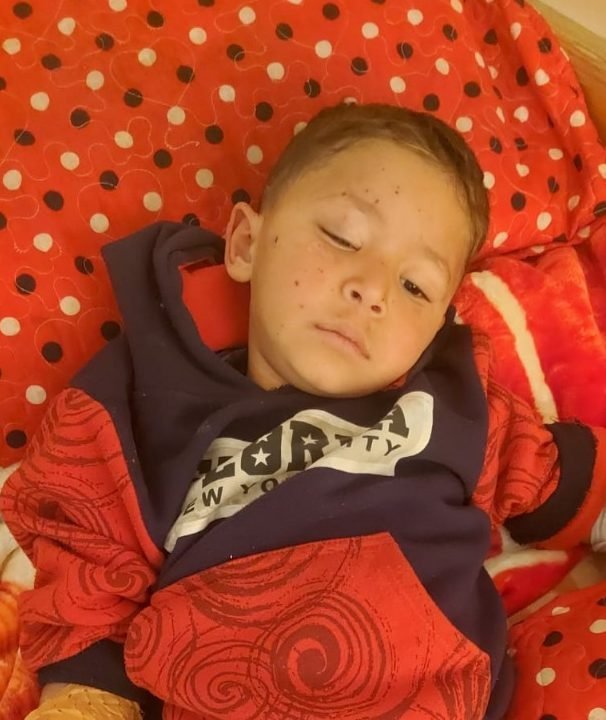
Gaza Herald – In a moment that lasted only seconds, the life of seven-year-old Shawqi Basil Al-Loulahi turned into an ongoing tragedy marked by pain and disability. His mother found him lying on the ground near their home in Khan Younis, covered in blood and wounded by shrapnel across his body, after a direct strike in the area coinciding with Israeli drone activity that fired shells and opened fire nearby.
The child was not inside the home at the time. His mother searched for him in the surrounding area before discovering the devastating scene. She rushed him to Nasser Medical Complex in Khan Younis, where he was admitted to intensive care after losing consciousness completely.
Medical reports indicate that Shawqi’s injuries were severe and complex. He underwent surgery to remove part of his intestines due to extensive shrapnel damage. The attack also led to the complete amputation of his right hand and caused permanent loss of vision in his right eye.
After three days in intensive care, the child gradually regained consciousness under close medical supervision, though the physical and psychological consequences are expected to remain long-term.
His mother, Safaa Barbach (29), a mother of three from Khan Younis, says the incident was shocking and unexpected, and that the moment she found her son was the most painful of her life. She described finding him injured near their home while drones were suddenly firing shells and bullets in the area.
She added that her son was injured while outside the home when Israeli drones were hovering overhead and firing, causing his critical wounds.
She explained that the family has been living under harsh displacement conditions since the beginning of the genocide, moving from Rafah to Khan Younis, and repeatedly struggling with shortages of water, electricity, and food. They were forced to rely on canned food and carry water from distant areas despite its unsuitability for children.
On May 28, 2024, the family received orders to evacuate their area ahead of military attacks in Rafah, forcing them to move again, first to Qizan Abu Rashwan and later to the Al-Mawasi area in Khan Younis, where they lived in a tent under extremely difficult humanitarian conditions.
Regarding life in displacement, the mother said: “The situation there was extremely difficult due to the large number of displaced people and the lack of basic necessities.”
After his condition stabilized, doctors recommended urgent medical evacuation outside Gaza to treat his right eye injury and to fit prosthetic limbs to replace his amputated hand.
The family now lives in a heavy state of waiting, hoping to save his remaining vision as quickly as possible. However, Shawqi’s fate remains uncertain amid the continued closure of the Rafah crossing and strict restrictions imposed on medical referrals from Gaza, which are preventing him from receiving the urgent treatment he needs.

