
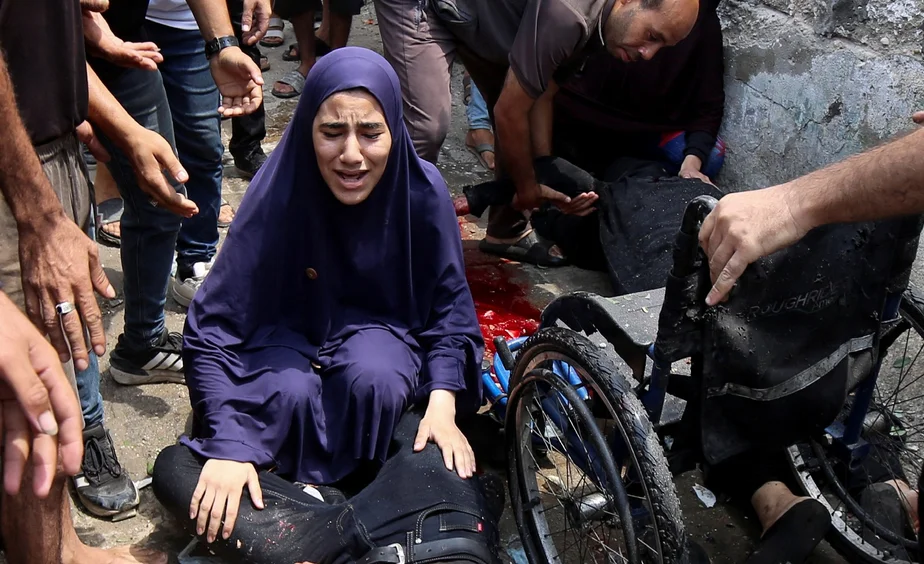
Gaza Herald_ Through personal testimonies shared on Facebook and in direct conversations, four Palestinian mothers recount the unbearable loss of their children, offering a glimpse into a devastation that has reached nearly every home in Gaza.
The human cost of Israel’s ongoing genocide in Gaza is immeasurable. Nearly two million Palestinians are living with grief and trauma, and every family carries its own story of loss amid relentless massacres and the systematic destruction of homes.
For a mother, losing a child is a wound that never heals. In Gaza, that pain has reached an unprecedented scale. Death has not arrived one child at a time, but in waves, tearing entire families apart in moments.
On May 24, Dr. Alaa al-Najjar, a pediatrician, lost nine of her children in a single Israeli airstrike. Her home was bombed while she was working at Nasser Hospital in Khan Younis, desperately trying to save the lives of others.
Words fall short of describing what these mothers have endured. Still, some women whose children were killed by Israel have chosen to speak, refusing to let their children be reduced to statistics. Their stories, drawn from public posts and direct testimony, reflect only a fraction of the suffering endured by families across Gaza since October 2023.
Buried Alive
Poet Alaa al-Qattrawi lost all four of her children at once, under circumstances almost too painful to comprehend.
On December 13, 2023, Alaa was at her family home in central Gaza, while her children were staying with their father in Khan Younis. When Israeli forces invaded the city and detained their father, the children were left trapped inside the house with their grandmother.
Alaa’s daughter, Orkida, managed to call her mother, begging for help. She said they could not escape because Israeli snipers surrounded the house. Shortly afterward, Israeli soldiers confiscated all mobile phones, severing communication for four months.
Later, Alaa learned that the house sheltering her children had been bombed.
Addressing her daughter, she wrote, “I cannot imagine your soft body and beautiful hair buried beneath the rubble of a three-story concrete house. I don’t want to imagine it. But I still hear your voice before the call was cut off, telling me you would wait for me and that you were taking care of your little sister, Carmel.”
In April 2024, after Israeli forces withdrew from Khan Younis, the truth became unavoidable. All four children were killed, Yamen, eight, twins Kinan and Orkida, six, and Carmel, three. Their bodies remained buried beneath the rubble for four months, unreachable.
Reflecting on childbirth, Alaa writes about the faint surgical scar from her cesarean sections. For years, she barely noticed it. After losing her children, it became a source of constant pain.
“I used to forget it existed,” she wrote. “Now I feel it with every breath. It reminds me, every minute, that I gave birth to four beautiful children, and then was left alone.”
She later addressed her children directly, listing the lives they never got to live, the schoolbags, favorite foods, books, dreams, friendships, music, and spiritual journeys that were all stolen. “Israel took all of this from you,” she wrote, “and gave you four graves instead.”
After a ceasefire was announced in October 2025, Alaa reflected bitterly, saying she could believe the occupation was a monster, and that humanity had become its prey.
Under the Rubble
On January 15, 2024, Aya Shamma was at home with her three children, Yaman, seven, Nasser, five, and baby Rayan, just 51 days old. While the children slept, an Israeli airstrike hit the house.
The building collapsed. Yaman suffocated beneath the rubble. Baby Rayan was thrown from the third floor into a neighboring home. Aya and her son Nasser were pulled out by neighbors.
Aya writes that her tears never stop. “If crying could bring loved ones back, you would already be here,” she wrote.
She described crawling out from under the debris and feeling her own heartbeat, convincing herself her child must still be alive. “Was I so naive,” she asked, “to forget that each of us has a separate heart?”
Aya remembered Yaman as a curious child who once asked why animals hurt one another and why the world could not live peacefully. She tried to protect him from cruelty, only for that cruelty to take his life.
“I did not even get to say goodbye,” she wrote. “Death reached him before my arms did.”
She later wrote of her impossible wishes, hoping her son might return, even briefly, in a dream or a breeze, just to sit on her lap again.
Childhood Stolen
Aya Hassouna lost her husband and two young children in a single Israeli attack.
On August 9, 2024, her husband Abdullah was playing with their children, Hamza, four, and Raghd, two, outside their tent in Khan Younis. They had been forcibly displaced from Gaza City.
An Israeli missile struck in front of the tent, killing all three.
Aya, the sole survivor, wakes each morning and looks toward the place where her family was killed. The tent that once echoed with laughter now holds silence.
Hamza’s close friend Malik survived only because his mother called him inside moments before the strike. The child now visits daily, asking Aya when Hamza will return.
When she tries to explain death, Malik asks why Hamza cannot call or send photos. “This war has stolen childhood itself,” Aya wrote.
She refuses to describe her children as dead, saying they are alive with God, playing in Paradise.
At night, she hears another child crying nearby, a voice that reminds her of Raghd. She stays awake, grieving and clinging to patience, hoping for reunion.
One Grave for Many
Asma al-Mughari lost 23 family members when Israeli planes bombed her home in the Bureij refugee camp on October 17, 2023.
Her two children, Aya, six, and Abdullah, five, were killed along with her parents, siblings, nieces, and nephews. Their bodies remained under the rubble for 29 days before being buried together in a single grave.
“I will never forget being told that eight children were buried together,” she wrote.
Asma chose not to see her children’s bodies, holding onto the memory of them alive.
On a holiday, she wrote to them, saying she did not dress them or give them gifts, adding, “In Paradise, Mama.”
Commenting on an image of children killed in Gaza, Asma imagined an alternate world where children sleep safely in warm beds, read bedtime stories, and fall asleep without fear. “In Gaza,” she wrote, “that story is not told. It is witnessed.”
After an international political speech honoring Israeli soldiers, Asma wrote of the injustice of a world that celebrates those who killed her children while ignoring tens of thousands of Palestinian children lost.
Although the pace of daily killings slowed after a ceasefire announcement, for bereaved parents, time offers no healing.
Gaza’s people live atop millions of tons of rubble, carrying grief that will follow them for life. With no meaningful international accountability or commitment to reconstruction, their future remains uncertain.
Until justice is served, the voices of these mothers endure, refusing to let their children become numbers, and bearing witness to a loss that defines Israel’s genocide in Gaza.

