
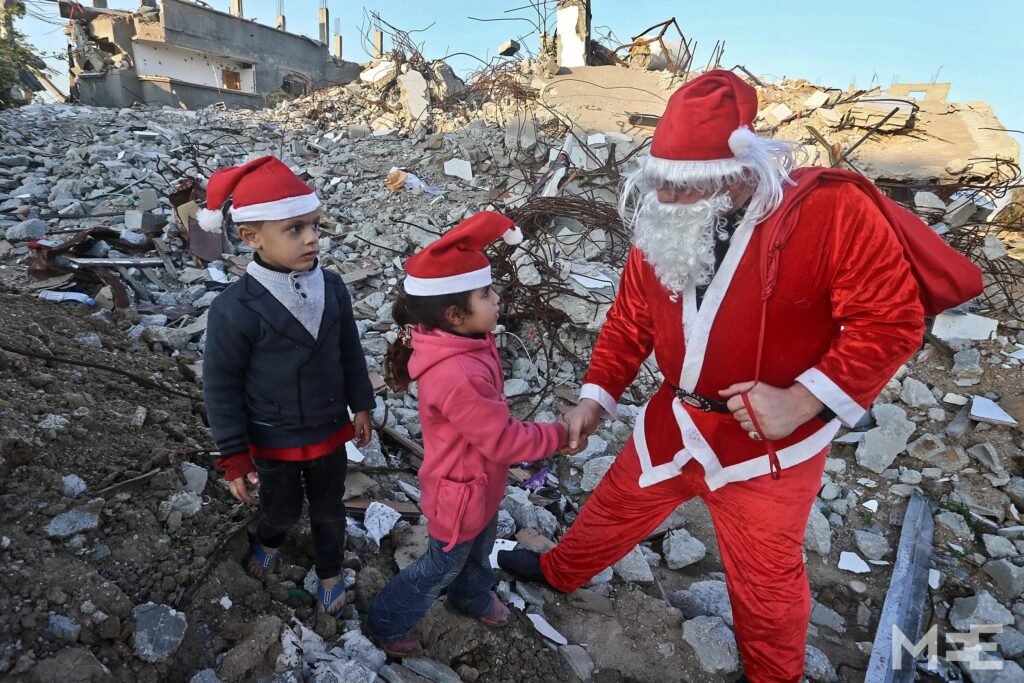
Gaza Herald_ In Gaza, a land still bearing the scars of a prolonged and devastating Israeli assault, the lighting of a Christmas candle inside the Holy Family Church became more than a religious ritual. It was a collective act of defiance and belonging, an affirmation that Gaza’s people, across faiths and communities, remain rooted in their land despite siege, destruction, and ongoing attempts at forced displacement.
Inside the Holy Family Church in Gaza City, a modest Christmas Mass was held in a quiet and reverent atmosphere, attended by some worshipers and clergy. It marked the first communal Christmas observance since the ceasefire took effect, following months in which religious life had been suspended amid relentless bombardment and mass displacement that engulfed the city and its neighborhoods.
A Church That Became a Shelter
The Mass carried meaning far beyond prayer. During the war, the church itself was transformed into a refuge for dozens of displaced families, both Christians and Muslims, seeking safety from Israeli attacks. Its facilities sustained damage from nearby shelling and explosions: windows shattered, walls cracked, and surrounding areas repeatedly rendered unsafe.
Holding the Mass under these conditions became a declaration of life and endurance. It signaled that Gaza’s spiritual and communal spaces, like its people, had survived the assault and refused to disappear.
A Pastoral Visit Bridging Gaza and Jerusalem
The Christmas celebration followed a three-day pastoral visit by the Latin Patriarch of Jerusalem, Cardinal Pierbattista Pizzaballa, accompanied by Patriarchal Vicar General Bishop William Shomali and several priests. The delegation entered Gaza to inaugurate the Christmas season, assess conditions at the Holy Family parish, and review humanitarian relief and reconstruction priorities.
During the visit, the delegation met with local clergy and parishioners and toured ongoing aid projects, reaffirming the enduring connection between Gaza’s Christian community and the Patriarchate of Jerusalem. Children welcomed the visitors with simple Christmas songs and symbolic gestures, briefly restoring joy to a place long overshadowed by war.
The Patriarch noted that this visit felt different from those conducted during active hostilities. For the first time, he said, he was able to meet parishioners with a measure of calm, despite the immense devastation surrounding them. He emphasized that hope persists through children, education, and communal life, and conveyed global solidarity with Gaza’s people from churches and individuals worldwide.
From Survival to Rebuilding Life
In his Christmas homily, the Patriarch stressed that Gaza has entered a phase that must go beyond mere survival. He described this moment as the beginning of rebuilding life itself, socially, spiritually, and humanly.
Drawing parallels between the birth of Christ under conditions of poverty and displacement and the current reality in Gaza, he underscored that God’s path is aligned with the suffering, the dispossessed, and the marginalized. He reminded worshippers that history is shaped not by empires or weapons, but by people’s moral choices and steadfastness.
Reconstruction, he said, is not limited to rebuilding homes and institutions. It begins with healing hearts, restoring trust, and reaffirming love as the only force capable of undoing the devastation of war.
A Permanent Presence, Not a Marginal One
The Patriarch reaffirmed that Gaza’s Christian community is not temporary or peripheral. Despite its small size, it remains deeply rooted in the land and committed to serving as a stabilizing presence in a city exhausted by destruction. He called for unity and collective responsibility in rebuilding Gaza, materially and spiritually, through shared effort and mutual care.
As part of the visit, the delegation also stopped at Saint Porphyrius Greek Orthodox Church, meeting with its priest and parishioners in a clear gesture of Christian unity. The visit underscored that Gaza’s Christian institutions stand together in confronting shared suffering and collective loss.
One Gaza, Beyond Religious Divisions
The Christmas Mass unfolded within Gaza’s broader humanitarian catastrophe. In a territory where Christians number only a few hundred, mostly concentrated in Gaza City, the celebration highlighted a deeper truth: suffering in Gaza knows no religious boundary.
Muslims and Christians alike endure displacement, hunger, insecurity, and loss. In this reality, steadfastness has become a shared identity, uniting people in their struggle for survival, dignity, and the right to life.
This unity was echoed in a joint statement issued by Christian clergy, who questioned the meaning of celebration amid ongoing death, destruction, and genocide. The statement noted that Israeli violence continues not only in Gaza but also across the West Bank, through assassinations, mass arrests, home demolitions, land seizures, and settler attacks.
The message emerging from Bethlehem, Nazareth, and Jerusalem, the clergy said, is unmistakable: injustice must end, equality must prevail, and light will ultimately overcome darkness. Celebrating Christmas, they emphasized, is itself a declaration of life in the face of death.
Holy Family Church: A Witness to Gaza’s Endurance
Throughout the Israeli assault, the Holy Family Church stood as a shelter and sanctuary. Its damaged walls and shattered windows bear witness to the violence inflicted on Gaza’s civilians, including those who sought safety near its grounds and were injured by nearby airstrikes.
Church officials confirmed that displaced families, Christian and Muslim, found refuge within its compound after losing their homes. The church’s continued presence, despite repeated targeting of its surroundings, stands as a testament to Gaza’s refusal to be erased.
Faith as Resistance
In this sense, the Christmas Mass in Gaza was not merely a religious observance. It was a human declaration from a city that refuses to collapse, and from a people who insist, across faiths, that Gaza will remain alive.
Amid rubble, siege, and grief, the message was clear: faith in life, dignity, and justice is stronger than all instruments of war.

