
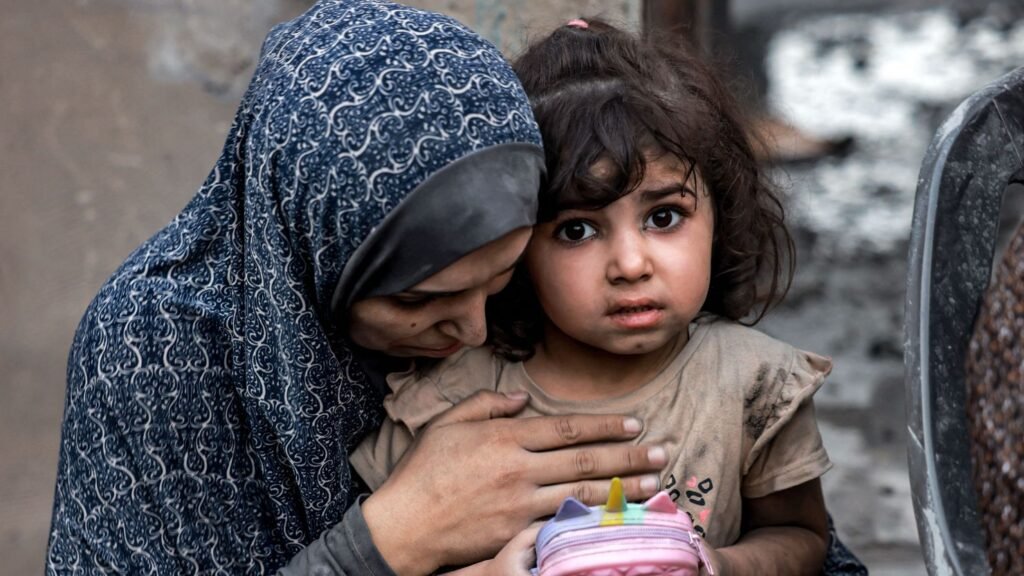
Gaza Herald — In a modest shelter made of displacement tents on the outskirts of Deir al-Balah, sits Rida Alaywah, a woman in her sixties, worn down by time and by an occupation that reshaped every part of her life, turning her home into what has become an orphanage.
In her arms rests a baby barely a month old, the youngest of thirty-six grandchildren left behind by her five children, all of whom were killed in the latest Israeli assault on Gaza.
A Burden Beyond Imagination
For her, life is no longer simply survival; it is an immense responsibility. She lost her sons and daughters one after another through fifteen separate displacements, under the rubble of bombings, in tents that collapsed onto the bodies of her family, and yet she remains standing.
In a tired voice that sounds like rubble groaning under its own weight, she recalls: “At the hospital… I found my husband beside me. I asked about my children, one by one, and each time they told me: ‘He’s gone…’ It was as if my heart split open all at once.”
In that attack, she lost Muhammad, Muhammadin, Izzat, Rasha, and Na’ila, along with several grandchildren. Now, all that Um Rida can do in this harsh place is surrender to God’s will, despite the crushing loss she carries.
Despite her injuries, she insisted on leaving the hospital against medical advice so her grandchildren would not be left without anyone to care for them. She fled with the children on foot to Nuseirat in the center of the Gaza Strip, where they spent three nights exposed to the cold with no shelter.
Cold, Displacement, and Survival
The children suffered from a cold and vomiting until a resident offered them a small piece of land and brought them a tent. Ten days later, after the ceasefire, she returned to Gaza City.
Today, Um Rida lives atop the rubble of her destroyed home in Shuja’iyya, inside a makeshift tent built from scrap metal and torn fabric. She salvaged whatever she could from old bedding, but her grandchildren continue to live in the merciless cold. In the most recent storm, the entire tent flooded.
She says: “The storm days were worse than the days my children were killed… I stood in front of my grandchildren, helpless. I couldn’t do anything.”
Her husband is elderly, which places the full weight of raising a new generation solely on her shoulders, after losing an entire one.
A Story That Mirrors Gaza’s Wider Tragedy
Um Rida’s story is not unique; it is part of a far larger tragedy unfolding across Gaza. An entire generation of children now lives without a father, a mother, or both, torn apart by a war machine that erased families and scattered loved ones.
International organizations estimate that the number of orphans in Gaza has reached nearly 57,000 children, with forty thousand having lost one or both parents. Many of them are now completely alone, the largest orphan crisis in modern history.
The story of Rida and her grandchildren is a testament to immense human suffering, but also to endurance. Despite the destruction and the unbearable loss, she continues her mission with what can only be described as miraculous patience. Holding her infant granddaughter to her chest, she says: “As long as a child can still laugh in Gaza, life has not ended.”
In this woman’s arms, amid rubble, ruins, and unimaginable grief, lies the truest image of Gaza: unbreakable resilience, hope rising from loss, and life insisting on itself despite everything.

