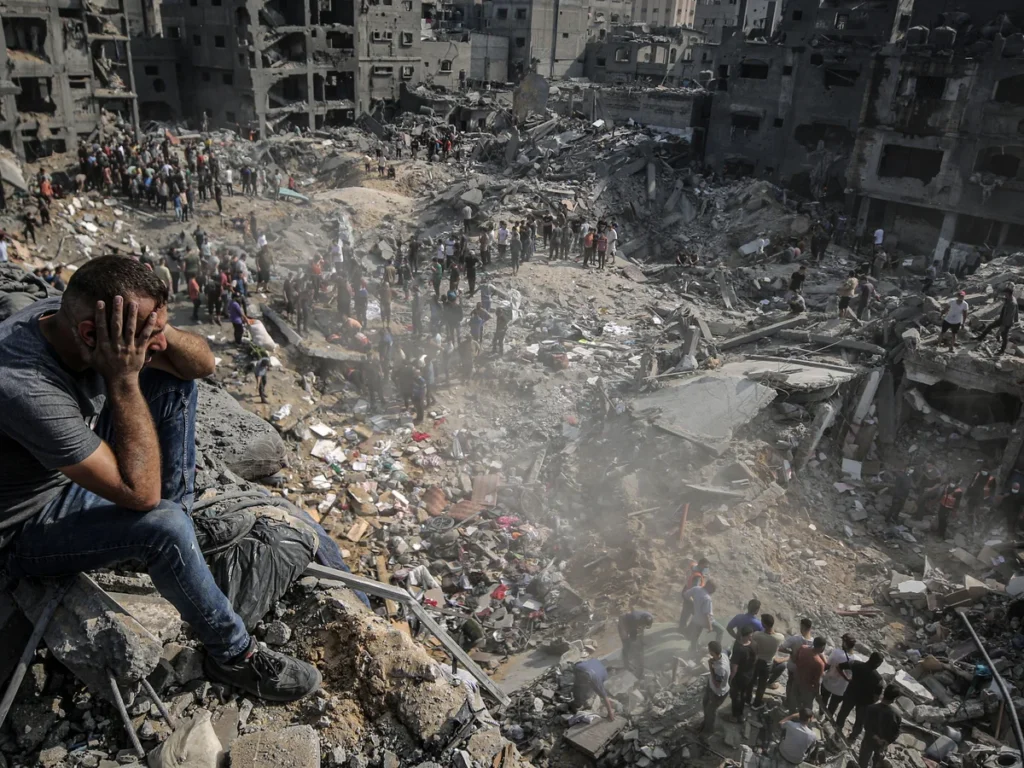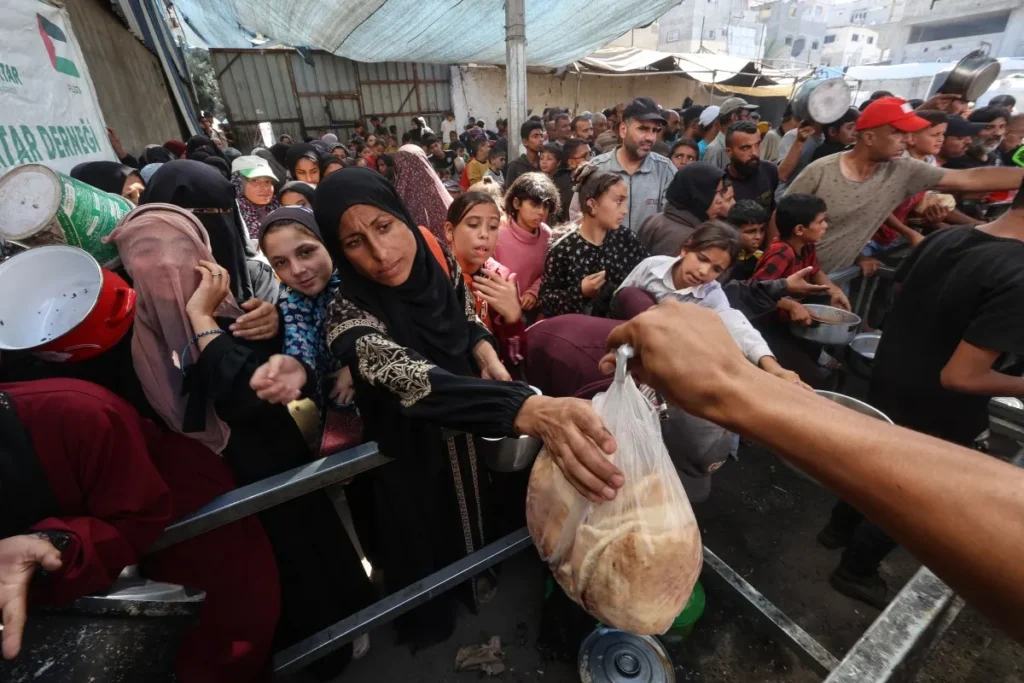
Gaza Herald_ Since the announcement of a ceasefire to halt Israel’s genocidal war on Gaza, little has changed for Palestinians on the ground. Israeli authorities continue to use border crossings and humanitarian aid as tools of political and security blackmail, deliberately delaying the implementation of the agreement that stipulates the entry of sufficient supplies into the devastated enclave.
Meanwhile, Israel has launched a misleading propaganda campaign, releasing selective images of Gaza’s markets showing food on display to create the illusion of normalcy and recovery after the genocide. However, these carefully staged scenes conceal a harsher reality: prices remain astronomically high, far beyond what most residents can afford. The majority of Gaza’s population faces acute food insecurity, a lack of cash circulation, and severe shortages of basic goods in neighborhoods reduced to rubble.
A Policy of Strangulation and Humanitarian Extortion
According to Gaza’s Government Media Office, only 986 aid trucks have entered the Strip since the ceasefire took effect on October 10, including just 14 carrying cooking gas and 28 with diesel fuel. Out of 6,600 trucks that should have entered by Monday evening under the agreement—an average of 600 trucks per day—Israel has allowed barely a fraction through, continuing its policy of suffocation, starvation, and humanitarian extortion against more than 2.4 million Palestinians.
Officials stress that these limited quantities fail to meet even the bare minimum of Gaza’s humanitarian needs. The enclave requires at least 600 trucks of aid daily, carrying food, medicine, relief materials, fuel, and cooking gas to maintain minimal living conditions. Over 22,000 wounded and sick Palestinians urgently need to travel abroad for more than 500,000 surgical procedures. At the same time, 288,000 displaced families remain homeless and in desperate need of tents or temporary housing as winter approaches.
Winter Approaches the Tents
The fear of another cold, miserable winter looms large. Heba Alaa al-Din, a mother of five, wonders how she will keep her children warm inside a thin fabric tent. During Israel’s latest assault on Gaza in August—an offensive aimed at reoccupying parts of the city—her family lost their home near Sheik Radwan Reservoir. “We refused to leave Gaza City during the genocide,” she said. “We moved from one place to another. Part of our house burned, and my brothers-in-law’s apartments were badly damaged. But in the last attack, the entire building was flattened. The area looks like an earthquake hit it.”
Pausing to look at her children, Heba added that this winter feels like the hardest yet. “We don’t know how we’ll survive the cold.”
International organizations have repeatedly called for expanding humanitarian access to Gaza. The World Food Programme reported that the amount of aid entering the Strip since the ceasefire remains minimal—sufficient for only 500,000 people for two weeks. Although some shipments reached northern Gaza, the quantities are far from enough to cover the needs of a population facing acute shortages of food, clean water, and basic supplies.
Similarly, UNRWA spokesperson Adnan Abu Hasna said Israel continues to block around 6,000 aid trucks waiting at Gaza’s gates—enough to feed the population for six months—along with hundreds of thousands of tents and shelter materials needed for the coming winter. Only a small number of commercial trucks have been permitted entry, while 95% of Gaza’s population depends entirely on humanitarian aid and cannot afford to buy these goods.
A Struggle to Prevent the Collapse of the Ceasefire
Amjad Al-Shawa, head of the Palestinian NGO Network in Gaza, warned against focusing solely on truck counts without addressing the quality and type of aid entering the Strip. He emphasized that the urgent priority is food, clothing, tents, shelter materials, and water infrastructure—including desalination stations and water tanks—to secure daily essentials.
Al-Shawa told Al-Araby Al-Jadeed that Gaza needs more than 1,000 aid trucks per day to meet actual humanitarian needs.
Meanwhile, Egyptian media reported intensive consultations in Cairo between Egyptian officials and Hamas leadership, focusing on fully reopening the Rafah crossing and returning the remains of Israeli captives as part of the next phase of talks in Doha, Qatar.
Cairo News Channel said Egypt’s intelligence chief, General Hassan Rashad, traveled to Israel today to discuss stabilizing the fragile ceasefire amid growing diplomatic efforts to prevent its collapse.