
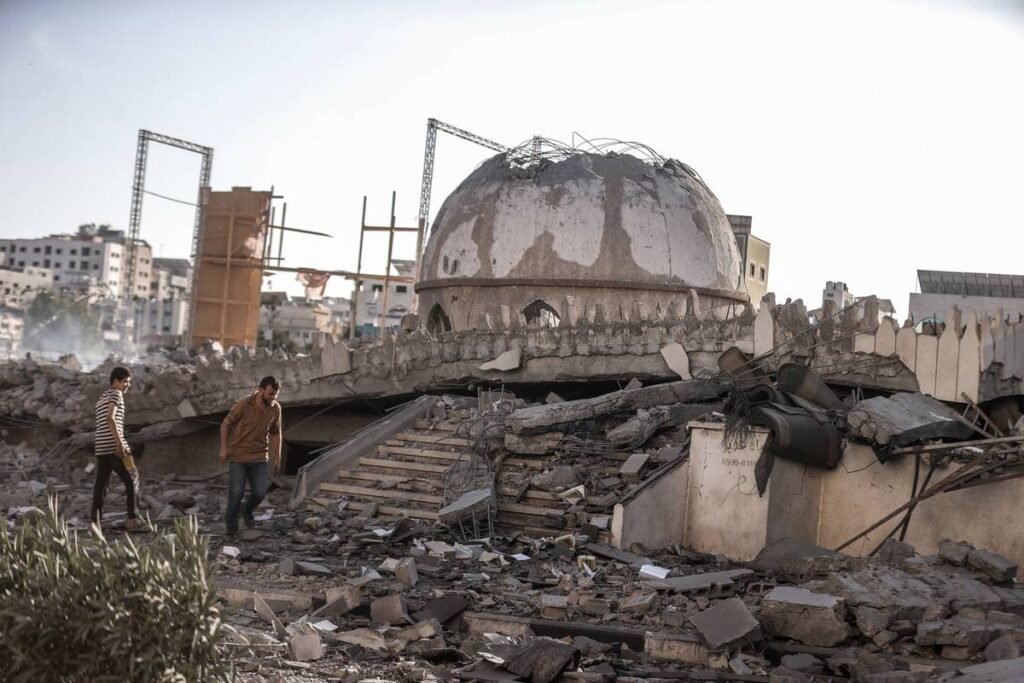
Gaza Herald _ Amid the ongoing genocide in Gaza, a displaced Palestinian family stumbled upon a half-destroyed home that still stood against the rain. They moved in, clinging to the illusion of shelter and safety in a world reduced to ash.
For a brief moment, the quiet felt merciful, until an Israeli sniper shattered it.
The mother, stirring a pot of lentils over a fire, her six-month-old asleep on her lap, was struck in the chest. Her husband’s desperate attempt to rush her to a hospital triggered more gunfire. Trapped, he watched her bleed to death.
Even her burial drew bullets. With no safe ground to dig, he found an old solar-powered refrigerator. Wrapping her in plastic and rope, he placed her body upright inside. The children, refusing to believe, kept talking to her.
“Why won’t you answer, Mama?” they asked.
Ten days later, when the guns fell silent for a moment, the father lifted her frozen body, wrapped it in a blanket, and found a place to finally lay her to rest.
This story is one among many in Witness to the Hellfire of Genocide: A Testimony from Gaza by 24-year-old Wasim Said , a chronicle of survival, memory, and the unbearable cost of silence.
Writing from the Edge of Death
Said, a physics student from Beit Hanoun, began writing his book in the midst of destruction , between October 2023 and January 2025 , hoping to capture life in Gaza before it was extinguished.
He didn’t finish his first chapter before Israel shattered the ceasefire, and Gaza descended deeper into unthinkable horror.
His world became one of constant flight, endless hunger, and unbearable thirst. Water was poisoned or destroyed, food was denied, and hospitals were rubble. Every day brought new bodies in the streets, people killed searching for water or bread.
At night, under the hum of drones, Said wrote by candlelight or none at all, each word a rebellion against erasure. He wrote not to be pitied, but to leave proof that he once existed.
“Read this not as fiction,” he writes, “but as a gravestone. As if a voice beneath the dirt were whispering: I was here. I could have lived , if only you had spoken.”
The Collapse of Ordinary Life
The book opens on October 7th, as bombs rained over Gaza. Said describes his family of thirty fleeing through streets that looked like the Day of Judgment , limbs scattered, the marketplace reduced to fire.
He and fifty others took shelter in a classroom just ten meters wide. Soon, twenty thousand people crowded into the same school. With only ten toilets for all of them, Said timed his trips to 1 a.m. to avoid the line.
But the real story, he says, belongs not just to him, but to everyone who survived the impossible.
Bearing Witness for the Silenced
Said decided to widen his lens:
“It would be unjust to keep the story only mine,” he writes. “These pages must hold the voices of those the world never heard, the unseen faces, the suffering that cameras ignored.”
From mass graves to famine lines, he recounts a people surviving by sheer will. Bread became a treasure. Families rationed crumbs and prayed for flour.
The Flour Massacre
Then came February 29, 2024 — the flour massacre.
Israeli soldiers and foreign mercenaries opened fire on starving Palestinians gathered near Gaza City to collect flour from aid trucks. At least 109 were killed, thousands wounded.
Said’s family friend, Abu Malik, survived. “Wasim,” he said, “it was flour mixed with suffering, mud, and body parts.” He swore never to go again.
Helicopters later dropped aid that crushed people beneath it or sank into the sea. “The birds of paradise,” one survivor said, “turned out to be the dragons of hell.”
Between Hunger and Humanity
Even amid famine and violence, Said found glimmers of human dignity, neighbors sharing scraps, youth risking their lives to reach bombed bakeries.
He writes about two surviving bakeries in Deir al-Balah where fights broke out in the lines. As he struggled for bread, he thought of his younger brother’s cries of hunger echoing in their tent.
“The sound of his stomach,” Said wrote, “roared in my head like thunder.”
Children were trampled in the chaos, some abandoning bread altogether to save their lives. Still, the moral fabric of Gaza held firm , compassion endured where the world’s humanity did not.
The Unwritten Tombstone
Said’s testimony, written while fleeing airstrikes, stands as both memorial and indictment.
His friend Mousa Alsadah describes it as “a message from the valley of death, from the inferno of genocide, to the Arabs and to all of humanity.”
And indeed, it is.
As readers, we glimpsed Gaza’s ruin through screens between meals and morning commutes. But Said’s words demand more , not a moment of pity, but a lifetime of reckoning.
Louis Allday, who helped translate the text, calls it an act of resistance , not only mourning what was lost, but fighting to change what remains to come.
Said writes without flourish, without escape. Every word bears the hum of drones and the tremor of explosions.
“They are part of the text itself,” Alsadah writes. “You can hear them between the lines.”
Bearing the Weight of Witness
When history writes its volumes on Gaza, many voices will tell its story. But few will carry the immediacy of Wasim Said , a young man writing from the mouth of hell itself.
His book is not just testimony.
It is the living echo of a people who refuse to be erased.

