
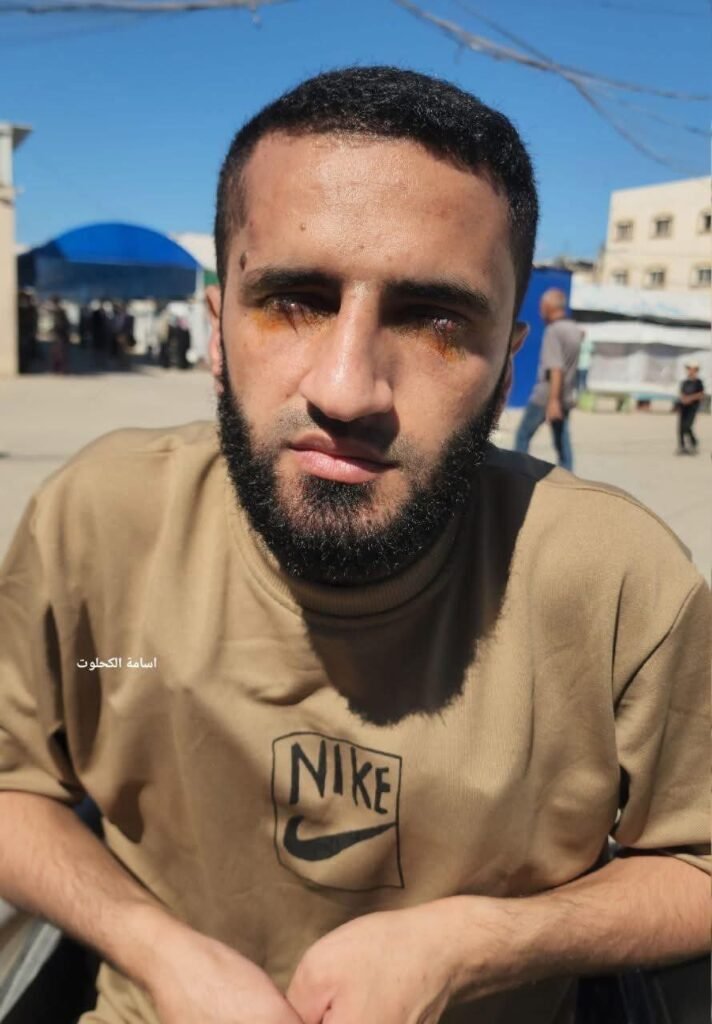
Gaza Herald_ In the heart of Gaza’s devastation, 28-year-old Mahmoud Abu Foul sits in a tent among the ruins, his eyes clouded with darkness, the price of eight months in Israeli custody. Once a victim of a 2015 bombing that took his leg, Mahmoud’s story is a portrait of suffering repeated across generations of Palestinians. Arrested late last year from Kamal Adwan Hospital during Israel’s military campaign, he says his detention was marked by relentless torture, humiliation, and medical neglect.
“During the first seven days, it felt like being held in a waiting zone, constant beatings, insults, and humiliation,” Abu Foul said, recalling the beginning of his ordeal. “We were handcuffed and blindfolded almost all the time — I spent around 280 hours shackled, maybe more.”
He described even the most basic human acts as a form of torment. “You had to lower your blindfold just enough to find your food,” he said, describing meals as part of the psychological abuse meant to strip detainees of dignity and control.
Mahmoud was later transferred to Sde Teiman, a military base in the Negev desert that former detainees have described as a site of systematic torture and inhumane treatment. “It’s the prison that breaks men,” he said bitterly, recalling the words used by other prisoners. There, he endured repeated beatings and electric shocks until one day, he was struck so violently on the head that he lost consciousness.
When he awoke days later, Mahmoud realized he could no longer see.
“When I woke up, I realized I had lost my sight,” he said quietly, his voice heavy with disbelief. “I kept asking for medical treatment, but they only gave me one type of eye drops. It reduced the inflammation, but not the pain. My eyes kept tearing, full of discharge, but no one cared.”
Even his hunger strike, a desperate plea for medical care, was met with silence.
Now back in Gaza, Mahmoud lives under a tent near the ruins of his home, his body scarred and his vision gone. His story is one of hundreds that have emerged since Israel’s mass arrests and detentions began during its war on Gaza, where hospitals, schools, and shelters have become targets.
His testimony sheds light on what rights groups, including Amnesty International and Human Rights Watch, have called a systematic campaign of torture and enforced disappearance against Palestinians detained since the start of Israel’s assault.
In a land where the wounded are re-arrested and the blind are left untreated, Mahmoud’s words echo through the rubble:
“They can take our eyes, our homes, our freedom, but not our truth.”

