
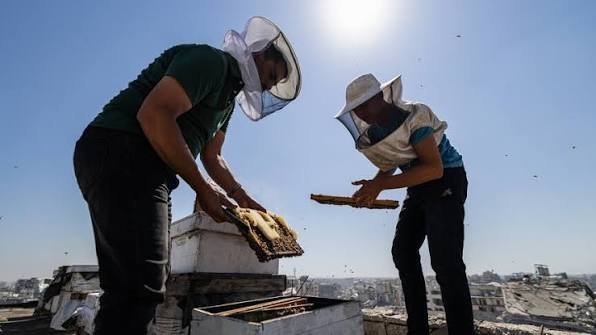
Gaza Herald _ Thousands of beehives have been destroyed, vegetation has been devastated, and hundreds of beekeepers are struggling to survive as Gaza’s once-thriving honey industry faces unprecedented losses.
A once-flourishing industry devastated
Gaza’s beekeeping sector has suffered an estimated $39 million in losses since October 2023, according to the Cooperative Society of Beekeepers in Gaza.
The organization said nearly 30,000 beehives have been destroyed, while more than 6,000 workers have lost their livelihoods as the war has damaged agricultural land, destroyed vegetation, and restricted access to key areas where bees once fed.
Before the war, Gaza’s beekeepers produced between 380 and 400 tons of honey annually, supplying local markets and supporting hundreds of families. Today, the industry is struggling to survive amid widespread destruction and severe shortages of essential supplies.
Destruction of Gaza’s apiaries
The Cooperative Society of Beekeepers said Israeli military operations have wiped out a large portion of Gaza’s apiaries and damaged more than 85 percent of vegetation and forest areas that served as critical grazing grounds for bee colonies.
The destruction has affected around 905 registered beekeepers across the Strip, many of whom depended on honey production as a primary source of income.
Beekeepers cut off from vital land
In the central Gaza town of Al-Zawaida, beekeeper Amin Eid is trying to preserve what remains of his family’s decades-old trade.
Before the war, Gaza had hundreds of beekeepers who produced and distributed locally made honey. But Eid said the conflict has transformed the industry, leaving producers with only a fraction of their former capacity.
He said the Israeli military’s establishment of the so-called “Yellow Line” under the U.S.-backed ceasefire framework has prevented beekeepers from reaching eastern areas beyond Salah al-Din Street, which were among Gaza’s most important grazing zones for bees.
“Beekeepers cannot move their hives there because of security risks and restrictions on movement,” Eid said, explaining that attempting to access those areas could put their lives in danger.
Rising costs threaten recovery
The cost of rebuilding the industry has also surged under blockade conditions.
Eid said the price of a box of wax sheets has increased from around 30 shekels ($9.83) before the war to between 1,200 and 1,500 shekels ($393–$491) today.
Many beekeepers who once managed hundreds of hives now have only a small number remaining and are attempting to restart their businesses with limited resources and overwhelming costs.
He said shortages of wood and beekeeping equipment have made recovery even harder, especially after many residents were forced to burn available materials for heating during periods of fuel shortages and hunger.
Calls for support to save Gaza’s honey production
Eid called on international organizations and agricultural groups to provide urgent assistance, including wax sheets, frames, hive boxes, sugar supplies, and safe access to natural grazing areas.
“Gaza can produce high-quality natural honey, but restrictions prevent us from using these resources,” he said, recalling that local producers once described honey as “yellow gold.”
Despite the destruction, Gaza’s beekeepers are attempting to keep the industry alive by moving surviving colonies to coastal areas and residential neighborhoods, where limited vegetation remains available.
For hundreds of Palestinian families, beekeeping remains more than a source of income; it is a vital part of Gaza’s food system and a symbol of resilience amid an ongoing humanitarian crisis.

