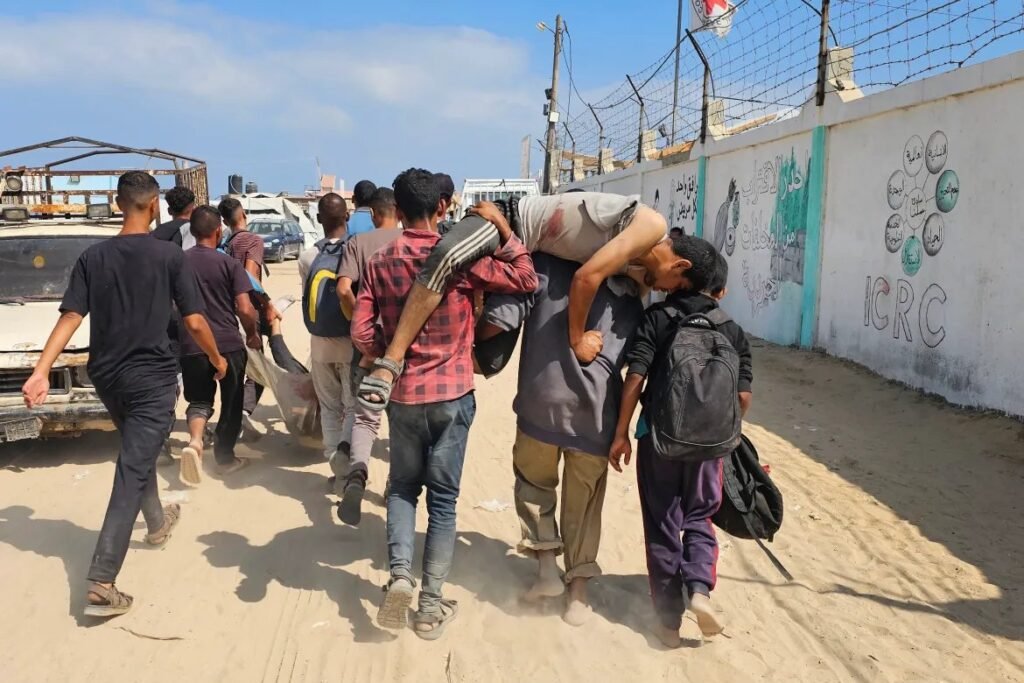
Gaza Herald — As Israel’s genocidal war on Gaza surpasses 65,000 deaths and leaves more than 168,000 wounded, a different battle unfolds behind closed doors: who will rule Gaza after the war?
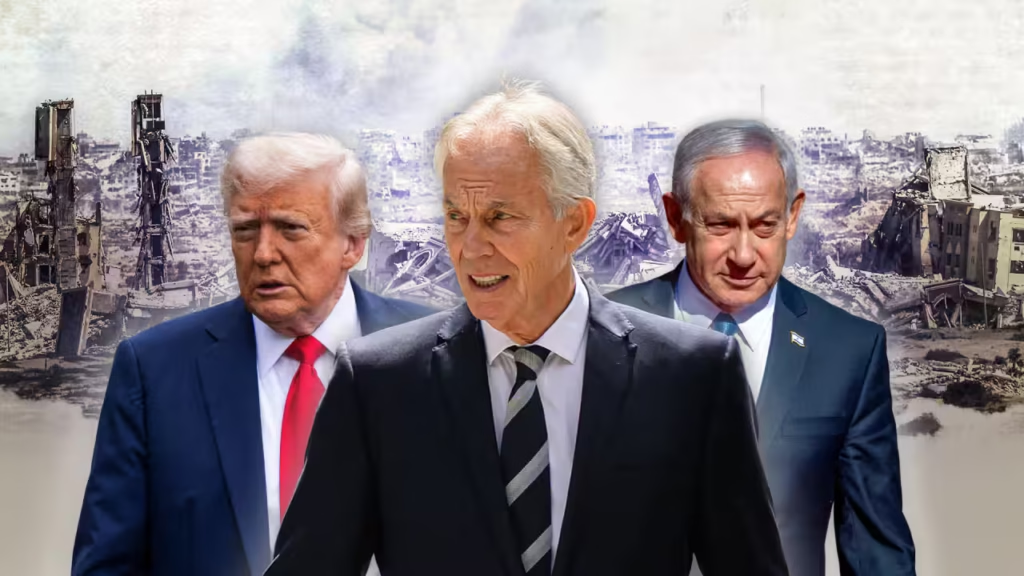
Former British Prime Minister Tony Blair is advancing a blueprint for a so-called “Gaza International Transitional Authority” (GITA), cloaked in the legitimacy of the UN but carrying sweeping implications for Palestinian sovereignty. Documents, structural outlines, and budgets reveal a political project that critics warn could entrench external domination while erasing the possibility of genuine Palestinian self-determination.
What the Blair Plan Proposes
The proposal envisions a supreme authority under a UN Security Council mandate for five years. A council of 7–10 members, mostly Western figures and business elites, with only token Palestinian representation, would act as Gaza’s “supreme political and legal authority,” empowered to issue binding legislation and oversee governance.
Local ministries would exist but be staffed by technocrats monitored by the council. Security would be managed by a multinational force at borders and crossings, while a demilitarized Palestinian police unit maintained internal order. Economically, a Gaza Investment and Development Authority (GIPEDA) would drive reconstruction through foreign investment, turning Gaza into an externally managed economic zone.
Budgets Prioritize Control over Recovery
The financial blueprint places heavy emphasis on security structures and oversight bodies, while large-scale reconstruction is left to vague donor commitments outside the core budget. Offices earmarked for Cairo, al-Arish, or Amman signal that external management would dominate. Donor leverage would grant foreign governments and corporations extraordinary power to dictate Gaza’s economy and society.
Political and Legal Implications
Blair’s model is less about humanitarian relief than about reimposing international custodianship. Palestinian representation is symbolic, while real decision-making rests with outsiders. The proposed security system is designed to neutralize resistance and remove Palestinian factions, including the Palestinian Authority, from shaping Gaza’s future.
Economically, GIPEDA entrenches dependency, redirecting reconstruction into profit-driven projects that prioritize investors. Most troubling is the plan’s property registration scheme, which could legitimize permanent displacement by legalizing demographic engineering.
Legal experts warn that the plan undermines international law: Gaza remains an occupied territory, and Israel, as the occupying power, is responsible for civilian protection and reconstruction under the Geneva Conventions. A trusteeship would absolve Israel of its obligations while criminalizing Palestinians’ right to self-determination and resistance.
Regional and Global Reactions
The plan has been promoted in U.S. and Israeli circles, reportedly with backing from Jared Kushner and “full support from Trump.” Netanyahu remains cautious but maintains dialogue with Blair. Finance Minister Bezalel Smotrich, meanwhile, openly boasts of Gaza’s “real estate wealth.”
Palestinian officials reject the plan outright. Deputy Foreign Minister Omar Awadallah declared, “Gaza is an integral part of the State of Palestine. We will not accept any plan that treats it as real estate or a financial investment for foreign companies while excluding Palestinians.” Hamas has denounced Blair as unwelcome, while Turkey’s Foreign Minister Hakan Fidan dismissed the proposal outright.
Commentators have been even harsher. British journalist David Hearst described Blair’s role as “vultures feeding on the Palestinian holocaust.” Ash Sarkar remarked, “The devil was busy, so Blair showed up.” UN Special Rapporteur Francesca Albanese simply wrote: “Tony Blair? Hell no.”
What’s at Stake
If implemented, Gaza would effectively be placed under external trusteeship. International bodies and business elites would dictate security and economic policy, while Palestinians would be reduced to service providers under occupation. Donor aid would become political leverage, reconstruction would be weaponized, and sovereignty would be erased.
This model aligns with Israel’s long-term strategy: retaining security control while evading legal responsibility for genocide and destruction. But such a plan risks provoking mass resistance and collapsing under its own illegitimacy.
The Palestinian Alternative
True recovery requires an immediate and unconditional end to Israel’s assault and blockade, a full withdrawal of Israeli forces, and the empowerment of a Palestinian administration built on internal consensus. Reconstruction should serve Palestinian society, not foreign investors, and accountability must be pursued through the ICC and other mechanisms for Israel’s crimes.
The essential question remains: who gives Tony Blair the authority to decide Gaza’s future? Palestinians are the rightful owners of their land and destiny. Any plan that sidelines them in favour of foreign trusteeship is not a path to peace but another form of colonial control.