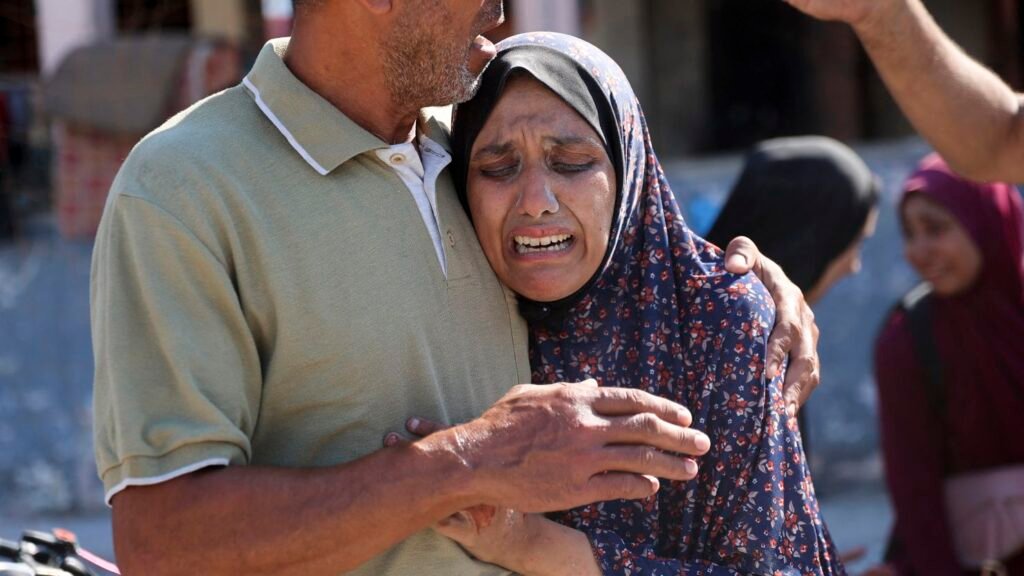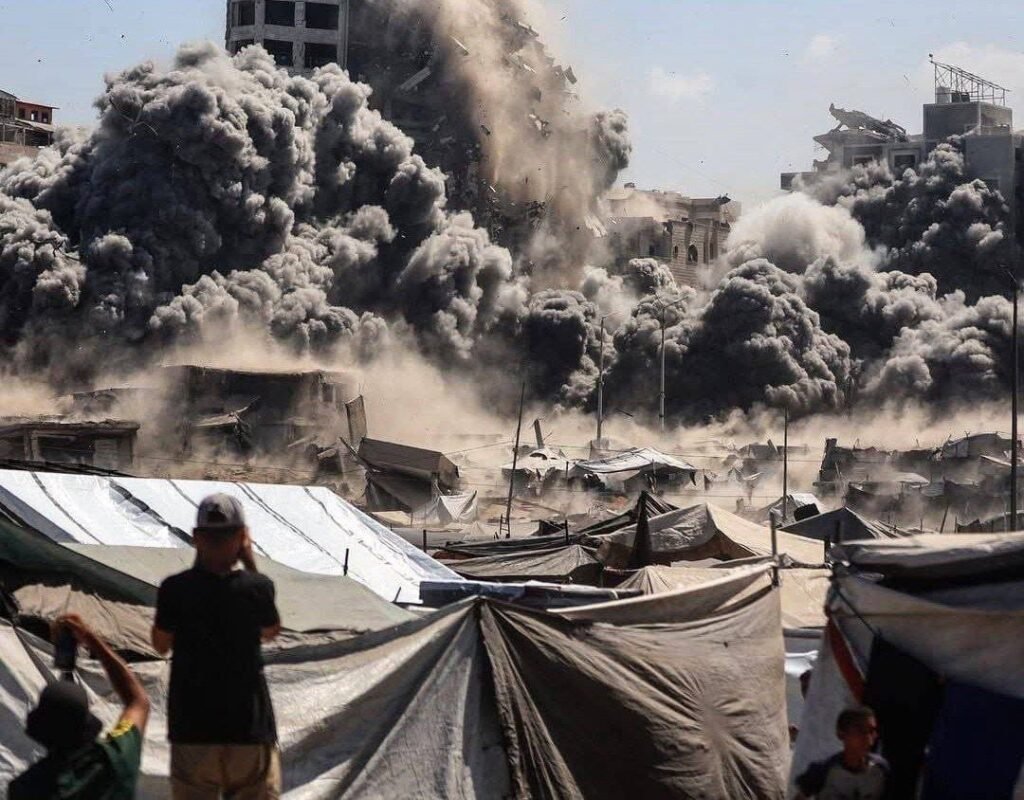
Gaza Herald- The Israeli military has intensified its campaign against Gaza City, not only through bombs and missiles but through the systematic destruction of the very essentials that sustain life. Palestinians who once vowed to remain in their homes, even under constant bombardment, are now being forced to abandon their neighborhoods, not by direct strikes alone, but by the calculated removal of water, electricity, shelter, and communication. This deliberate policy is part of Israel’s wider strategy to depopulate Gaza City and push nearly one million of its residents toward mass displacement.
A War Against Survival
Since mid-August, Israel has escalated its attacks on vital lifelines: high-rise buildings, schools-turned-shelters, rooftop solar panels, water tanks, internet hubs, and mobile charging stations. For families who relied on these fragile resources, survival has become impossible.
Emad Sarsawi, a 43-year-old resident, explained how the bombing of solar panels in his neighbourhood sealed the fate of many families. “I swore I would never leave, even if it meant dying with my wife and children. But this is worse than death. Without water, without power, without a way to even know what’s happening outside, we are left to die slowly.”
Israel’s Broader Plan for Gaza
Since launching its genocide in October 2023, Israel has cut off water, electricity, and fuel, bombed communications infrastructure, and blocked aid. Gaza’s 2.2 million people have endured famine and repeated total blackouts. Last month, Israel officially approved its plan to occupy the Strip, starting with the seizure of Gaza City.
Within weeks, hundreds of homes were demolished, more than 1,800 people killed, and thousands injured. In total, over 64,800 Palestinians have been killed and 164,000 wounded since the war began, 80 percent of them civilians, according to leaked Israeli military figures. Yet, despite the carnage, hundreds of thousands still refuse to leave Gaza City, insisting that nowhere else in the Strip is safe.
Destroying Gaza’s Charging Points
In the absence of household electricity, street-side charging points powered by solar panels became a lifeline. For a small fee, displaced families could recharge phones and stay in touch with loved ones.
But Israel has now begun to target these hubs. “When they bombed one building, it wasn’t the apartments they were after—it was the charging point on the ground floor,” said 26-year-old displaced resident Ahmed Ubeid. “The next day, another neighbour shut his down out of fear. Without phones, we are blind and cut off.”
He added that many displaced Palestinians now relocate south, not out of choice, but because the basics of survival, charging a phone, finding water, are being deliberately wiped out.
Bombing Schools and Shelters
The strategy has extended to schools, which for nearly two years have doubled as shelters for displaced families and as sources of water and electricity for entire neighborhoods. Over the past week, Israel has ordered evacuations of multiple schools in Gaza City, particularly in the Tal al-Hawa area, before bombing them.
Ubeid, who has lived in one such school with his family since being displaced from Shujaiya, said: “This school became our home. All schools in the South are overcrowded. There’s not even space in the streets for more tents. By closing schools here, they are cutting us off from drinking water, from electricity, from any chance of survival.”
He added, “They are shutting down every service that keeps us alive. Those who insist on staying find themselves abandoned, second-guessing their decision, watching their neighbourhoods collapse into silence.”
The systematic destruction of Gaza’s lifelines is more than collateral damage; it is a weapon of war. By erasing water sources, destroying solar panels, bombing schools, and targeting charging points, Israel is enforcing mass displacement through deprivation. What bombs do not achieve instantly, the absence of electricity, water, and communication ensures over time. For Palestinians in Gaza City, survival itself has been turned into a battlefield, and the choice is no longer between life and death, but between dying under the rubble or dying slowly from thirst and isolation.