
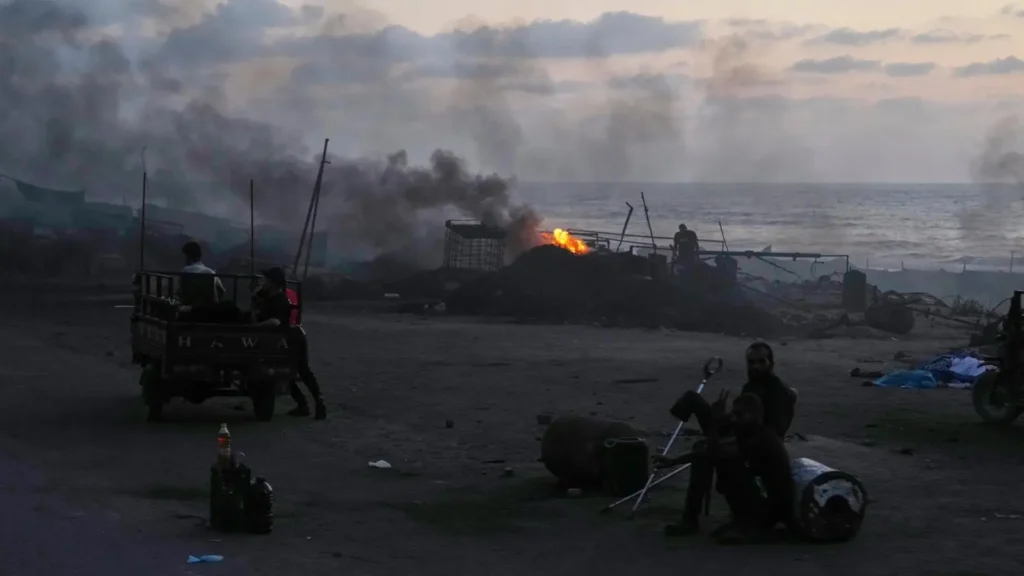
GazaHerald – Israel has threatened to destroy a ten-story residential building in Gaza City that for more than a decade housed thousands of archaeological artifacts, Haaretz reported. The warehouse, located on the ground floor, stored antiquities collected over thirty years under the supervision of the French Biblical and Archaeological Institute of Jerusalem (EBAF).
Following the warning issued on Wednesday, the Ecole Biblique and EBAF urgently appealed to the French government, UNESCO, and the Latin Patriarch of Jerusalem for intervention. These appeals helped delay the bombing long enough for a last-minute rescue operation to be carried out.
By Thursday, under dangerous and chaotic conditions, the antiquities were secretly transferred to a safe location. “This is a high-risk operation in extremely dangerous conditions for all involved,” said Dominican friar Olivier Boucquillon, EBAF’s director, who described the frantic efforts to save a rare chapter of Gaza’s history.
Father Boucquillon stressed the near-impossible logistical challenges: “There are almost no international actors on the ground. There is no longer any infrastructure, so we had to find solutions, transportation, and workers when nothing was working.”
The operation was conducted discreetly to avoid putting lives at risk, as Israeli bombardment of Gaza City’s residential towers continued. Israel has claimed that Hamas uses such towers for military purposes, a justification widely rejected by heritage experts and human rights organizations.
Heritage Under Fire
The rescued antiquities are considered “extremely ancient heritage, very precious to the region,” Boucquillon said, reflecting Gaza’s role as a crossroads of civilizations, from the Pharaohs and Greeks to the Byzantines and Islamic eras.
But not everything could be saved. Archaeologist René Elter, who documented many of the pieces, admitted, “We saved a large portion of the antiquities, but in the process of rescue there is always damage and choices. There will always be regret.” He emphasized the scientific importance of the warehouse, where every artifact was meticulously preserved and studied, warning that “perhaps this will be the only remaining trace of Gaza’s archaeological history, through books, publications, and libraries.”
UNESCO reports that at least 94 heritage sites in Gaza have already been damaged since the war began, including the 13th-century Pasha Palace. The Strip’s two main museums have also suffered devastating losses, one completely destroyed, the other severely damaged.
These attacks come alongside the ongoing bombardment of Gaza’s homes, hospitals, schools, mosques, churches, and universities. Observers warn that Israel’s assault is not only devastating Gaza’s civilian population but also erasing its cultural and historical memory.
“Gaza is one of the oldest cities in the world,” Boucquillon said, noting the tragic irony that a city shaped by countless civilizations now faces the deliberate destruction of its heritage.

