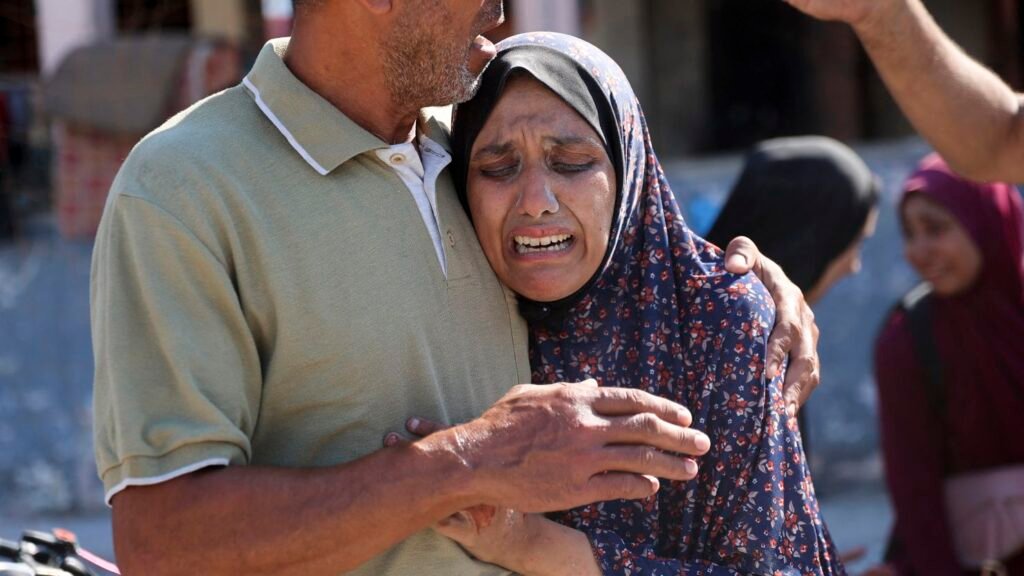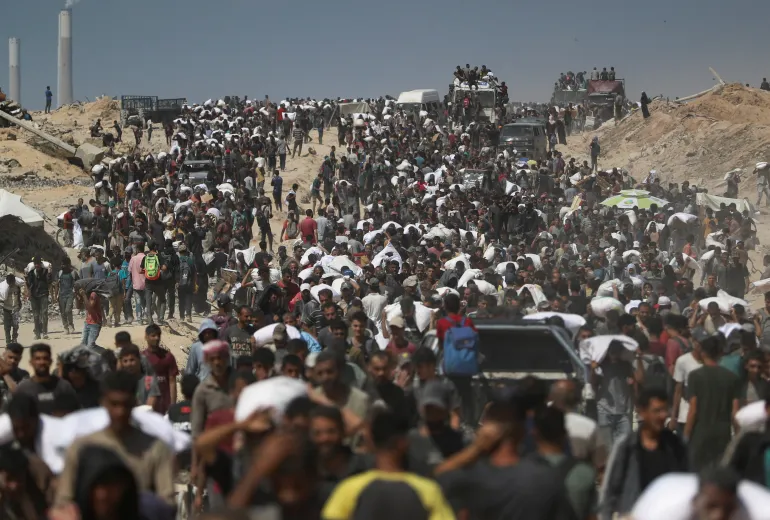
Gaza Herald- Gaza today is a landscape of destruction and despair, where ordinary acts like fleeing home have become exercises in survival. Families are trapped in a relentless cycle of displacement, unable to find safety anywhere in the besieged territory. Roads are clogged with rubble, children cry for food and shelter, and every step forward carries the shadow of imminent danger.
Amid this human catastrophe, the stories of those fleeing, returning, or struggling to survive reveal the full scale of the humanitarian crisis and the high cost of living under continuous bombardment.
Displacement in Gaza is no longer simply a journey from one place to another; it has transformed into a relentless cycle of suffering. Along roads littered with rubble and the cries of children, families move southward, carrying nothing but fear and a few tattered blankets. Yet the supposed refuge offers no protection, only uncertainty and the looming threat of death.
The background is never silent. Bombs explode, smoke thickens the sky, and the shadow of danger accompanies every step. The displaced constantly glance over their shoulders, as though pursued by death itself.
Bombardment Instead of Orders
The Israeli occupation has refrained from issuing a formal evacuation order for Gaza City. Instead, it has relied on a far deadlier approach: relentless bombardments, robot-delivered explosives in narrow alleys, and incendiary devices that consume homes and tents.
Maher Abu Rizq, forced to flee al-Zaytoun neighborhood, recalled, “We didn’t wait for any order. Houses around us were collapsing. Robots entered the alley and detonated near my brother’s home. No one survived under the rubble. After that, we grabbed our children and ran.”
The Cost of Flight
Displacement has become a struggle with economic exploitation. Renting a small truck to transport a family can exceed 2,500 shekels, while the cost of one square meter of empty land in al-Mawasi or Deir al-Balah reaches 15 shekels per month.
Reem Awad, a widow fleeing south with her three children, said, “I spent all my savings just to leave. Then I learned I had to pay rent for land to pitch a tent. I had nothing, so we stretched a piece of cloth along the roadside. At night, bombs explode as if the battlefield followed us.”
Returning to the North
In a cruel twist, some families are returning north. Overcrowded southern areas, lack of basic services, and ongoing attacks in so-called “safe zones” leave them with no choice but to go back.
Khaled Shubeir explained, “We thought the south would be safer, but it was a trap. There, we risk hunger and disease; here, bombardment. We chose to face death in the ruins of our homes.”
Camps of Desperation
Camps hosting the displaced are overcrowded forests of tents with minimal water, no sewage systems, and almost no medicine. Children sleep on the bare ground, falling ill as disease spreads unchecked.
Hala Mansour, a volunteer in al-Mawasi camp, Khan Yunis, told our reporter, “The tents are so close that a single shell could wipe out dozens. Even the thin canvas offers no protection from rain, sun, or shrapnel. Children get sick without medicine, and families wake up each night to explosions.”
A Looming Medical Catastrophe
Gaza’s healthcare system is crumbling under siege and attacks.
Dr. Rami Zaarab explained, “We face thousands of injuries daily, along with hundreds suffering from respiratory and skin illnesses due to overcrowding. We have no antibiotics, disinfectants, or even basic gauze. Any new displacement wave will trigger an uncontrollable health disaster.”
The Economy of Death
War has devastated Gaza’s economy. Even displacement itself has become a black market, with exorbitant prices for transportation, blankets, and even drinking water.
Mahmoud Jaber, once a taxi driver, said, “Now, I wander homeless with my family. I saw traders charging triple for a sack of flour. The displaced have become involuntary customers, while the occupying army leaves us to die amid hunger and bombs.”
Childhood Stolen
Children bear the heaviest toll: no schools, no play, no safety. Some scribble fragments of stories in tattered notebooks while living through unthinkable horrors.
Ten-year-old Sundus shared her dream: “Just one night without rockets and bombs. We’ve been deprived of food, safety, water, shelter, and education, and now our lives are threatened every moment. They stole our childhood.”
No Safe Haven
For Gazans, there is no safe place. The north is under fire, the south crowded and disease-ridden, and the sea blocked. Displacement has become a journey between two deaths, while remaining behind is equally deadly. Families move from one danger to another, trapped in an unending circle of fear, destruction, and despair.
The plight of Gaza’s displaced is a stark reminder that there are no easy solutions in a land under siege. Families move between destruction and disease, children grow up amid fear and loss, and necessities have become luxuries. Yet amid this suffering, the courage of those who flee, rebuild, or stand in solidarity, whether inside Gaza or across the world, speaks to a resilient human spirit. Their stories call on the international community to recognize the reality on the ground and to act decisively to alleviate the suffering, protect civilians, and uphold human dignity.