
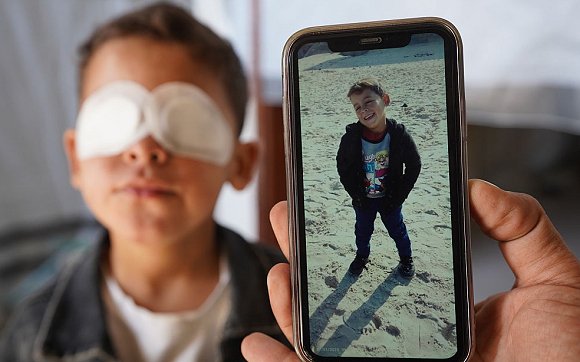
Gaza Herald – Between the narrow tents of displacement camps in Deir al-Balah, 12-year-old Mohammed Awda now walks slowly, feeling his way through life after losing his sight when a genocide remnant he thought was a toy exploded in his hands.
“I thought it was a toy, but it exploded in my face. Since that moment, I haven’t seen anything,” he said.
The child also lost four fingers on his left hand, leaving him fully dependent on others for basic daily tasks.
He clings to hopes of receiving specialized treatment and surgeries that could restore part of his vision, but those hopes fade amid the ongoing blockade and the collapse of Gaza’s healthcare system.
Life turned upside down
Inside a cramped tent lacking basic living conditions, Mohammed sits beside his father, who helps him eat and get dressed after he once lived as an active, independent child.
His father, Hossam Awda, said: “Mohammed’s life has turned completely upside down.”
He added: “He used to love playing and moving around. Now he lives in total darkness. Sometimes he even asks me in broad daylight: is it night or day?”
The father described the question as heartbreaking, reflecting the shock experienced by a child who suddenly lost his sight due to war remnants.
Double suffering in displacement
Mohammed’s suffering is compounded inside overcrowded displacement camps, where basic services are absent and no facilities exist for persons with disabilities, making his daily movement extremely difficult.
This comes amid widespread destruction caused by the genocide, which Palestinian sources estimate has damaged around 90% of Gaza’s infrastructure, including homes, roads, and public facilities.
Despite everything, Mohammed still holds onto a simple hope: “The war took my childhood, but I want to live like other children, to learn, play, and move freely.”
Education and hope
Despite his condition, the child insists on continuing his education, relying on listening instead of sight to follow lessons.
He studies at Al-Noor Center for the Blind, run by UNRWA in Deir al-Balah.
“I want to study and finish my education, and my dream is to travel for treatment,” he said.
Medical hopes fading
Doctors say there is still a chance for partial recovery if he receives proper treatment, but Gaza’s collapsing health system and strict blockade make this nearly impossible.
His father says his son urgently needs complex surgeries, including nerve reconstruction, facial repair, corneal transplantation, and prosthetic support, none of which are available locally due to shortages and restrictions.
“I want nothing in this world except for my son to see me again and return to a normal life,” he said. “The landmine didn’t just hit his eyes, it hit my heart.”
He added: “I will remain his life support, but how can I help him when I cannot take him for treatment? The closure is a death sentence for him.”
Growing danger from unexploded ordnance
Warnings continue over the danger of unexploded ordnance in Gaza.
In April 2026, the UN Mine Action Service (UNMAS) warned of the rising risk from explosive remnants of war after two years of genocide, reporting hundreds of casualties linked to such devices, with numbers likely underreported.
Earlier estimates by Gaza Civil Defense spokesperson Mahmoud Basal suggested that around 71,000 tons of unexploded explosives and military remnants remain scattered across the territory.

