Gaza Herald_ A new investigation has uncovered the role of armed groups operating inside the Gaza Strip that are accused of working in coordination with Israeli military forces against Palestinian civilians, as Israel’s genocidal assault on the enclave continues.
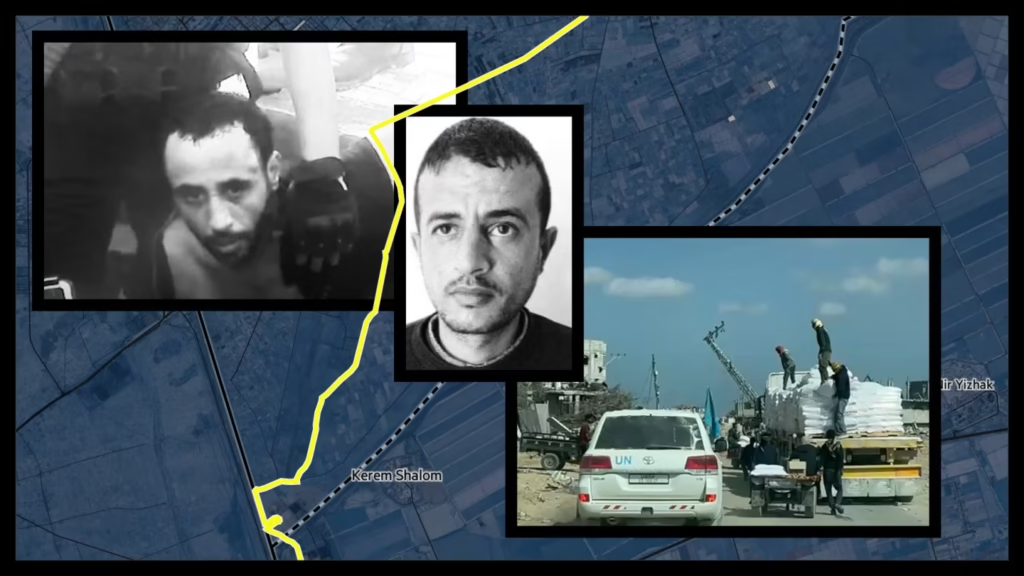
The investigation documents the identities of these groups, their movements, and the areas in which they operate, including locations Palestinians are barred from accessing under ceasefire arrangements. Audio and video materials cited in the report show how individuals were recruited inside Gaza and deployed to carry out security-related tasks aligned with Israeli objectives.
According to the findings, these armed factions are accused of collaborating with Israeli forces while operating freely in restricted zones, despite repeated denials issued by some of the groups themselves. The investigation reinforces growing evidence that these militias are being used to exert control over civilians and undermine Palestinian social cohesion from within.
The issue is not new. Last year, Israeli Prime Minister Benjamin Netanyahu publicly acknowledged that Israel had activated armed local gangs in Gaza on the recommendation of security officials as part of its campaign against Hamas, which governs the territory.
Recent testimonies from Palestinians returning to Gaza through the partially reopened Rafah crossing further illustrate this coordination. One returning woman described how she and other women were stopped at a checkpoint manned by Palestinian gunmen identifying themselves as members of the Popular Forces, commonly known as the Abu Shabab militia. Their family names were announced publicly before each woman was escorted to a separate point where Israeli soldiers were stationed. There, they were subjected to invasive body searches, blindfolded, handcuffed, and interrogated about events linked to October 7.
Israel’s war on Gaza has so far killed at least 71,851 Palestinians and wounded more than 171,600 since October 2023.
Who Are These Armed Groups?
One of the most prominent militias identified is the Popular Forces, originally formed by Yasser Abu Shabab, who was killed in December and later replaced by Ghassan al-Dahini. The group has previously claimed responsibility for protecting supply routes linked to newly established aid distribution centres backed by the United States and Israel.
These aid mechanisms were widely criticised for bypassing established humanitarian frameworks and for deadly incidents in which Israeli soldiers and private security personnel killed or wounded Palestinians attempting to access food. While Israel repeatedly accused Hamas of stealing aid, claims rejected by humanitarian organisations, the investigation found evidence suggesting that Popular Forces members were instead looting aid and reselling it to Gaza’s starving population.
Clashes between Hamas and the Popular Forces have reportedly occurred since late 2024, with Hamas accusing the group of direct collaboration with Israeli forces.
Another armed faction identified is the so-called Strike Force Against Terror, led by Hussam al-Astal. Video evidence places members of this group inside areas of Khan Younis that are off-limits to Palestinian civilians. Al-Astal, a former officer in the Palestinian Authority’s security forces, was previously accused by both the Authority and Hamas of collaborating with Israel in the 1990s.
Together, these findings point to a deliberate strategy of outsourcing control to armed proxies inside Gaza, groups that operate under Israeli protection while contributing to repression, intimidation, and the fragmentation of Palestinian society amid an ongoing genocidal campaign.