
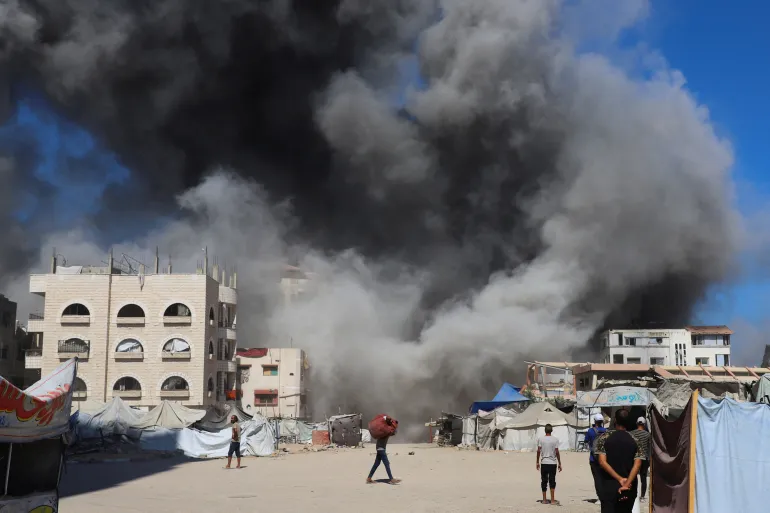
Gaza Herald_ Even after a ceasefire was declared, Gaza remains trapped in a relentless cycle of destruction. While the world looks toward fragile diplomatic agreements for signs of relief, evidence emerging from Israeli soldiers themselves reveals a starkly different reality on the ground, one in which demolition, violence, and collective punishment persist unchecked. Far from signaling peace, the ceasefire appears to have merely shifted the tactics of devastation, allowing systematic destruction to continue under a veil of political diplomacy.
Videos posted by an Israeli soldier on social media platforms show ongoing demolitions of Palestinian homes in the Gaza Strip more than 100 days after the ceasefire officially took effect. The footage, reviewed by Middle East Eye, was uploaded in late December by a soldier operating a private Instagram account under the name Ariel Ashkenazi.
One video, dated December 25, was geolocated to Beit Hanoun in northern Gaza and depicts the controlled destruction of residential buildings. Additional clips posted on December 26 and 28 document further demolitions, suggesting a sustained campaign rather than isolated incidents.
The captions accompanying these videos reveal an ideological undertone. Two posts used the phrase “Aliyah Bet,” historically linked to the organized migration of European Jews to Palestine prior to the establishment of Israel, while another invoked “the power of the Spartan,” glorifying extreme militarism and domination. These phrases echo remarks made by Israeli Prime Minister Benjamin Netanyahu in September, when he called on Israel to become a “super Sparta,” advocating perpetual militarization and aggressive expansion under the guise of self-defense.
The demolitions occurred on both sides of the so-called “yellow line,” a militarized buffer zone imposed by Israeli forces after the ceasefire agreement. Despite international assurances that hostilities would end, Israeli military operations have continued deep inside Gaza, devastating neighborhoods already reduced to rubble.
The ceasefire was meant to halt more than two years of genocidal warfare, during which over 71,000 Palestinians were killed and nearly 90 percent of Gaza’s infrastructure was destroyed. Yet since the agreement, Israeli forces have killed at least 477 Palestinians and wounded more than 1,300 others. Gaza’s Government Media Office reports at least 1,300 ceasefire violations, including hundreds of shootings, home demolitions, military incursions, and airstrikes.
Filming War Crimes
Throughout the war, Israeli soldiers have repeatedly documented their actions, often celebrating destruction. Videos circulating online show troops detonating civilian homes, mosques, universities, and public facilities. In other clips, blindfolded and bound Palestinian detainees are forced to record humiliating messages, while soldiers pose with money looted from civilian homes.
Additional footage shows bulldozers destroying food supplies meant for humanitarian distribution and soldiers singing as schools burn behind them. Some videos even depict Israeli troops mocking Palestinians by wearing women’s clothing taken from ransacked homes, transforming scenes of devastation into grotesque performances.
Human rights experts argue that these recordings may constitute direct evidence of war crimes. More troubling, however, is the casual manner in which these acts are filmed, shared, and celebrated, reflecting a disturbing normalization of brutality.
The continued demolition of Gaza, long after the announcement of a ceasefire, exposes the hollow nature of diplomatic promises when they are not backed by accountability. These videos, recorded by Israeli soldiers themselves, shatter any illusion that hostilities have ended. Instead, they reveal a calculated campaign of domination, humiliation, and erasure.
As Gaza’s civilians struggle to survive amid ruins, the international community faces a moral test: whether to confront these documented violations or allow them to fade into digital archives without consequence. Without urgent intervention and accountability, the ceasefire risks becoming nothing more than a political fiction — one that masks an ongoing war against an already devastated people.

